
Address Newsletter
Our weekly digest on buying, selling, and design, with expert advice and insider neighborhood knowledge.
When it comes to online gardening trends and how they translate to reality, mileage can vary.
“Chaos gardening” lit up TikTok last year, its advocates tossing fistfuls of seed into soil — or even grass — while seeming to hope for a wildflower meadow. There are reasons that a planned approach can yield more reliable results: crowding plants can outcompete one another, and not all seeds will thrive in every yard placement. But for some who practice it in the Boston area, chaos gardening is more than an online trend: It’s a longtime mindset they say has helped them maintain a more forgiving relationship with their spaces, easing up on their expectations and enjoying the garden on its own terms.
“I do have ideas for what I want to grow, but whatever works,” said Dana Werbin, who gardens in Jamaica Plain. “If a seed grows there, that means it likes the conditions.”
It’s not that Werbin’s approach lacks design: It’s just that the garden is, to a greater extent than some, also the designer. Their “volunteer” tomatoes — ones that sprout from dropped seeds, tend to do better than planted seedlings, for example.
“I could make the decision to rip it up and plant it elsewhere, but it already made the decision that it likes where it is, so I’m not gonna mess that up,” they said, “because it’s going to give me good tomatoes.”
Werbin’s description of their garden is a picture of both chaos and order. They don’t know exactly where something will grow, but the garden will let them know. That’s where they will find the scallions this season.
“It’s a percentage of, like, 70 percent chaos, 30 percent order,” they said.
For Kris Engdahl, the decision opened up a neighborhood conversation.

She sees her chaos garden approach as an outcropping of milpa gardening, a sustainable and regenerative indigenous practice related to the “three sisters” method of planting corn, beans, and squash together. Engdahl’s Watertown front yard received a lot of street salt, which seemed to encourage crabgrass. So, she tore it up and tried flowers: roses, marigolds, and impatiens. But her interest turned to growing food, and she thought, why not? She replaced flowers with a range of vegetables and herbs. Sometimes she added more flowers. Sometimes, tricolor chard. She followed her whims, and soon the garden followed its own.
As it evolved, the garden’s proximity to the sidewalk attracted interest. Located a short walk to a community path, the foot traffic is frequent. The variety became a magnetic conversation-starter. A group of passersby, with her permission, harvested cilantro. A woman took chard and returned the next day with a delicious recipe she made with it.
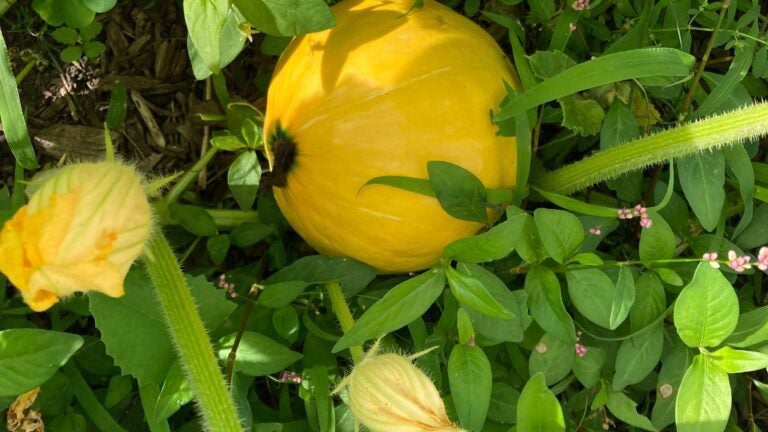
With each season, different plantings would express themselves with more or less influence. One year, Engdahl’s garden was dominated by dill and daikon (white radish). Sometimes pumpkins popped up; sometimes green beans would thrive.
And while it can feel that way to Engdahl, to its admirers, the garden was not independent from its gardener. Last year, Engdahl said she fell behind on maintenance — stymied, as we all experience — by life and the heat wave. And even during these cold intermediate months, someone checked in.
“I had somebody on Sunday [ask]: ‘How are you doing? We love looking at your garden. I was concerned about you,’” she said.
Sometimes the balance will seem off in some way, and Engdahl will correct it. One season’s parsley, which produced months of winter broths, became next season’s rabbit food.
“Sometimes I will do something, and it will be wrong, but gardens are dynamic,” she said. She plans to continue this year, following up on her practice of “no dig” gardening, adding her own homemade compost.
Garden designer Demetra Tseckares has found the chaos gardening mindset useful when responding to clients who are looking for lower maintenance. Meadows are a great fit for replacing a sunny lawn. Tseckares will hand-seed the area, but is careful to select intentionally, avoiding pre-sold mixes that can often include invasive or aggressive plant species.
“I’ve been trying to get people to understand what a beautiful garden looks like in a different way, because these super neat, super tidy … cleaned-up gardens that don’t allow a single leaf or a single stem to stand are dead zones, they kill an entire generation,” Tseckares said of the insects that may use stems and leaves for habitat, supporting other parts of the wildlife population.
And it’s a more sustainable approach — including financially.
“You can change it every year, or it will just do its own thing,” she said, noting that gardeners can harvest seeds at the end of the season for next year’s plantings.
Werbin’s next season, like many gardeners, will begin well before the last frost. Using a small greenhouse, they will start seedlings during the cold season. But they also will practice experimental sowing with a packet of their own mixed seeds as an intentional surprise, to see what comes up.
Not every experiment is fruitful. Last year, Werbin nurtured a plant they thought was ginger. It turned out to be grass.
“I was giving so much love to this weed, thinking that it was going to turn into something, and it wasn’t,” they said.
But care and forgiveness are never wasted. Now Werbin, who has a professional horticulture background, is studying for a career pivot into nursing.
“Cultivating a rapport with your patients is just like getting the soil ready,” she said. Their approach to gardening required openness and nonjudgmental thinking. They talk to their plants. And they are carrying that practice into their nursing study.
“I wouldn’t be the same student nurse, if I didn’t have that experience,” said Werbin.
Lindsay Crudele can be reached at [email protected].


Our weekly digest on buying, selling, and design, with expert advice and insider neighborhood knowledge.





To comment, please create a screen name in your profile
To comment, please verify your email address
Conversation
This discussion has ended. Please join elsewhere on Boston.com