
Address newsletter
Get the latest news on buying, selling, renting, home design, and more.
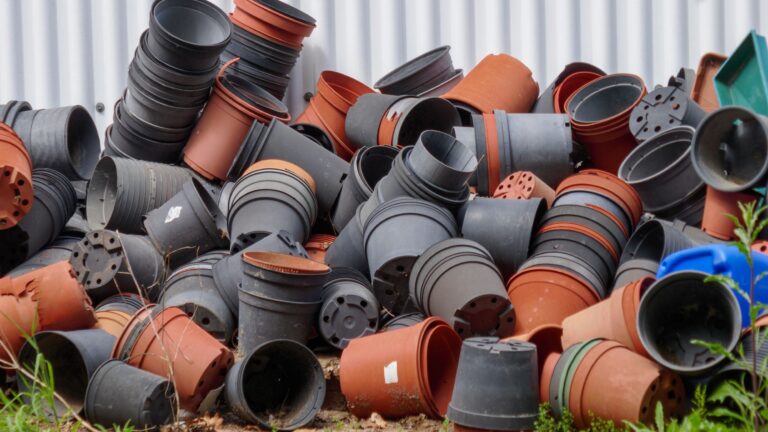
As I was setting up my grow lights and heat mats last week in preparation for sowing seeds, I was struck by the neatly stacked pile of old plastic pots lurking in the corner of my shed. I reuse pots, plug trays, and six-packs as much as possible, but the plastic usually degrades after a few seasons. I am not the only gardener who has faced this conundrum, but what options are there? My thoughts then turned to an uncomfortable truth about the horticulture industry: We still rely heavily on nonrecyclable plastic pots to deliver our beautifully grown annuals, perennials, shrubs, and trees. Every five years, the US Department of Agriculture Statistics Service conducts a census of the horticulture industry. The most recent one, in 2019, found that 68 percent of plants sold nationally were in plastic containers. How many pots is that? Nearly 242 million. Wow!
Historically, more plants were sold as bare-root, ball and burlap, or in terra-cotta pots. Clay pots are reusable, but they are fragile, heavy, and ill-suited for large-scale nursery production. Like many other plastics in our lives, plastic pots have slowly become more prevalent for economic reasons. The Association of Professional Landscape Designers has launched the initiative “Healthy Pots, Healthy Planet” to raise awareness and offer alternatives. Check out this link for more resources, including an excellent research paper written by local plant designer and good friend Marie Chieppo. What alternatives are there? What can we as a community do to throw away less plastic? Let us use a reader’s question to discuss what can be done.
Q. Hi, Uli. First and foremost, I certainly appreciate your articles in the Sunday Globe. They always contain useful info. As with most home gardeners, I’ve accumulated a collection of empty plastic pots of assorted sizes and colors. I cleaned and stacked them, and there they sit. As I’m sure you know, they are not recyclable, at least here in Dennis, and I really hate to dispose of them when they could have a second life somewhere somehow. Who would take these pots? I was thinking of calling the local schools; perhaps the science teachers could put them to good use in their classes.
GIL, West Dennis
A. There are three ways gardeners can limit their plastic use: Find alternative pots; create ways to reuse existing ones, including donations to community gardens and schools; or get them into a dedicated recycling stream. Each of these approaches has advantages and challenges, so no single one is a silver bullet solution. Alternatives to plastic pots include plantable ones made from rice hulls, peat, cow manure, wood pulp, and coconut coir. They will break down in the soil and allow the roots to grow through the walls. Peat-based plantable pots have a different environmental impact — the peat is not sustainably harvested — so it is best to seek out containers that do not have it.
Compostable pots also are designed to break down in the heat of a compost pile. The drawback is that your pile must get hot enough to initiate breakdown. It is easier to do this with industrial-size compost piles, but home gardeners can turn their piles more often to heat them up.
Bioplastic pots contain a plant-based resin, not a petroleum-based one, and while they can be reused many times, they are ultimately destined for landfills.
Reusing pots is an excellent strategy. Save the sturdy ones, and use them year after year. I keep larger pots from trees and shrubs and tote them along while weeding and editing my garden. Schools often need pots to support botany education, and community gardeners need them, too. Reach out to these groups to help brainstorm ways to reduce plastic use.
Finally, we can turn to dedicated recycling streams. Black plastic pots are made from various resins, but only a few are considered recyclable. Furthermore, the optical readers at recycling plants often reject black plastic pots because they cannot accurately determine the resin code (the small triangle with a number) on the bottom. Home Depot locations will accept unused horticulture plastic if it has been well-cleaned. This program has been running since 2009. Weston Nurseries also accepts used pots for recycling, and there are others regionally.
If you support your local garden center, engage the leadership on this issue. Gardening already makes us feel good. Why not feel even better knowing less plastic is ending up in landfills?
Uli Lorimer is the director of horticulture at the Native Plant Trust in Framingham. Send your gardening questions, along with your name/initials and hometown, to [email protected] for possible publication. Some questions are edited for clarity.
Get the latest news on buying, selling, renting, home design, and more.





To comment, please create a screen name in your profile
To comment, please verify your email address
Conversation
This discussion has ended. Please join elsewhere on Boston.com