
Ask the Gardener: Deck your yard with boughs of holly this winter
Cold weather is the time for evergreens to come forward and announce their presence.
With the holiday season upon us, the temperatures properly cold, the leaves all on the ground, and the official start of winter just days away, my attention is drawn to the anchors of the garden: evergreens.
Frequently outshined by their flashier and flowering garden cousins during the warmer months, winter is the time for evergreens to come forward and announce their presence. Perhaps because we are drawn to the color green when so much else in the landscape is dominated by hues of brown and gray, or perhaps because their forms and textures are so pleasing to our eyes, no one can deny that beautiful evergreens anchor the garden.
My love affair with conifers and hollies began with my first job out of college at the United States National Arboretum in Washington, D.C. I was stationed to work in the Gotelli Conifer Collection, featuring over 800 varieties of conifers complemented by swaths of rhododendrons, crape myrtles, grasses, and perennials. I had no idea that so many different colors, shapes, forms, and textures could exist. Since then, I have especially valued conifers and other evergreens as integral parts of any garden design.
Here are three of my favorite evergreen trees along with excellent selections of each species.
Although I may be biased toward eastern North American plants, the first evergreen tree I recommend is Juniperus virginiana, or ‘Emerald Sentinel.’ This selection of easter red cedar is ideal for smaller gardens due to its compact and dense shape, only growing to 15 feet tall at maturity and about 7 feet wide. The foliage of Emerald Sentinel is dark and lustrous green, which offsets the powder blue juniper berries quite nicely. The fruit draws cedar waxwings and a host of other winter songbirds, some of which may even decide to stay and build a nest within the dense boughs. It prefers full sun to produce its best foliage and fruit and is drought and salt-tolerant once established.
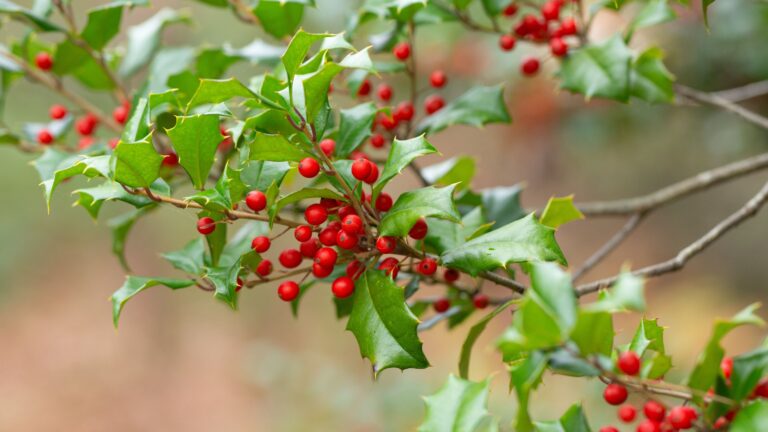
What better tree to deck the halls with than American Holly? Already long associated with the holiday season, the first Europeans to land on these shores were delighted to find American holly, quickly adding it to their festive decorations as a sign of the season. It was one of George Washington’s favorite trees, and several still survive that he planted at Mount Vernon in Virginia. Holly enthusiasts have bred and selected many varieties, with over 1,000 named to date. Hollies are dioecious, indicating separate male and female plants. For berries to form, you must have a female plant and at least one male in the vicinity. The following recommended selections are all females, so be sure to include a male holly such as Ilex opaca, ‘Jersey Knight.’ Ilex opaca ‘Greenleaf’ is a classic selection growing into a perfect pyramid shape and only reaching 20 to 25 feet high, well-suited for smaller spaces. The foliage is spiny, dark green, and especially deer-resistant. It tolerates a wide range of soil conditions, except for wet or water-logged.
Japanese Umbrella Pine are wonderful and uncommon conifers for our region; their shapes and texture quite different and singular from other more popular evergreen trees. The tree gets its name from the umbrella-like whorl of thick green needles that appear at the ends of the branches. In Japan, this tree can reach 90 feet in height, but in cultivation, it attains less than half its size, about 30 to 35 feet. Sydney Waxman of the University of Connecticut has selected several excellent forms of this tree, two of which I will mention here. First is Sciadopitys verticillata ‘Winter Green,’ which tops out at 20 feet tall and nearly as wide, growing in a very attractive tight pyramidal shape. The young branches are quite flexible, but I would advise knocking snow off in the case of heavy accumulation. The second selection from Waxman is called Sciadopitys verticillata ‘Joe Kozey,’ noted for its more narrow upright habit, growing the same height as Winter Green but only 6 feet wide.
If you wish to learn more about conifers and hollies, the American Conifer Society and Holly Society of America are good places to start. For readers in the Boston area, the Arnold Arboretum has an exceptional conifer collection. Wishing all a joyous holiday season filled with warmth, family, friends, and plants!
Uli Lorimer is the director of horticulture at the Native Plant Trust in Framingham. Send your gardening questions, along with your name/initials and hometown, to [email protected] for possible publication. Some questions are edited for clarity. Subscribe to the Globe’s free real estate newsletter at Boston.com/address-newsletter.





To comment, please create a screen name in your profile
To comment, please verify your email address
Conversation
This discussion has ended. Please join elsewhere on Boston.com