
Address newsletter
Get the latest news on buying, selling, renting, home design, and more.
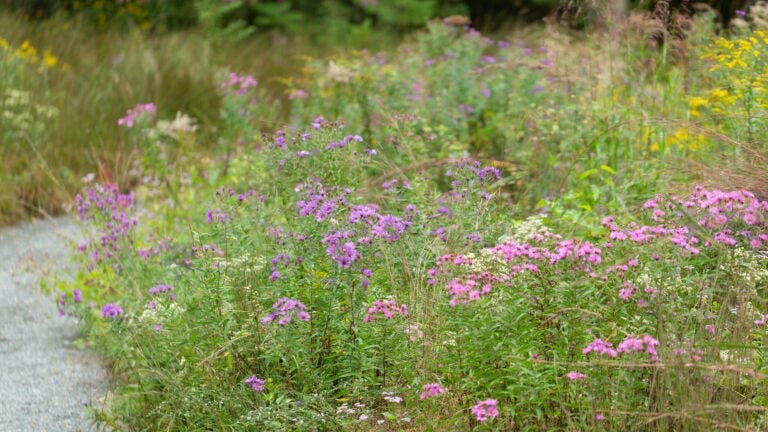
With the insect sounds of summer waning, pollinators seem to feel an urgency, recognizing that days are numbered before winter dormancy commences. I was drawn to the audible thrum of insects on my late-flowering asters this week. Specifically, our native New England aster and two excellent selections of aromatic aster, ‘October Skies’ and ‘Raydon’s Favorite.’ All are in full bloom a week into October and alive, with insects seeking the last drops of nectar and grains of pollen for the season. New England aster can reach 6 feet tall and bloom in various pink, purple, or magenta hues. ‘Purple Dome’ and ‘Vibrant Dome’ are compact selections with purple and pink blossoms, respectively. Both selections of aromatic aster are compact growers forming a low mound of foliage that is covered in purple blooms. These plants offer floral resources well into autumn and help pollinators enter the winter season with adequate reserves. My recommendations are but a small amount of the species, hybrids, selections, and cultivars of asters that are on the market.
The choices are overwhelming, and it can be challenging to feel confident about what to plant, let alone how to best care for your new plant. If only the name would give you the information to shape your decision and inform maintenance. But, alas, gardeners are not given everything they need to know when shopping for or caring for their plants. We’ll explore what information a plant name can provide in our second reader question.
Q. I have discovered in the last week that skunks/turkeys are scratching up my lawn, so I guess I have grubs? Is there something I should do this fall to repair the lawn, or should I wait and make sure I have grub control put down in the summer?
J.F., North Andover
A. Finding ways to share our gardens and lawns with wildlife can be challenging. While temperatures are suitable for overseeding bare patches of lawn, the seed itself is likely to draw in other birds that see your efforts as a free buffet rather than an attempt to repair your lawn. Be sure to cover the newly seeded area with straw to keep the seed in place and out of avian stomachs. For grub control, I would recommend making applications in the spring to target scarab beetle grubs, the ones most likely feeding on lawn grass roots. Beneficial bacteria or nematodes are nontoxic and easy to help control beetle grubs in your lawn with the aim of limiting their appearance on your wildlife menu next fall. The Ecological Landscape Alliance has an informative article in which you can learn more. As always, be sure to enjoy your garden and slow down to observe the rhythms of life that our gardens sustain.
Q. I was very excited to find out what to do with my Endless Summer hydrangeas that flowered so beautifully for the first time this summer. And then you gave all these Latin names, and I have no idea which is mine. Can you please clarify?
LINDA MAGALNICK, Topsfield and Delray Beach, Fla.
A. All garden plants trace their origins to plants from the wild. In an effort to make sense of the dizzying diversity of plant life in the world, scientists have adopted a classification hierarchy based on similarities between flowers and fruits to better understand how plants are related to one another — botanical Latin, a.k.a. technical terms and expert jargon. Knowing what plant science calls a plant provides only partial information for a gardener.
Regionally, plants have different and often colorful common names reflecting appearance, culture, and use. Hydrangea macrophylla, a.k.a. bigleaf hydrangea, sets expectations about the size of the leaf relative to other hydrangeas. If a plant name appears in a single quote like Hydrangea macrophylla ‘Nikko Blue,’ it means that humans have altered or selected from the species (bigleaf hydrangea) for a desired character like compact growth, disease resistance, or more giant, longer-lasting blooms. Lastly, plant breeders release a series of cultivars under a single name to better market their products. Endless Summer hydrangeas is such a trademarked series. Within Endless Summer, there are several registered cultivars (‘Popstar,’ ‘Summer Crush,’ ‘Bloom Struck,’ ‘The Original,’ ‘Twist N Shout,’ ‘Blushing Bride’) — each different in color but otherwise identical in size.
How can a gardener discover what they have, where it came from, how it was grown, and how to care for it when the only information provided is partial? Endless Summer are bigleaf hydrangeas that were developed from wild Hydrangea macrophylla. Species names can tell you where it came from in the wild. Cultivar and trademarked series names give you a bit more, but only if you can compare them with knowledge of other cultivars. Not surprisingly, there is no single resource to uncover all of this information, but here are three that do a great job. Missouri Botanical Garden Plant Finder, Cornell University, and the North Carolina Extension Gardener Tool Box. If you are still feeling confused, it’s OK. Even the experts struggle to interpret the information! What we can agree on is that nurseries can do a better job of providing more when you purchase the plant.
Uli Lorimer is the director of horticulture at the Native Plant Trust in Framingham. Send your gardening questions, along with your name/initials and hometown, to [email protected] for possible publication. Some questions are edited for clarity.
Get the latest news on buying, selling, renting, home design, and more.





To comment, please create a screen name in your profile
To comment, please verify your email address
Conversation
This discussion has ended. Please join elsewhere on Boston.com