


Address newsletter
Get the latest news on buying, selling, renting, home design, and more.
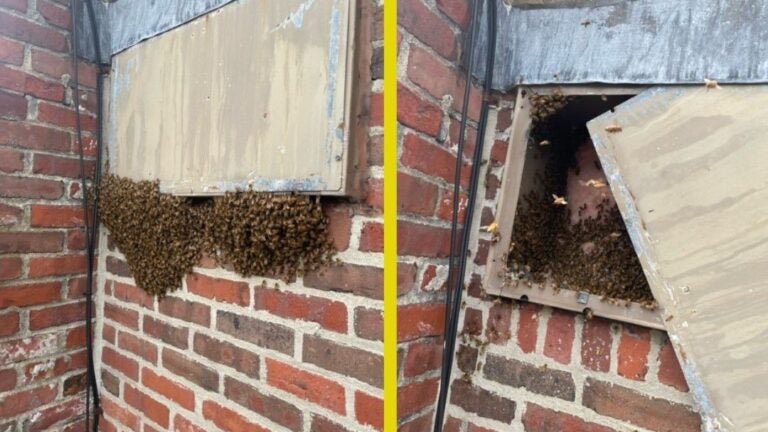
There’s nothing like a freebie — especially when the prize is free bees.
When you’re not expecting them, several thousand honeybees in your yard can be a startling sight. But what looks like a pest control call to the average person is a jackpot to a local network of beekeepers who are poised to pounce during summer’s “swarm season.”
“When my phone rings, I always know it’s gonna be a bee call, because the person on the other end can’t talk,” said Alexandra Bartsch, swarm coordinator for the Middlesex County Beekeepers Association.
While the term “swarm” may call to mind horrific B-movie images of killer insects, that perception is a flight of fancy. Swarming is a natural — and especially peaceful — part of the honeybee’s reproductive cycle. Still, they pose an inconvenience when globs of them are parked on a car bumper or porch railing. That’s why Bartsch, a Lexington-based master beekeeper who has tended bees since 1978, maintains a 70-beekeeper-strong alert list, ready to assign a rescue when a swarm is on the lam.
Each swarm season, which tends to take place in early summer, Bartsch estimates that she matches three or four dozen swarms for recapturing, depending on how difficult the winter was for bees. In spring, the Boston Beekeepers Association Facebook page and its email group also become a de facto network for matching found swarms with those who want to pick them up.
Bartsch’s list looks forward to swarm season, when the bees’ hives, installed early in spring, may have failed, the bees want to expand, or the keepers just want to help save them. If a colony doesn’t make it, the keepers may supplement their hive with late-season “nucleus” colonies, or “nucs” — a few frames of comb with bees already at work inside that can be plugged into a hive. But they’re pricey. Plan B? Just wait for a swarm.
“Bees are so precious now that to buy bees … it’ll cost between $200-250 to buy what’s basically in a swarm,” Bartsch said. “So all of these beekeepers are ready, willing, and able to go out. It’s like having a couple of $100 bills hanging in a tree.”
Bartsch interviews the caller to rule out the wrong kind of sting-y surprise: Yellowjackets or hornets don’t qualify for rescue. Timeline is also a factor: To assign a beekeeper, Bartsch favors the quick, because swarms can take off at any time. And bees don’t care about your vacation plans.
“Memorial Day weekend — I call it ‘Swarm-morial Day weekend,’ because we always seem to get swarms on that weekend,” she said. “Friday night of Memorial Day weekend when everybody leaves town, sometimes I have to go and get the swarm because there’s no one around,” she said.
“I have all kinds of gizmos, you know, a telescoping flagpole with a net on it,” she said.
Swarms happen when early season colonies outgrow their quarters before a beekeeper has a chance to add more space to their hive, because of another condition they just don’t like, or they want to overthrow their queen. Bees that plan to swarm lay a new queen. The “swarm cell” in which she is formed bulges off the honeycomb frame like Gonzo’s nose, and experienced beekeepers know how to spot this early tell. If they’re quick to act, they can take steps to prevent the swarm from taking off, but sometimes, bees just want to swarm.

Absconding bees — about half the original colony — surround (usually) the old queen and land somewhere nearby while scouts figure out a more permanent location.
And that crash pad may land them in unfamiliar territory.
Their natural home is the cavity of a tree, Bartsch explained. “Unfortunately, sometimes, because there aren’t that many natural places for them to live, they’ll find the eaves of your home or the walls or in a chimney or something, and then it becomes a problem.”
Bartsch has picked up swarms in all kinds of creative locations, she said: in the ground, on a lawn, in the middle of the road. She’s found them on a water meter, on a car, and last year, on a Boston Whaler in Marion Harbor.
That’s where it can get dangerous. But for bees — not for people. If the bees aren’t safely rehomed, they can risk dying altogether. And swarming colonies, gorged with honey, prefer not to sting.
“The only reason that a bee will sting you is to defend her hive,” Bartsch said. “And bees don’t have a hive when they’re swarming. You can literally put your hands into the center of the [bee cluster] and not get stung.”
Just before the recent holiday weekend, a homeowner in Back Bay discovered that a sizable clump of bees had moved into an upstairs porch. She was frightened, but some quick Googling connected her to Bartsch, who sent out the alert to her network.
William Blocher is the beekeeper who took Bartsch’s call. He’s a director of the Worcester County Beekeepers Association, collects swarms with a custom-built bee vacuum, and has 30 of his own hives. He arrived — looking somewhat like a Ghostbuster — to soothe the rattled homeowner.

Sue, who asked to be identified by her first name only to protect the privacy of her tenants, saw Blocher pull up with a bee-themed license plate. He began by describing what she was seeing.
“You explain that there’s really nothing to be afraid of,” he said. “I like to explain the life cycle of the bees; they want to live and they want to reproduce. And this is part of how they reproduce. And people are always fascinated.”
The number one tip? “We give them a jar of fresh honey,” Blocher said.
Then he got to work, gently vacuuming bees. Sue said she’d never been so close to so many bees, and her fear turned to curiosity. Blocher pointed out a shiny red seal on the queen’s thorax, a tag some beekeepers use to help make her easier to spot.
“He just oozes patience and calm,” Sue said of Blocher, “which is exactly the opposite of what you think about when you think about a swarm of bees.”
Sue said that what had begun as a scary inconvenience turned her into an appreciator: for bees and for those who care for them.
“I can see why people become passionate beekeepers,” she said. “After that encounter, I can understand where your affinity for the hobby comes from.”
With that about-face, will Sue be signing up for the next chapter of Bee School?
No can do, she said.
She’s allergic.
Lindsay Crudele can be reached at [email protected].
Get the latest news on buying, selling, renting, home design, and more.





To comment, please create a screen name in your profile
To comment, please verify your email address
Conversation
This discussion has ended. Please join elsewhere on Boston.com