
N.H. landscape designer admires her kale and eats it, too
Jenny Lee Hughes's signature remained her slightly renegade love of edibles at a time when they were generally segregated from ornamental plants.
Based on the ultrascenic view of Center Pond in Stoddard, New Hampshire, Jenny Lee Hughes and her husband, Edward Yoxen, blindly bought the shell of a 1774 farmhouse and its densely wooded 50 acres. It turned out the house was unsalvageable. Hughes, a landscape designer, and Yoxen, a retired academic, preserved what they could of the “ghostly remains” but ultimately rebuilt the Greek Revival home, adding rooms, including a farmhouse kitchen. “We weren’t young and foolish,” says Hughes of the purchase made when she was 51 in 2004. “We were just foolish.”

The couple had no master plan for the heavily wooded landscape, but that changed when some sheep, a gift from Hughes’s mother, arrived and they had to clear 8 acres for the flock’s grazing. While they were at it, Hughes removed trees from another 2 acres to accommodate gardens.
They started with an upper terrace, doing what Hughes knew best — stonework. In the 1980s, she had worked with a group of serious stone-wall masons, hoping to uplift the trade at a time when few took artistic garden masonry seriously. Not only did they master the art of stone-walls-with-panache, they also incorporated fancy footwork into patios and other facets of their rocky designs. “We thought we were the cat’s meow,” Hughes recalls. The experience led her to study at Radcliffe’s landscape design program in Cambridge, Massachusetts, where, she says, extremely talented teachers “taught me that there is never just one approach to a design.” She adopted a fusion style, doing things more courageously and curvaceously but also incorporating a newfound respect for European garden design, with its formal hedges and button-down lines. “I really love every style, as long as it’s done well,” she says.

Throughout this evolution, Hughes’s signature remained her slightly renegade love of edibles at a time when they were generally segregated from ornamental plants. “Why separate them?” she asks. “Why not explore vegetables as part of the limitless roster of what we use in gardening?” If her clients were so inclined, she happily worked everything from arugula to zucchini into her designs. In her own backyard, she took the practice to extremes, using grains and pairing self-seeding annuals with vegetables to lure pollinating insects to cross over between edibles and ornamentals.

Like the sheep, her organic approach to gardening came from her mother. Hughes grew up in rural Massachusetts on a steady diet of Rodale’s Organic Gardening. Other kids mowed the lawn, “but my mother made me mulch the flower, vegetable, and dye plant beds,” says Hughes. She learned biodynamic gardening (and lived in a yurt) at an alternative New England high school before traveling to Oregon to join a commune with an emphasis on gardening. “The gardens were really imaginative,” says Hughes. “Some were in moon and star shapes.” But learning to integrate vegetables with flowers came from a Puerto Rican neighborhood in Cambridge where she found inexpensive rent and gardeners who got the most out of small city lots.

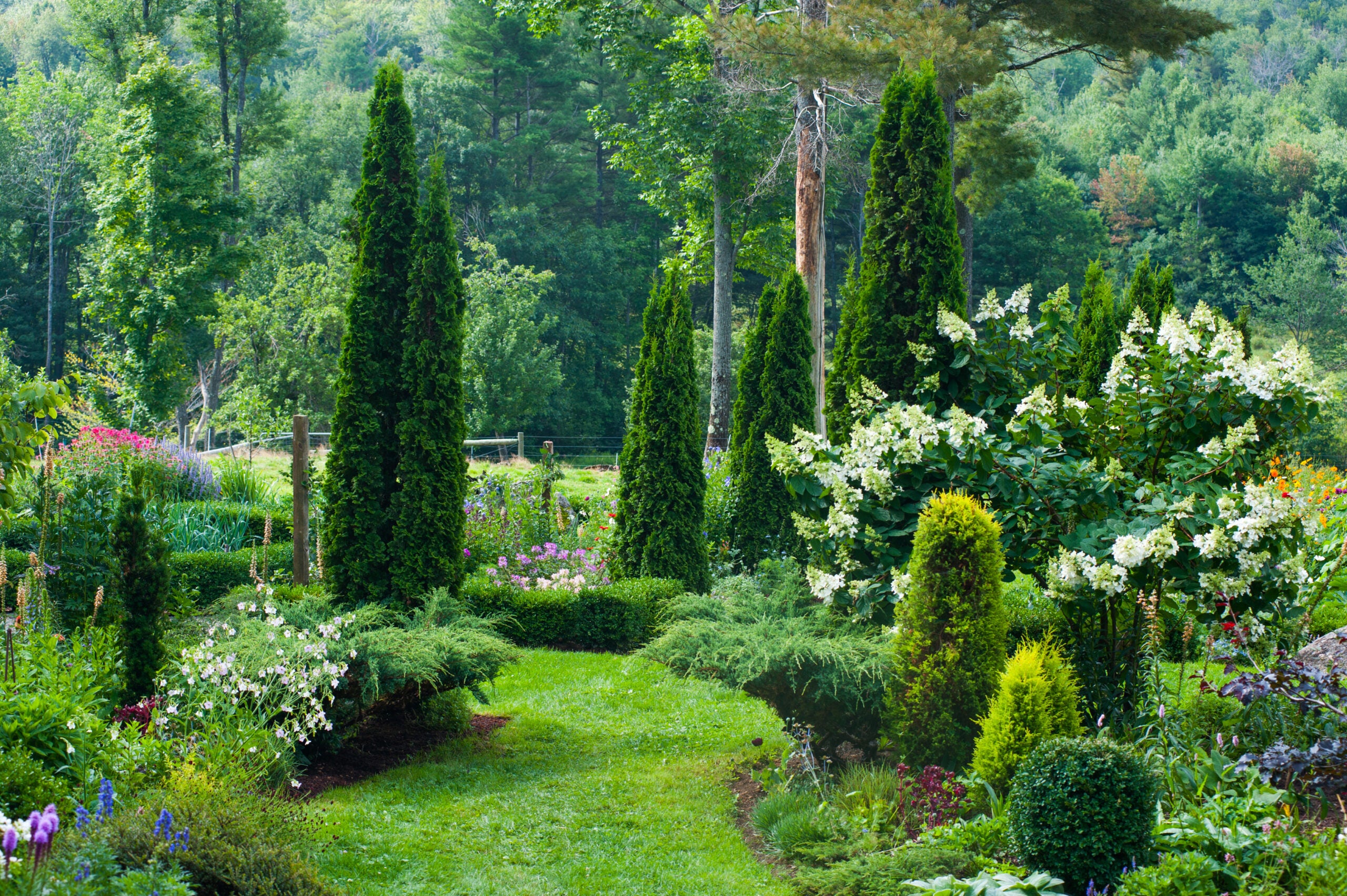
On the Stoddard property, Hughes, who prefers to eat organically grown food, saw growing edibles as practical. She planted a substantial vegetable garden close to the house. From there, she went ornamental. She installed vertical sentinel arborvitaes, Thuja occidentalis ‘Degroot’s Spire’, to echo the vertical lines of distant hills and establish a dialogue with the surroundings. She left a few forest pines intact, giving the foreground mature elements and a sense of continuity. A rescued heirloom apple orchard plus a few cherry, peach, and plum trees add visual intrigue and extend the harvest to fruits.

That initial clearing of the land revealed piles of stone from a project abandoned by a previous farmer. The rocks provided material for terraces and walls around the house. Next, Hughes roughed out the curves of the gardens and installed small trees such as Styrax obassia, because, she says, “you want open spaces to stay open.” Five hundred boxwood plugs served as an economical way to slowly create hedges. “Six years later,” Hughes says, “the hedge began to look like something.” She then began adding vegetables to the gardens beyond the vegetable beds, along the way discovering combinations that work well. Shirley poppies make good bedfellows with edibles, “if I remember to thin the seedlings out,” Hughes says. “Too many poppies, and there’s no room for vegetables.” Lettuce, cabbage, and kale can partner with shrubs that are still in their fledgling stages. Even tomatoes can be planted in tandem with young or small-stature shrubs, “as long as there is enough space and sunlight.” Eggplants are paired with nasturtiums. Heuchera looks great with purple cabbage. Curly parsley combines beautifully with calendula or Profusion zinnias. Golden lemon thyme makes a nice contrast beside the boxwood hedge. All together, it is a hardworking landscape that is practical and beautiful.

Hughes is constantly striving to keep the scene a reflection of where she is “at” as a designer. “I hope I don’t have a ‘style,’ ” she says. “My garden is different because it’s my garden. When working with clients, I’m sensitive to their personality.”
There is one gardening tenet that Hughes believes applies to any garden: “Leave an empty slot, and the earth just wants to grow weeds.” In her own landscape, edibles, not weeds, fill those voids with integrity and art — and tasty food for the table.





To comment, please create a screen name in your profile
To comment, please verify your email address
Conversation
This discussion has ended. Please join elsewhere on Boston.com