
Exotic plants thrive in this tropical oasis — in Connecticut
Logee’s roots run deep. The family-owned nursery in Danielson, Connecticut, marks its 125th anniversary this year.
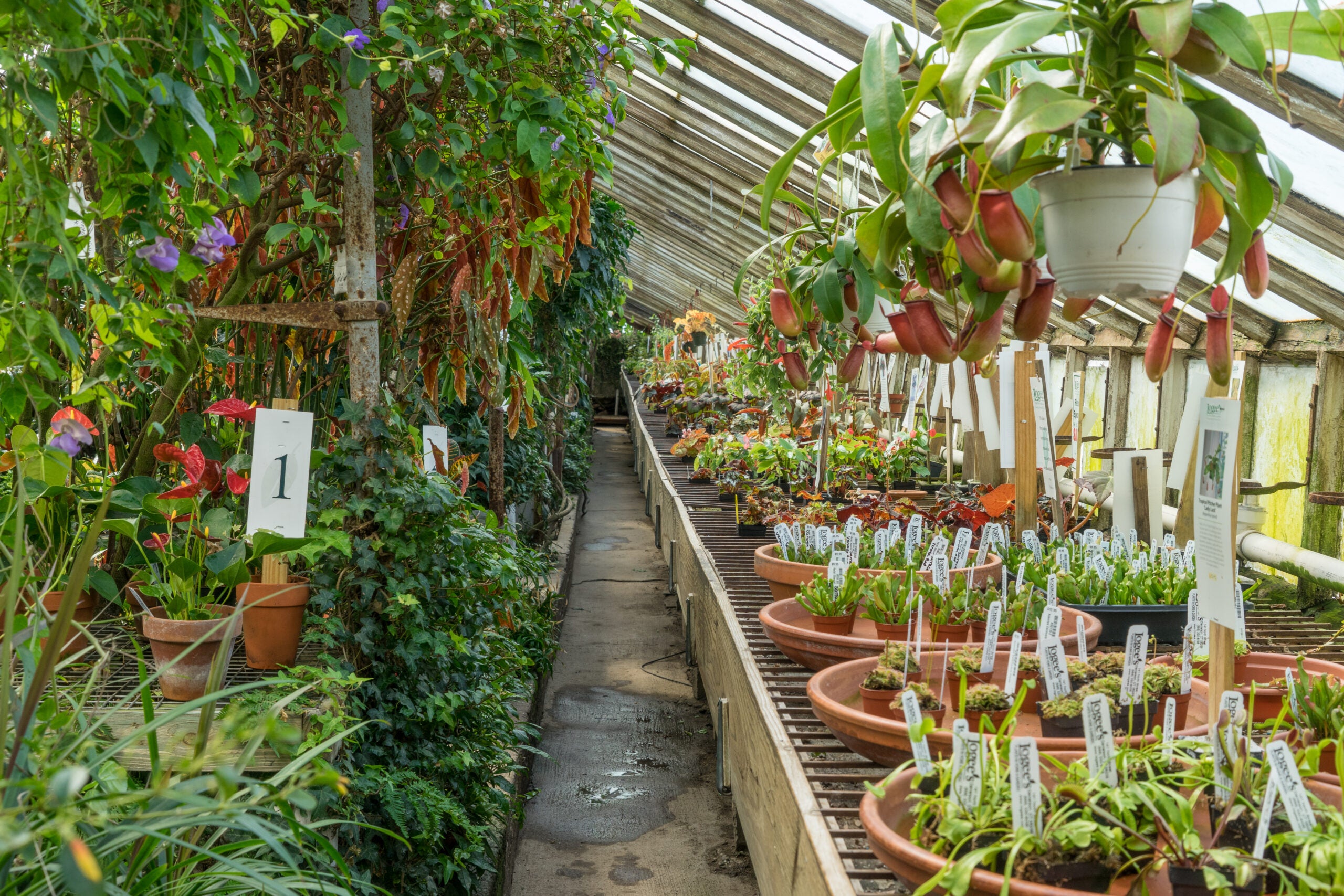
Logee’s roots run deep. The family-owned nursery in Danielson, Connecticut, marks its 125th anniversary this year. Charming and quirky, this mecca for carefully curated tropical, subtropical, and edible treasures from every continent is not to be confused with an ordinary garden center. There are no petunias or marigolds here. Rather, the inventory of bold, beautiful, and fragrant flowering plants includes 1,000 rare, exotic species with 150 to 200 more added every year. They are spread across seven greenhouses, where visitors can inhale the heady scents and admire plants like the pungent corpse, which can take seven years to flower, the fall-blooming black bat flower, or the eerie sea urchin tillandsia. There is miracle fruit, whose tasty berries when chewed will render sour food sweet, and the wicked, carnivorous tropical pitcher plant ‘Lady Luck’ and Venus’ flytrap. Cooks might fancy the dwarf Meyer lemon trees, vanilla vines, fragrant coffee, or black pepper plants, laden with black, white, green, and red peppercorns.
Seventy-five percent of the material is grown in-house, with many offerings exclusive to Logee’s. However, most of the exotic stock is easy to grow and will thrive in a pot, a prerequisite for anything Logee’s sells.
The business began in 1892 when rose grower William D. Logee and his wife, Ida, a botanist, opened a cut-flower shop in an abandoned greenhouse on her family’s farm. Today, the building, known as The Fern House, contains sprawling staghorn ferns, banana plants, loquats, philodendrons, hibiscus, and alocasias.
Other greenhouses on-site offer endless horticultural intrigue. There is the Lemon Tree House, where an enormous ‘Ponderosa’ lemon tree grows out of the dirt floor. Continuously producing American Wonder lemons since 1900, its fruit can weigh up to 5 pounds each, and they dangle like giant ornaments from the gnarled branches. Cuttings are for sale, while individual lemons can be purchased during the December holiday season, when the crop is most prolific.

Cultivating below ground under a glass roof was a popular way to conserve energy in 1918 when The Herb or Pit House was constructed. The subterranean structure filled with herbs continues to perform its task nearly a century later.
In the circa 1920 Longhouse, a determined octogenarian ficus snakes along a wall through the retail area and up two flights of stairs, where tendrils fan across the ceiling in leafy green circles. Colorful passionflowers, guavas, cinnamon plants, and cacao line the shelves of The Potting House, which dates to the late 1920s. The Big House, rescued from another grower and reassembled at Logee’s after the 1938 Great New England Hurricane, shelters a 67-year-old persimmon tree, a 76-year-old jasmine, and a 107-year-old kumquat tree with six varieties of grafted citrus waiting to be picked.
During the Great Depression, three of William and Ida Logee’s children sold handmade bouquets door-to-door in wealthy neighborhoods. The then-grown children continued to run the floral enterprise while William focused on his burgeoning plant collection. Son Ernest developed prize-winning hybridized begonias, and he and daughter Joy, founding members of the American Begonia Society, introduced countless begonias to the market. After Ernest’s death in 1950, Joy and her husband, Ernest Martin, a fellow horticulturist, ran Logee’s for the next two decades. In the 1960s, they eliminated the fresh-flower concept to concentrate on plants and their mail-order audience.
After Ernest died in 1971, Joy continued to run the nursery with their 21-year-old son, Byron. “This was my chance to make it easier for customers to shop,” Byron recalls with a smile. “I revved up a chain saw to tame many of the unruly ‘elders’ blocking the narrow aisles.” Eight years later, when Joy made him head of the company, he undertook an important improvement: As the energy crisis loomed, he and his physicist brother, Geoffrey, hand-built a 1,200-square-foot passive solar greenhouse to save on fuel.

Byron continues to oversee the legendary operation with his ex-wife and business partner, Laurelynn Martin. “I was an athlete who didn’t realize the joy, stress-reducing, or thought-expanding benefits of gardening before I became part of Logee’s,” says Laurelynn. “It has changed my life, and it brings me pleasure to share my insights with others venturing into the world of plants.”
Today, the company boasts a 19,000-square-foot energy-efficient greenhouse with an internal shipping department, a research laboratory, and two propagation centers under one roof. “I’m a plant geek,” says Byron. “Sometimes seeing a flower or tasting something for the first time allows us to embrace our connection to nature. This new space gives me room to experiment and introduce new finds, like uncommon fruiting tropicals, to our consumers. In some small way, I hope I can spark someone to touch into their own humanity.”
See some of their plant varieties:
Logee’s Plants for Home & Garden 141 North St., Danielson, CT, 860-774-8038; logees.com, will host its quasquicentennial festival, Celebrating Fruiting, Rare and Tropical Plants, on June 17 from 10 a.m. to 4 p.m. There will be greenhouse tours, plants priced at $18.92 in honor of the year the business began, music, crafts, local food vendors, classes, and labyrinth walks.




To comment, please create a screen name in your profile
To comment, please verify your email address
Conversation
This discussion has ended. Please join elsewhere on Boston.com