
See how Vt. gardener transformed nearly 5,000 bulbs into waves of color
To launch the gardening year each spring, Natalie Harder hosts a tea party timed to match the tulip display in her gardens.
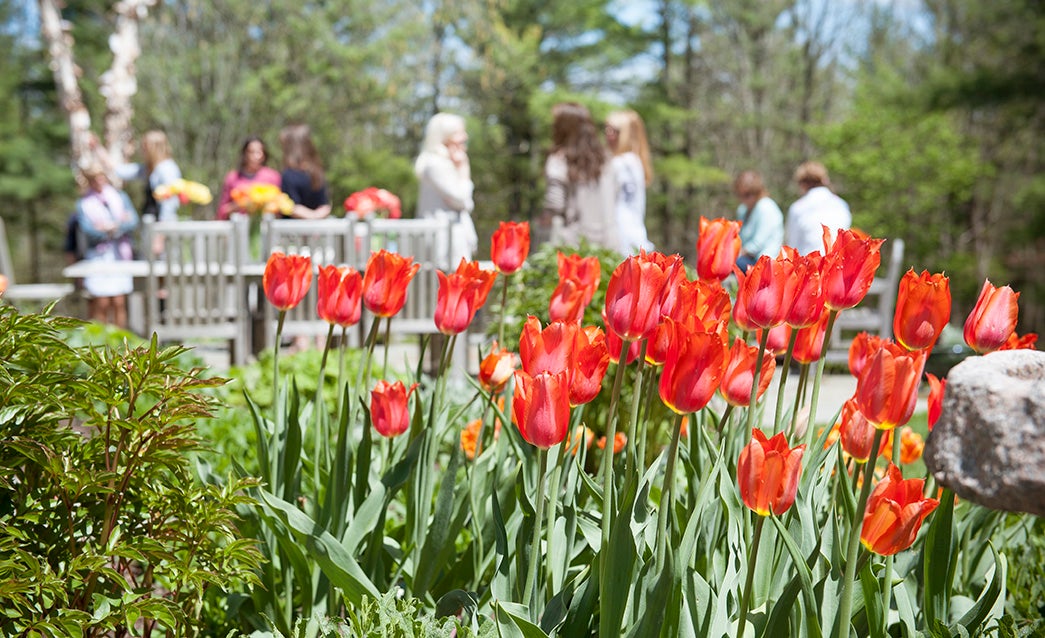
To launch the gardening year each spring, Natalie Harder hosts a tea party timed to match the tulip display in her gardens. When the close to 5,000 bulbs she planted the previous fall throughout beds and borders surrounding her Cape-style home in Shelburne, Vt., are at peak bloom, she welcomes guests to view the explosion of color.
“Each year, I try something new,” says Harder, an experienced gardener whose passion for the paint-box effect leads her to choose a varying palette of tulips. Early-, middle-, and late-blooming types are orchestrated to create a dazzling effect that lasts for weeks.
The first flush of green leaves and the delicate blooms of redbud create an ebullient mood for partygoers. Drinks are served on the screened porch or outside among eye-popping bouquets Harder has arranged using her collection of handblown Simon Pearce vases.
“I always keep a pair of rubber boots by the door for anyone who wants to swap out their nice footwear,” she says, and she provides umbrellas if the weather calls for them.

A south-facing patio, designed by landscape architect Tricia King and built by Distinctive Landscaping of Charlotte, Vt., gives a commanding view of the 8-acre property that includes a pool, a children’s playhouse, and a fire pit.
Behind the house, along the lawn’s edge where the backyard transitions to a hardwood forest and an undergrowth of ferns, more than 1,000 tulips draw the eye in sweeps of pink, orange, and lipstick red. Around the house and pool, stone paths are edged with yellow and purple tulips that glow in the sun, their petals catching the light like stained glass.
For optimal effect, bulbs are mass-planted with about 15 to 20 bulbs per hole, with groupings of roughly 100 bulbs in each sweep, dug into compost-enriched soil among drifts of salvia, cranesbill, lady’s mantle, and old-fashioned bleeding heart.
Harder makes notes at the height of bloom and reviews planting combinations with her longtime gardener, Susan Longe, to decide what works and what doesn’t. “It’s like a guest list,” says Harder. “Are you invited back to the party?” Markers are left in beds to indicate placement, using a coding system, and photos are taken as reference for next fall’s planting.

A favorite that makes the party list every year is ‘Akebono,’ a large yellow Darwin hybrid with petal tips etched in salmon red. “It’s like you’ve taken a brush to each petal,” says Harder. “I love unique tulips with different colors. It’s like painting with plants.” Masses of these are grouped directly outside the kitchen window, along with speckled snake’s head lily and sweeps of deep-blue grape hyacinth. “Sometimes I come inside to look, and plant according to the view,” says Harder.
A wall of local Panton stone creates a sunny microclimate by the front porch, where perennials such as candytuft, creeping sedum, and cranesbill emerge early from dormancy, surrounding clumps of purple ‘Blue Spectacle’ tulips, a double variety.
Hostas and spotted lungwort make good shade companions to ‘Spring Green,’ a single viridiflora type with ivory petals and green flame-like tepals that makes a quiet statement in the dappled light along the pool’s edge. Elsewhere, in sunny beds, ‘Dordogne’ tulips command attention as peony and bluestar clumps emerge. A cutting bed holds many special varieties such as ‘Daydream,’ a large hybrid tulip that changes from yellow to orange as it matures, and ‘Charming Beauty,’ which has a blush apricot hue. These and other varieties are used as annual cut flowers.
So much color, so much joy.
Check out more of the flowers here:




To comment, please create a screen name in your profile
To comment, please verify your email address
Conversation
This discussion has ended. Please join elsewhere on Boston.com