
Address Newsletter
Our weekly digest on buying, selling, and design, with expert advice and insider neighborhood knowledge.
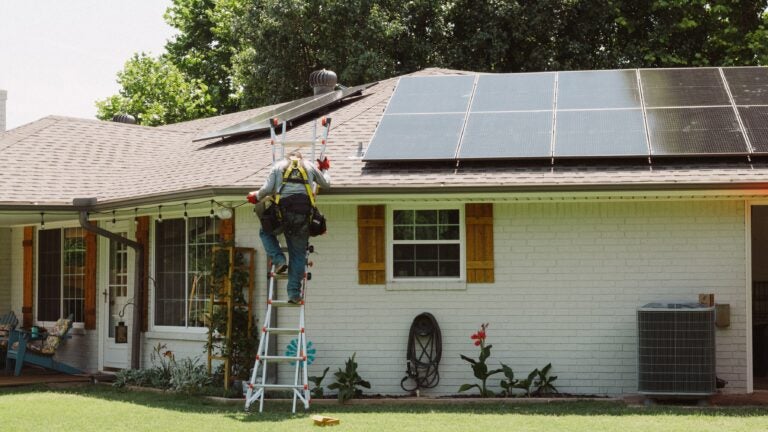
When Meg Grady’s clients saw solar panels on the roof of a four-bed, three-bath seaside Colonial in Winthrop, the prospective buyers were less than enthused.
“It was not the most positive reaction,” said Grady, an agent with Lantern Residential/Eastielove, who explained that the home had not been owner-occupied, making it difficult to know what upkeep was required for the panels.
There was also the question of the contractual details between the owner and the solar panel company. The home’s location near the beach added additional complexity, since the roof already needed to withstand the natural elements, in addition to the weight of the panels.
In neighborhoods across America, salespeople walking door-to-door selling solar panels are almost a dime a dozen. For some Massachusetts homeowners, the option to go solar is a welcome one, considering that skyrocketing monthly energy bills could drive any Bay State resident into the fetal position.
But with the tremendous expansion of the residential solar industry in the last decade comes the unfortunate downside: The US Department of the Treasury said consumer complaints about solar companies are increasing, citing issues ranging from predatory sales tactics to false statements about loans and tax credits. That leaves prospective home buyers in the challenging position of figuring out what exactly they’re getting themselves into when the home they fall in love with happens to already have solar panels on top of it.
Kate Ziegler, a realtor with Arborview Realty in Boston, has seen both ends of the spectrum. She said environmentally sensitive buyers are particularly interested in homes with solar panels, but that only hits the tip of the iceberg when it comes to their reasoning.
“The type of buyers that are really keen on solar panels are the type who are thinking of upgrading their oil heat to heat pumps and their boilers to on-demand water heaters. They’re the type of buyers who are thinking of electric car chargers. It’s about efficiency in terms of utility usage. They’re thinking of upgrading their electrical capacity to meet that higher demand,” Ziegler explained. “On the other hand, some buyers are completely overwhelmed with the premise.”
If a prospective buyer comes across a home they like that has solar panels, they must consider several details. Because the installation of solar panels requires putting holes in a roof, the roof’s integrity needs to be investigated thoroughly.
“If you put a leased product on top of your roof, and you need to fix or make changes to your roof, then that obviously adds complexity,” said Grady, who also has her buyers determine who will be maintaining the solar panels after the sale.
One of the most important aspects of buying a home with solar panels is the financial component. Since many people are taking out loans to get solar panels, potential home buyers need to make sure they won’t be saddled with assuming that debt. Grady always asks sellers to pay off the loans so the buyers don’t have to take on liability or financial responsibility for the panels.
In Grady’s case, her buyers loved the Winthrop home so much that they decided to move forward with the purchase, even with the panels. However, they didn’t do so without considering all their options.
“The solar panels are still on there,” said Grady. “However, we did negotiate it so that the solar panels were completely paid off. My clients, if they choose to, can remove them tomorrow.”

Our weekly digest on buying, selling, and design, with expert advice and insider neighborhood knowledge.





To comment, please create a screen name in your profile
To comment, please verify your email address
Conversation
This discussion has ended. Please join elsewhere on Boston.com