
Address newsletter
Get the latest news on buying, selling, renting, home design, and more.
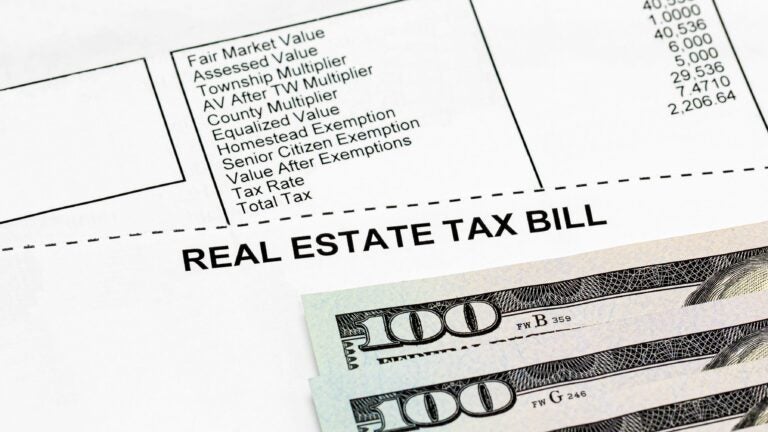
The Bay State might have the misfortune of being labeled “Taxachusetts,” but experts point to how it’s not as bad as it could be from a property tax standpoint. That distinction goes to New Jersey — at least this year, anyway.
Still, Massachusetts home buyers shouldn’t be caught off guard by property tax increases, which can add even more financial stress to homeownership.
“Over time, property taxes have inched up, but I think it’s really about how the counties and the state manage their financials,” said Ellen Steinfeld, senior executive vice president of consumer lending and payments at Berkshire Bank.
Property taxes are what homeowners pay to their city or town based on the assessed value of their home and the municipal tax rate. This tax rate varies by community and largely depends on a municipality’s financial status and spending levels.
If you average these tax rates, the effective property tax rate across Massachusetts is 1.14 percent on every assessed dollar — making Massachusetts the 18th highest of any US state and the District of Columbia, according to Rocket Mortgage.
New Jersey has the highest property tax rates in the country. Illinois, New Hampshire, Vermont, and Connecticut round out the top five, respectively.
Plus, a study the Massachusetts Taxpayers Foundation, in collaboration with the Massachusetts Competitive Partnership and the Donahue Institute at the University of Massachusetts Amherst, released Monday ranked the state 46th (from strongest to weakest) in the nation when it comes to state and local tax collections per capita as a competitive weakness.
Rates can vary significantly within the state itself.
Almost one-third of Massachusetts municipalities have split property tax rates between commercial and residential dwellings, according to the Pioneer Institute of Public Policy Research, a maneuver some states use to offset the high cost of housing with a reduced tax burden. This often means municipalities with higher commercial bases can have lower residential taxes.
Bucolic Wendell — with a municipal property tax rate of $22.15 per $1,000 of assessed value — had the highest rates in the state in fiscal 2024, according to the Massachusetts Department of Revenue. Chilmark on Martha’s Vineyard — at $2.12 per $1,000 of assessed value — has the lowest. Some communities like Boston also offer a residential tax exemption that “reduces your tax bill by excluding a portion of your residential property’s value from taxation. Last fiscal year, the residential exemption will [have] saved qualified Boston homeowners up to $3,610.53 on their tax bill.”
Commercial and industrial property owners paid 58 percent of all property taxes in 2022 compared to 42 percent of residential property owners, per the Pioneer Institute report. But there is concern this balance could shift more toward residential property owners amid higher vacancy rates in commercial buildings following the pandemic.
“There’s a lot that goes into property taxes, but generally, I don’t see higher property taxes as a bad thing,” said Daryl Fairweather, chief economist at Redfin. “The downside of having property taxes very low is that it makes housing a more appealing financial investment, and then that can crowd out first-time home buyers if investors are buying homes simply because it has favorable taxes.”
Further, it’s important for homeowners to keep tabs on how frequent towns reassess property values to avoid sticker shock.
“Some municipalities do their assessments frequently, so the changes aren’t as big,” Fairweather said. “Some will do assessments more sporadically, and then people can get pretty big shocks when they go and see how much their home has been reassessed for.”
A reassessment doesn’t have to be the final verdict, however. You can contest an assessment by filing an abatement application with your local tax assessor’s office for potential overvaluation. Further, senior citizens are eligible for property tax credits and exemptions.
Massachusetts has a safeguard against municipalities going overboard with hikes: Proposition 2½ prevents a town from raising the rate more than 2.5 percent a year without a majority override vote.
There was an expectation coming out of the pandemic that override votes would increase amid rising inflation and dwindling government relief funds to cover budget shortfalls. That appears to be precisely what happened.
Prop 2½ override votes are becoming increasingly common: Nearly 100 such votes have taken place in the past 18 months — the most seen in more than a decade, the Globe’s James Vaznis reported in July. About two-thirds of them were successful.
Perhaps the nickname “Taxachusetts,” at least when it comes to property tax hikes on the horizon, isn’t such an overstatement after all.
Send comments to [email protected].
Get the latest news on buying, selling, renting, home design, and more.




To comment, please create a screen name in your profile
To comment, please verify your email address
Conversation
This discussion has ended. Please join elsewhere on Boston.com