
Address Newsletter
Get the latest news on buying, selling, renting, home design, and more.
Some frequently visited places in Boston were created by architects who had to fight for the right to design them.
Boston’s architecture scene wasn’t inclusive to architects of color until the 1970s and ’80s, according to Gerard Georges, interim president of Boston’s chapter of the National Organization of Minority Architects (NOMA).
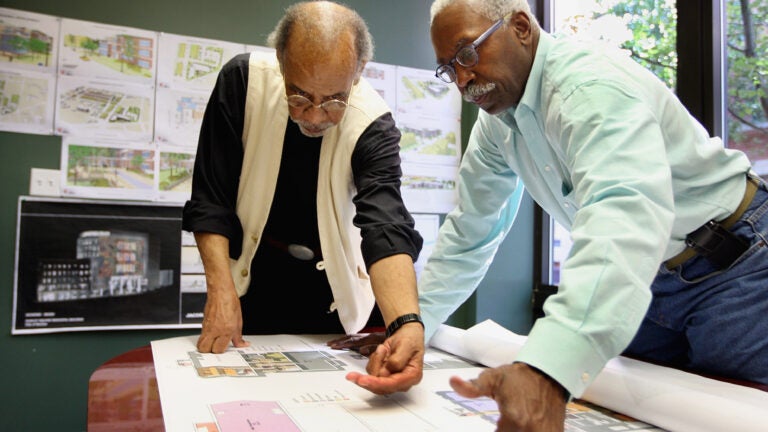
After two African-American architects — Donald L. Stull and M. David Lee — started a firm in 1966, universities strengthened their programs and more women and people of color were able to break into the field, Georges said.
“Back then, architecture was more of a social club than a true profession,” he said. “Through the strengths of [Stull’s] design sensibilities and Lee’s management capabilities, [they] were able to push through the barriers associated with getting higher-level or larger projects in the Boston area. They were able to prove themselves.”
Lee described the height of the 1970s as a “very exciting time” — one when communities were alive with activism and energy. He said he and Stull were able to “break the mold” when several organizations hired them. At the time, he noted, not everyone was willing to work with an African-American firm.
He added that timing and execution were two key factors in the firm’s success, as each project done well yielded more opportunities for work.
Stull and Lee designed Ruggles Station, Roxbury Community College, and a tower near Egleston Square. They also created several ventilation buildings under Interstate 93.


As a firm, Stull and Lee set itself apart by combining architecture with urban planning and design, Lee said. It was this overlap that allowed the firm to locate Roxbury Community College within a linear park — now known as Southwest Corridor Park — they had previously designed.
“In many cases, we would go from a planning and urban design perspective to actually doing some of the buildings within those areas we planned,” Lee said. “That distinguished us from a lot of firms.”
Georges said this innovation “paved the way for other architects.”
Stull and Lee also helped women and people of color access the world of architecture by hiring them when other firms wouldn’t, Georges said. Both architects attended Harvard and taught at universities in the area, and some of their students went on to join their firm.
Universities played a significant role in integrating the architecture scene because architects can really practice only if they’re licensed, Georges said. The Massachusetts Institute of Technology created the first architecture program in the United States in the 1860s, and was the blueprint for many other programs — including one at the Tuskegee Institute — that allowed Black architects to become licensed in a field that had historically excluded them.
Georges estimated that only 4% or 5% of the roughly 116,000 licensed architects in the nation are Black. The Directory of African American Architects reported in 2020 that just 2% of licensed architects in the United States are Black, with men outnumbering women nearly 4 to 1. Georges attributed these statistics to the challenges of creating a practice and joining a work environment that had not previously been welcoming or even inclusive.
“Leadership positions were tough and challenging roles to navigate,” he said. “There are a lot of other notable African-American architects in the country, but across [Boston] it’s been challenging.”
Lee, however, noted progress. Now, he said, architectural firms are “wide open.”
“I used to know just about every African American architect or designer, and now I don’t,” he said. “That’s a good thing.”
To make architecture more inclusive, Georges said it needs to be more accessible. BosNOMA and the Boston Society of Architecture created Project Pipeline, a weeklong camp for middle schoolers that introduces them to architecture and teaches the importance of it in everyday life. Georges said programs like this both make people aware of architecture and encourage them to explore it.
Get the latest news on buying, selling, renting, home design, and more.




To comment, please create a screen name in your profile
To comment, please verify your email address
Conversation
This discussion has ended. Please join elsewhere on Boston.com