
Ask the Gardener: Consider this plant to line your walkways
Carol Stocker takes readers' questions on seeding laws, selecting plants to line walkways, and planting American elms. .
What to do this week Visit public gardens in bloom. Resurrect and clean your patio furniture. Hook up the garden hose and add a spray nozzle for spring cleaning. Dig, divide, and relocate overgrown summer and fall-blooming perennials in your garden but wait until fall to move spring bloomers. Shop garden centers for perennials, but wait until May to plant annuals in Southern New England. Sow or transplant cold-weather vegetables, including beets, broccoli, chard, parsley, and cauliflower in the Boston area. Try pruning flowering shrubs and trees while they are budding and blooming so you can use the branches for bouquets. Sprinkle bulbs with bulb fertilizer and rose bushes with rose fertilizer before rain is expected. Pull weeds before they go to seed.
Q. When it’s time to reseed my lawn, should I use a crabgrass preventative?
N.I., Medfield
A. Early autumn is the best time to plant grass seed here. The second-best time is April for the Boston area and May for Northern New England. This is also a good time to thicken your lawn by overseeding, which is the secret to a great lawn. But if you seed, skip the crabgrass preventatives and other herbicides this year, including weed-and-feed products. Make sure the soil stays continually damp until the seed sprouts, then wait six weeks to fertilize.
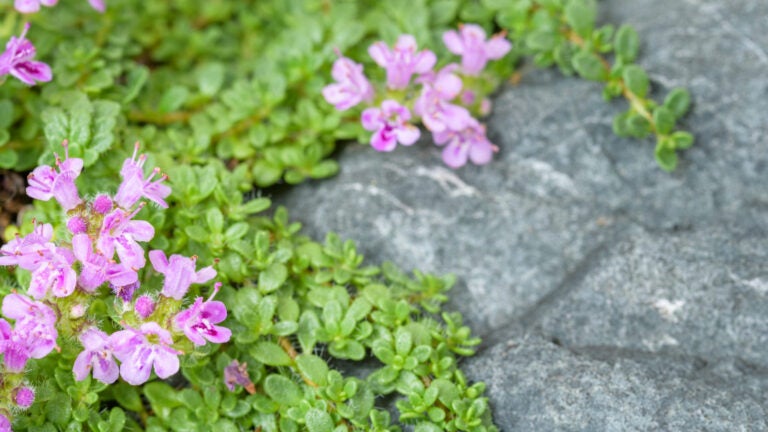
Q. What kind of plant material would work best between large concrete pavers on a pathway from the front around the house to the patio? It is 95 percent full sun. I am considering creeping thyme, ajuga, or something else. What would you suggest?
L.V., Westwood
A. I think thymes are your best bet. Try different ones that will release scent when you step on them, like creeping and woolly. They need a sunny site that does not stay damp. I’ve had good results with dwarf varieties of bugleweed planted between pavers in more shady situations.
Q. Our condo development has a master plan for trees. It includes “American elm.’’ Is that tree OK to plant?
G.F., Medfield
A. It is OK only if you get a named variety that has shown resistance to the dreaded Dutch elm disease. This great native tree lined American boulevards until the middle of the 20th century, when the disease wiped it out. Since then the search has been on for resistant varieties. Look for “Princeton’’ and “New Harmony’’ varieties, which rated highest for Dutch Elm disease resistance in a 2005-2015 trial coordinated by Colorado State University. I have been growing three “Princeton’’ elms I bought from Sylvan Nursery in Westport more than a decade ago that have been healthy and fast-growing. “New Harmony’’ and “Jefferson’’ have also shown resistance. Why take a chance on an American elm? Some people (like my husband) have a sentimental attachment to them from their youth. American elms are very good for wildlife, handsome, and fast-growing. Some have a vase shape that is perfect for a street tree; however, if your neighbor has a large elm tree, it is probably not an American elm. There are many exotic kinds of elms from around the world that don’t get Dutch elm disease.
Send questions and comments, along with your name/initials and community, to [email protected] for possible publication. Subscribe to our newsletter at pages.email.bostonglobe.com/AddressSignUp. Follow us on Facebook, Instagram, and Twitter @globehomes.





To comment, please create a screen name in your profile
To comment, please verify your email address
Conversation
This discussion has ended. Please join elsewhere on Boston.com