
Designer Terry Lin on making the most of your outdoor space
From making the most of a small space and hiding unsightly walls to choosing the right cushion color. Get more design inspiration at realestate.boston.com.
Terry Lin is the chief design officer of Outer, a new outdoor furniture brand. Lin previously worked in retail and product development, creating hundreds of successful furniture designs at Pottery Barn and new customer experiences at Walmart. He holds a bachelor of fine arts in industrial design from the Rhode Island School of Design and lives in San Francisco.
Lin recently joined staff writer Jura Koncius for The Washington Post’s Home Front online chat. Here is an edited excerpt:
Q. How can people in the Midwest and New England extend their outdoor living seasons?
A. Extending your outdoor living season is about identifying what keeps you from getting outside. In researching our company, we found that the “bookends” of enjoying the outdoors — setting up and breaking down outdoor furniture — was enough reason not to enjoy time outside. Minimize the bookends of your outdoor setup, i.e. getting the space set up and broken down quickly. The only difference between a summer and fall outdoor movie night is it might be 30 degrees cooler; it’s easier to throw on an extra layer on a brisk day than cooling off on an oppressively hot day. Have at least a 1:1 ratio of outdoor throw blankets for guests to keep the chill at bay, and consider heat lamps or a fire table to create warmth. Bonus if you can serve your guests a hot beverage they can cradle between their hands. Lighting up an outdoor space is a must and even more so when you want to extend the season.
Q. We live in a condo with a large but very drab patio with a cement floor and 6-foot-high brick walls. I can’t change either of these things, but how do I make them prettier? I was thinking of getting large plants. Can you suggest sources for interesting large planters? We also want new furniture that can stay outdoors all year. Our building is very 1960s modern. What stores do you recommend to fit this?
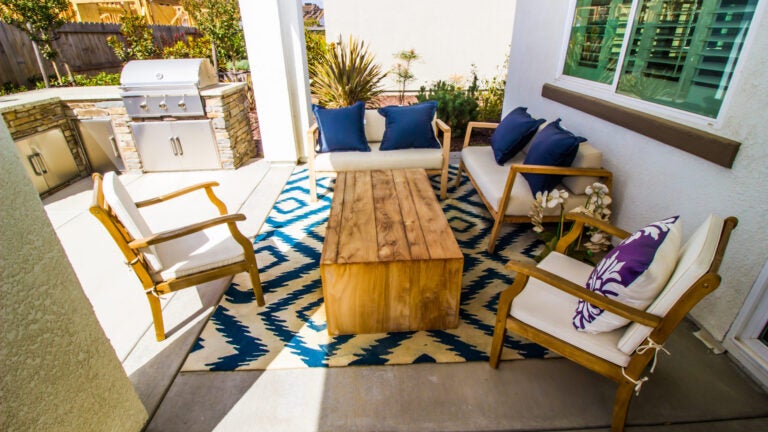
A. There are so many places and options for outdoor furniture, so I will instead educate you on what you should look for when selecting outdoor furniture. It’s designed to live outside, but of course not all outdoor furniture is going to last. There are a lot of options, but some are bad. I’ve seen too many designs that might look good in the photography but have a shallow sit and are not comfortable at all. Do your homework and find the perfect sizing for you. If there’s a sofa you love, grab a tape measure and measure its seat height and depth. Add those two numbers and use that as a reference when you shop. Find a suitable solution to protect your cushions, and invest in a furniture cover. Find the right coffee table to complement your sofa, which is essential for having your first cup of coffee or alfresco dinner.
A flat surface allows you to utilize your space easily and modify it to suit your needs. Get an outdoor synthetic rug with a simple, understated design so it doesn’t drive the overall look of your space or limit your ability to easily refresh. You’re trying to re-create your family room outdoors. These are the foundational pieces; the last and most fun part is accessorizing. You could try accent pillows, hurricane lanterns, throw blankets, woven baskets to store blankets, and pillows or decorative accessories. These small items give the space personality and make it comfortable and familiar. Let your personality and style shine with these items, and play with texture and coordinating color palettes.
Now for the concrete wall: Plants are a must. Get plants of different heights, leaf shapes, and shades of green, and put them in different planters so the wall falls into the background. When selecting planters, bigger is better, because plants need space to let their roots spread. Small plants mean less soil, which is more prone to dry out and will require more watering to stay healthy. Planters with thicker walls will help regulate soil temperature, while a thin-walled planter would heat up quickly. Getting outside is good for you, and plants are calming. Especially in the times we’re living, your home is a safe space.
Lighting makes all the difference. Bistro string lights hung across your space will make it feel magical and extend your time outside. Your future space is limited to your creativity, and these tips should put you on the right track to create a space in which you’ll want to spend time.
Q. I’m trying to figure out what color cushions to get on new outdoor furniture. I don’t want white or tan as they get too dirty. What is a good color to go with? Blue? Green? Something gray?
A. This is an age-old problem. The lifestyle shots of the perfect outdoor lounge that you see at a fancy resort is often white fabric. That’s dreamy but in reality, hard to maintain. Outdoor fabrics on furniture should be neutral; there are possibilities beyond khaki or taupe. I suggest navy or gray. My personal preference is gray as it is much easier to coordinate with many color palettes. Try to find a fabric that is not just a solid color or piece-dyed. Variations in color help create more visual interest and hide dirt and stains.
Q. How would you keep a wooden deck safe under a fire pit?
A. A fire pit pad should solve the problem. If you’re using a fire pit with a propane or natural gas assembly, make sure the design has a heat shield and has it sitting at least 12 inches above the deck.
Q. I’m thinking of purchasing or building a firepit. Your thoughts?
A. If you have the time and skills to build instead of buy, 100 percent build it. We live in a disposable culture where we never realize the effort it takes to produce something. By taking the time to understand the effort it takes, you will have a much deeper appreciation of product development and manufacturing. It also gives you the opportunity to build it with a friend or family. Just the effort of building it will give you an experience that will go far beyond the actual usage of your fire pit. It seems like this could be a bucket-list-worthy project.
Q. We’re moving into a ski home that has wood planks with very yellow and orange undertones. We’re thinking of painting that portion white and leaving the support beams their original dark brown. The main room is north-facing, so can you please recommend some Benjamin Moore paint colors that won’t read as cold or yellow?
A. White will make your space feel more spacious. I wouldn’t recommend a stark white color; try “Eggshell.” It’s always worthwhile to pick up a test pint or color and see how it looks on your walls. Make sure you have enough coverage since color is relative; the color will look very different depending on how much of the yellow and orange planks you see.
Q. How do you clean outdoor wicker?
A. All-weather wicker is relatively easy to clean. It’s worthwhile to make sure you get high-density poly ethylene (HDPE) wicker instead of polyvinyl chloride (PVC) wicker, which will peel, degrade, and crack faster. I start by hosing it off to get rid of the dust and pollen. Then make a solution of one part dish detergent to three parts water and give the wicker a good scrub. Finish it off by hosing it down and letting it dry.
Q. We want to remove the brick patio in our backyard, but the bricks are cemented in. How would we do this, and can we do this ourselves?
A. A cemented brick patio is more than just a weekend project. Do you have a concrete pad that the bricks are resting on? You’ll have to invest in the right tools and also manage the logistics of getting the bricks out of your backyard. I suggest you save your energy for the creative part of figuring out what your future space will look like.
Q. How do you improve a tiny deck? We have one with room for two small chairs, a table, and maybe a few plants. We’d also like to have more privacy.
A. Search Pinterest for small outdoor spaces that appeal to you, and you’ll find patterns in what catches your attention. It’s all about layering and adding visual interest and contrast. The small table and chairs are the foundation. Drape an outdoor throw on your chair and get a small area rug. Pick flowers and put them in a bud vase. The plants will break up the manufactured lines with something organic.
Q. I saw you recently launched rugs made of plastic bottles. How does that work?
A. I’m proud of this latest product we’ve launched, which is made from 100 percent recycled polyethylene terephthalate (PET) bottles. Sustainability is core to what we’re doing, and although we’re not a big company, we must do our part and want to continue to bring sustainability to the forefront of the conversation. We call it the 1188 collection, which refers to the number of bottles we use in each 9-by-12-foot rug.
Q. How did you know you wanted to be a designer?
A. I knew early on that my passion was something in design. I was an average math, science, and history student, but where I did stand out was in art and design. I was lucky my parents didn’t push a normal career path; at one point when I studied at the Rhode Island School of Design, I even considered becoming a ceramacist. There’s a Japanese term I love, “ikigai,” which is a concept that talks about finding the intersection of what you love, what you’re good at, what the world needs, and what you can get paid for. I’m fortunate I found mine.
Subscribe to the Globe’s free real estate newsletter — our weekly digest on buying, selling, and design — at pages.email.bostonglobe.com/AddressSignUp. Follow us on Facebook, Instagram, and Twitter @globehomes.





To comment, please create a screen name in your profile
To comment, please verify your email address
Conversation
This discussion has ended. Please join elsewhere on Boston.com