
Ask the Gardener: How to ramp up your rhubarb crop
Ask the Gardener’s Carol Stocker also weighs in on buggy houseplants and great trees for school gardens. Get more gardening advice at realestate.boston.com.
What to do this week: Enjoy your garden’s last hurrah! Cut back spent perennials with tatty foliage like daylilies so they don’t spoil the show of fall flowers. Replace faltering annuals with potted mums. Don’t bother taking the mums out of their pots; they probably wouldn’t survive the winter even if you plant them. However, this is the best time for planting almost everything else, including grass seed, trees, shrubs, perennials, and spring bulbs, so get digging! Wash and examine houseplants that have spent the summer outdoors. You can also spray them with organic pesticides a few days before you move them back indoors next week.
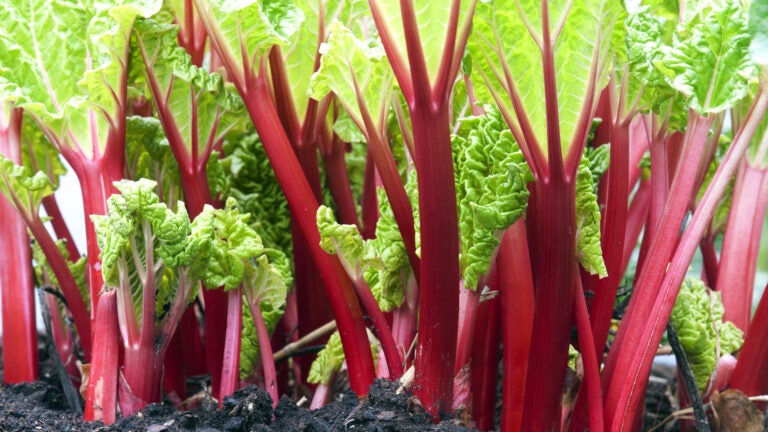
Q. Are rhubarb plants single sexed? I have several plants, and some flower every year. Others never flower. I remove the flowers, but those plants yield very little fruit. The non-flowering ones produce many stems. They all grow in the same area. Should I dig out the flowering plants and discard them? When buying new plants, how can I tell whether they are non-flowering?
J.K., Plymouth
A. Some trees, shrubs, and vines have genders, including holly, bittersweet, and ginkgo trees. They need two to tango, but only the females bear fruit. However, rhubarb and most other plants are self-pollinating and contain both male and female sexual organs. Rhubarbs need full sun, and any flowering stalks should be cut down as soon as they sprout to save energy. You could also dig up and divide the roots to reinvigorate the plants. Give some away. You need only three “eyes,’’ or nubby buds, per new plant. October is a good time to divide rhubarb. Incidentally, this is one of those chores you need to do every 10 or 20 years, so don’t feel pressured if you’re busy.
Q. What trees do you suggest planting in a school garden as a learning experience?
B.N., Milton
A. How about late-yielding apple trees so the fruit ripens after school starts? They flower around May 10, which would be before school lets out, too. Plant different kinds, including a disease-resistant Liberty apple, an heirloom apple, a dwarf, a columular apple (no side branches), and a crabapple. I would start small with trees purchased by mail. Maybe the kids can get involved is choosing varieties and actually planting the small trees when they arrive. And trees planted small usually grow a better root system. Apple trees produce edible fruit during the school year for cooking, cider, jellies, and all kinds of projects. They also draw a lot of insects, but most kids love bugs! Insect identification can be another project for teaching about nature’s food chain. Insects also attract birds and maybe nests. Entomologist Doug Tallamy says foreign and native apple trees are virtually identical genetically, so he counts them all as natives plants and among the best for birds and wildlife.
Q. I read with interest the letter from N.A. in Milton regarding fungus gnats (“Get rid of fungus gnats before bringing your plants indoors,’’ Ask the Gardener, Aug. 11.) I had a similar problem and didn’t want to use insecticide. An online website said a mixture of 1 part peroxide to 4 parts water poured onto the soil would kill the larvae and eggs, and it worked for me. I had to use it more than once, but it was nontoxic and did not harm the plants. Thank you for all your wonderful advice. . . . I am still using the neem oil spray you told me about last year for my black aphid problem.
P.M., Hanover
A. Thanks. Water with one part 3 percent hydrogen peroxide with four parts water to kill the larvae. You can also debug your houseplants simply by soaking the pot in a basin of water mixed with a teaspoon of mild liquid soap or organic insecticidal soap for 20 minutes. Discard any debris that floats to the surface and scrub the pot. Then rise it all off and spray the leaves with neem oil. Let them dry before bringing your plants indoors.
Events
Garden in the Woods (180 Hemenway Road in Framingham), the botanic garden of the Native Plant Trust, will host “Asters After Hours” on Sept. 27 from 5:30 to 7:30 p.m., giving visitors a rare chance to wander the woods and gardens at twilight while enjoying harvest-themed libations, light fare, and live music. Tickets ($23 members/$30 nonmembers) are available at nativeplanttrust.org.
Tower Hill Botanic Garden (11 French Drive, Boylston) is hosting a trio of plant shows and sales on fall weekends. On Sept. 22, the garden will host the Begonia & Gesneriad Society Show & Sale. Next weekend, Sept. 28-29, is the Dahlia Show. On Oct. 4, 5, and 6, there’s the Boston Chapter of Ikebana International exhibition. (This is also a good place to shop for Japanese-style pots.) Regular hours and admission fees apply. Visit towerhillbg.org for information.
Send questions and comments, along with your name/initials and community to [email protected] for possible publication. Subscribe to our newsletter at pages.email.bostonglobe.com/AddressSignUp. Follow us on Facebook and Twitter @globehomes.





To comment, please create a screen name in your profile
To comment, please verify your email address
Conversation
This discussion has ended. Please join elsewhere on Boston.com