
Sign up for the Today newsletter
Get everything you need to know to start your day, delivered right to your inbox every morning.
Venezuela’s ousted president, Nicolás Maduro, arrived in Brooklyn late Saturday to be held on drug and weapon charges, hours after President Trump said the United States had captured him and intended to “run the country.”
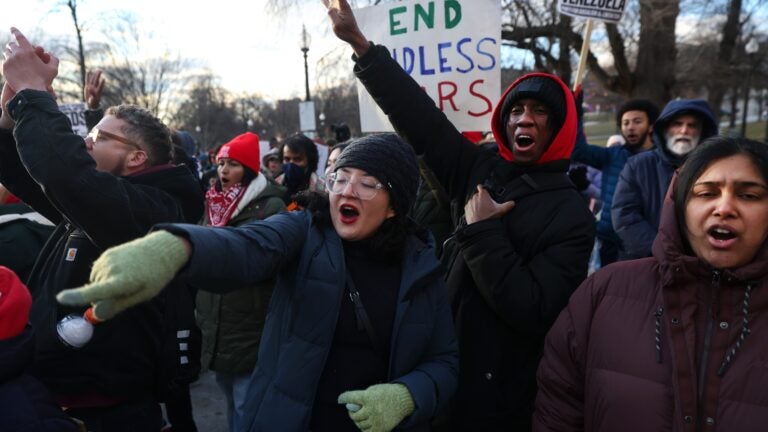
The US military operation in Venezuela followed a monthslong campaign by Mr. Trump’s administration to oust the authoritarian leader. In US cities, it has led to both protests against the military intervention and celebrations among some Venezuelan migrants over the ouster of Mr. Maduro.
Here’s what we know:
The United States carried out “a large scale strike against Venezuela” in which Mr. Maduro and his wife, Cilia Flores, were captured, Mr. Trump said.
Gen. Dan Caine, chairman of the Joint Chiefs of Staff, said at a news conference on Saturday that Mr. Trump ordered the operation late Friday. The mission involved 150 aircraft that worked to dismantle Venezuelan air defenses so military helicopters could deliver troops to Caracas, the country’s capital, he said.
The mission took about two hours and 20 minutes and continued into early Saturday, when Mr. Maduro and Ms. Flores “gave up,” General Caine said.
U.S. forces encountered significant resistance, Mr. Trump said. At least 80 people were killed, including military personnel and civilians, according to a senior Venezuelan official who spoke on the condition of anonymity to describe preliminary reports. Cuban state media reported that 32 Cubans were killed in the U.S. attacks on Saturday. President Miguel Díaz-Canel of Cuba said the people were from Cuba’s armed forces or its interior ministry, on a mission at the request of Venezuela, according to state media.
No Americans were killed, Mr. Trump said. Two U.S. officials speaking on the condition of anonymity said that about half a dozen soldiers were injured in the operation.
Secretary of State Marco Rubio said at a news conference on Saturday that it would not have been possible to inform U.S. lawmakers in advance of the strike. He and Mr. Trump described the mission as a law enforcement operation, rather than a military action, which would have required greater congressional oversight.
President Trump brushed aside concerns about the constitutionality of his administration’s actions during an interview on “Fox & Friends Weekend,” saying that Democrats who criticized him should praise the effort.
“They should say, ‘Great job,’” he said. “They shouldn’t say, ‘Oh, gee, maybe it’s not constitutional.’”
Representative Jim Himes of Connecticut, the top Democrat on the House Intelligence Committee, called on the administration to immediately brief Congress on its legal justification and its plan for the region.
Mr. Maduro, a self-described socialist, had led Venezuela since 2013. The Biden administration had accused Mr. Maduro of stealing the election that kept him in power last year.
The United Nations Security Council will convene an emergency meeting on Monday to discuss the U.S. strikes in Venezuela.
Vladímir Padrino López, Venezuela’s defense minister, said in a speech on Sunday that the government that was in place under Mr. Maduro was still in charge and that the Venezuelan military “will guarantee the governability of the country.”
Mr. Maduro’s vice president, Delcy Rodríguez, was sworn in as interim president in a secret ceremony on Saturday, according to people close to the Venezuelan government. Mr. Padrino López said Venezuela’s Supreme Court ruled Ms. Rodríguez was the acting president.
The day before, Mr. Trump said the United States intended to “run the country” until a transition of power could take place, but he offered few details about how that would work. His remarks mostly focused on how U.S. interests would extract and sell Venezuela’s oil.
On Sunday, Mr. Rubio said the U.S. military would maintain a “quarantine” around Venezuela to prevent the entry and exit of oil tankers under American sanctions and to maintain “leverage” on the country.
At a news conference, Mr. Trump said Ms. Rodríguez was “essentially willing to do what we think is necessary to make Venezuela great again.”
But in a live address to Venezuelans later Saturday, Ms. Rodríguez denounced the United States, saying, “There is only one president in this country, and his name is Nicolás Maduro Moros.”
Ms. Rodríguez is known as an economic troubleshooter who helped orchestrate the country’s shift from corrupt socialism to similarly corrupt laissez-faire capitalism.
The main opposition leader, María Corina Machado, who had organized what was widely seen as a winning presidential campaign in 2024, earning her the Nobel Peace Prize this year, posted a statement asking that her political ally, Edmundo González, be recognized as Venezuela’s president immediately.
In his own video statement on Sunday, Mr. González referred to himself as the president of Venezuela and called for political prisoners to be released.
Mr. Maduro and Ms. Flores “will soon face the full wrath of American justice,” Attorney General Pam Bondi said.
Mr. Maduro and Ms. Flores landed in New York on Saturday afternoon to face drug charges, U.S. officials said. They were being held at the Metropolitan Detention Center in Brooklyn and are scheduled to make their first appearance in court on Monday at noon, according to the Federal District Court in Manhattan.
A photo of Mr. Maduro in U.S. custody, released by Mr. Trump, shows him in handcuffs, wearing a black mask and headphones.
The attorney general posted an unsealed indictment charging him with narco-terrorism, cocaine importation conspiracies and possession of machine guns, charges that carry lengthy prison sentences if he is convicted.
The indictment appears similar to a 2020 indictment against Mr. Maduro, during Mr. Trump’s first term, which accused him of overseeing a violent drug organization known as Cartel de los Soles.
Analysts have said that Cartel de Los Soles does not exist as a literal organization, and that the term has been used more broadly to describe the alleged involvement of high-ranking Venezuelan military officers in the drug trade. However, no evidence has been publicly disclosed showing Mr. Maduro directing the effort.
Amanda Holpuch and Alexandra E. Petri contributed reporting.
This article originally appeared in The New York Times.
Get everything you need to know to start your day, delivered right to your inbox every morning.


To comment, please create a screen name in your profile
To comment, please verify your email address
Conversation
This discussion has ended. Please join elsewhere on Boston.com