
Sign up for the Today newsletter
Get everything you need to know to start your day, delivered right to your inbox every morning.
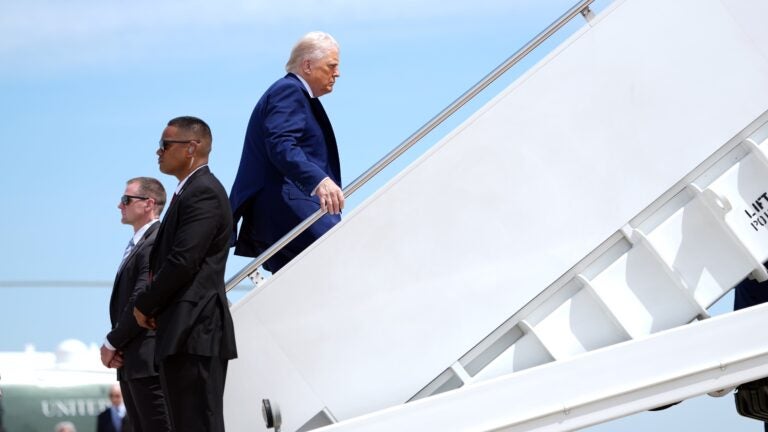
When U.S. presidents visit the Middle East, they usually arrive with a strategic vision for the region, even if it seems a far reach.
Jimmy Carter pushed Egypt and Israel to a historic peace accord. Bill Clinton tried and failed with Yasser Arafat, the Palestinian leader. George W. Bush imagined his war on terrorism would ultimately lead to democratization in the region. Barack Obama went to Cairo “to seek a new beginning between the United States and Muslims around the world.”
President Donald Trump will tour the Persian Gulf this week in search of one thing above all else: business deals. Planes. Nuclear power. Artificial intelligence investments. Arms. Anything that puts a signature on the bottom of a page.
While planning the first major overseas trip of his second term, a four-day swing through Saudi Arabia, Qatar and the United Arab Emirates, Trump told his advisers that he wanted to announce deals that would be worth more than $1 trillion.
As a branding exercise, it makes perfect sense. Surrounded by resource-rich royals and American business executives, Trump, who likes to brag about his deal-making skills, will scrawl his Sharpie over term sheets, and lots of them. He will visit palaces, walk on red carpets and be treated like a king in a region that is increasingly vital to the Trump family’s financial interests.
Yet, as a strategic exercise, the trip’s purpose remains foggy. During his 2017 journey to the region, Trump made waves by rallying dozens of leaders from majority-Muslim countries to confront and denounce extremism. It is unclear what foreign policy goals, if any, will be advanced on this visit.
During the Biden administration, negotiations over selling Saudi Arabia billions of dollars in civilian nuclear equipment — and the ability to enrich their own uranium — were tied to a diplomatic objective: persuading Riyadh to recognize Israel, envisioned by the Americans as an extension of the Abraham Accords, which Trump has described as the biggest diplomatic achievement of his first term.
Now, the negotiation appears to be moving forward, slowly, as a stand-alone business deal.
Trump’s aides insist he still wants to broker a normalization deal between Saudi Arabia and Israel. But with the Israel-Hamas war in the Gaza Strip still raging, Saudi Crown Prince Mohammed bin Salman has no interest in publicly embracing Israeli Prime Minister Benjamin Netanyahu. And Trump’s current interest in tying himself to Netanyahu is not much greater than the crown prince’s. So a stop in Israel did not make it onto his itinerary.
There will be no meeting in Riyadh between Trump and Russian President Vladimir Putin, as Trump had once hoped. And the Trump team has been cagey about the status of its nuclear diplomacy with Iran, not wanting to upset negotiations that have been happening behind closed doors in Oman, a country Trump is not visiting on this trip.
“Going to the Middle East right now is more about economics, not strategy,” said Dennis B. Ross, a longtime Middle East peace negotiator now at the Washington Institute for Near East Policy. “He clearly likes these kinds of trips that have announcements of big deals, because this is his preoccupation. His focus, his priority, is much more on the economic, financial side of things.”
In place of grand strategy will be a series of financial transactions that Trump will promote as producing jobs for American workers.
The agenda conveniently aligns with Trump’s expanding business plans. His family has six pending deals with a majority Saudi-owned real estate firm, a cryptocurrency deal with an affiliate of the government of the UAE, and a new golf and luxury villa project backed by the government of Qatar.
The Qataris are going to great lengths to court Trump. The Trump administration is poised to accept a luxury Boeing 747-8 plane as a donation from the Qatari royal family that will be upgraded to serve as Air Force One, in possibly the biggest foreign gift ever received by the U.S. government, several U.S. officials with knowledge of the matter said.
The plan under discussion raises substantial ethical issues, especially given that Trump could use the $400 million plane after he leaves office, receiving it as a donation to his presidential library. (On Sunday, the White House press secretary said any deal would comply with the law, and Qatari officials said it was still under review.)
Saudi Arabia, the UAE and Qatar manage trillions of dollars in assets around the world, and have increasingly become diplomatic and financial forces to reckon with. But their foreign policies have diverged from the United States’ in recent years. The three countries have forged close ties with China, Russia and Iran in addition to the United States, which remains their indispensable defense ally and operates military bases in their territories.
For Crown Prince Mohammed, Trump’s decision to make the kingdom one of the destinations of his first major trip abroad — for a second time — lends validation to his belief that Saudi Arabia is a rising global power, with a gravitational pull that powerful leaders cannot ignore.
As Trump visits these authoritarian states, he can feel assured that he will not be subject to the sort of protests and hostility he would expect if he visited some of the United States’ allies in NATO, such as Canada or Germany, where he is deeply unpopular.
The royal families of the Persian Gulf know better than anybody how to speak Trump’s language.
He raved for years about his gilded reception in Saudi Arabia in 2017, in his first foreign trip as president. They projected a multistory image of Trump’s face onto the facade of Riyadh’s Ritz-Carlton hotel, where Crown Prince Mohammed later imprisoned opponents. U.S. flags lined the highways, country singer Toby Keith performed for a full house of Saudi fans and Trump joined in a traditional sword dance. During a visit to a center for countering extremism, Trump placed his hands on a glowing orb alongside King Salman of Saudi Arabia and President Abdel Fattah el-Sissi of Egypt.
Yet, Trump left office in 2021 believing that the crown prince owed him. He had come to Crown Prince Mohammed’s defense at a time when Western elites were shunning him after the murder of Washington Post columnist and Saudi dissident Jamal Khashoggi.
Although Crown Prince Mohammed denied knowing about the killing in 2018, the CIA assessed that he was likely to have approved the mission by Saudi assassins, and there was a bipartisan outcry in Washington.
But Trump, after declaring that he would follow the evidence and take action against Khashoggi’s killers, stood by Crown Prince Mohammed and took credit for rescuing him.
“I saved his ass,” Trump told journalist Bob Woodward in early 2020. “I was able to get Congress to leave him alone. I was able to get them to stop.”
The crown prince has returned the favor.
No part of the world has been more important to the rising financial well-being of the Trump family than the Middle East, particularly since 2021, in the aftermath of the Jan. 6, 2021, attack on the Capitol, after which Trump and his relatives were treated as pariahs by much of America’s corporate community.
It was in that climate that Jared Kushner, Trump’s son-in-law and his former senior White House adviser, started his own investment fund. His biggest financier became Crown Prince Mohammed. Six months after Kushner left the White House, the crown prince overrode concerns from his investment advisers and ensured that the Saudi sovereign wealth fund invested $2 billion with Kushner’s company, making the Saudis, by far, its largest investor.
Trump had his own problems at the time. He was furious when the PGA of America voted, after the Capitol riot, to strip his New Jersey golf course of the PGA Championship. This was far more than a financial blow; it was personally painful for Trump. Golf is central to the Trump brand, and there was no bigger stamp of approval than hosting the PGA Championship event at Trump National in Bedminster, New Jersey.
Fortuitously, in 2021, the same sovereign wealth fund that had invested $2 billion with Kushner — the Public Investment Fund — started the breakaway LIV Golf. The Saudis spent millions poaching top PGA golfers, and the new circuit posed a significant threat to the PGA Tour before the two sides signed a preliminary partnership deal in 2023.
The timing was perfect for Trump, and he saw an opportunity to put his golf courses back on the world map. LIV Golf has held tournaments at Trump’s courses for four consecutive years, raising the international profile of Trump’s golf resorts and driving revenue to his hotels and restaurants.
Trump’s family also has signed deals with a majority Saudi-owned real estate company to build projects in Jeddah, Saudi Arabia; Dubai, UAE; Muscat, Oman; and other locations.
On Tuesday, when Trump is scheduled to arrive, the Saudi government is planning to host an investment forum with White House crypto czar David Sacks and other American business leaders, including the CEOs of IBM, BlackRock, Citigroup, Palantir and Qualcomm, a semiconductor company.
Crown Prince Mohammed has pledged to invest $600 billion in the United States over the next four years — a number that economists say is highly unlikely to materialize as the kingdom grapples with a cash crunch. The Emiratis have pledged $1.4 trillion in U.S. investment over 10 years.
Sheikh Mohamed bin Zayed Al Nahyan, the ruler of the UAE, has increasingly struck out on his own path. The country’s growing links with both U.S. rivals such as China and expanding economies such as India are in preparation for a world that may someday be no longer dominated by the United States.
But the Persian Gulf leaders appreciate Trump’s transactional nature. Trump, they have found, does not lecture them about human rights.
This article originally appeared in The New York Times.
Get everything you need to know to start your day, delivered right to your inbox every morning.



To comment, please create a screen name in your profile
To comment, please verify your email address
Conversation
This discussion has ended. Please join elsewhere on Boston.com