
Sign up for the Today newsletter
Get everything you need to know to start your day, delivered right to your inbox every morning.
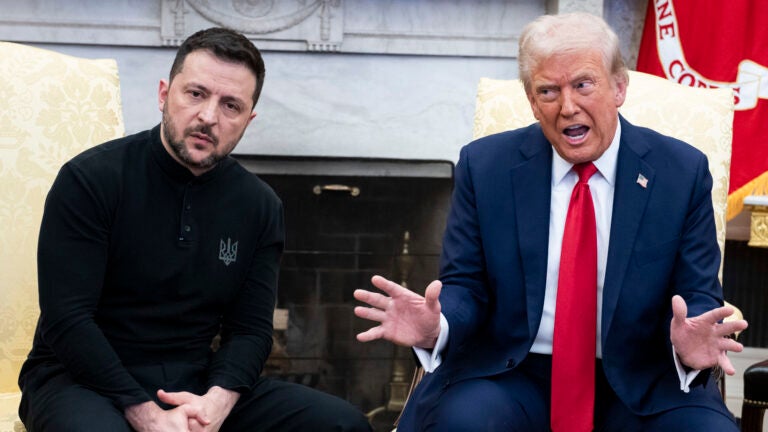
WASHINGTON — President Donald Trump and Vice President JD Vance loudly berated President Volodymyr Zelensky of Ukraine on Friday in an explosive televised shouting match unlike any seen in the Oval Office between an American president and foreign leader in modern times.
Trump and Vance castigated Zelensky for not being grateful enough for U.S. support in its war with Russia and sought to strong-arm him into making a peace deal on whatever terms the Americans dictate. With voices raised and tempers flaring, Trump threatened to abandon Ukraine altogether if Zelensky did not go along.
Talking over the Ukrainian leader, Vance told Zelensky that it was “disrespectful” for him to come to the Oval Office and make his case in front of the U.S. news media and demanded that he thank Trump for his leadership. Trump jumped in and told the Ukrainian leader, “You’re not really in a good position right now” and that “you’re gambling with World War III.”
“You’re either going make a deal or we’re out,” Trump added. “And if we’re out, you’ll fight it out and I don’t think it’s going to be pretty.”
The exchange was one of the most dramatic moments ever to play out in front of television cameras in the Oval Office and underscored the radical break between the United States and Ukraine since Trump took office. Trump has effectively sided with Russia while falsely blaming Ukraine for starting the war and calling Zelensky a “dictator.”
Despite Trump’s claim last week, it was Russia that first attacked Ukraine in 2014 and then mounted a full-scale invasion in 2022. Although Ukrainian elections have been suspended for the past three years under martial law, Zelensky became president on the back of a landslide election victory in 2019. President Vladimir Putin of Russia, by contrast, is an actual dictator whose elections have been widely dismissed as frauds and who faces an international arrest warrant for war crimes.
Trump had seemed to be trying to put his rift with Zelensky to the side before their meeting, brushing off a question Thursday about whether he still considers the Ukrainian leader a dictator.
“Did I say that?” Trump asked. “I can’t believe I said that. Next question.”
At a later news conference with Prime Minister Keir Starmer of Britain, Trump did not respond to a question about whether he owed Zelensky an apology for calling him a dictator. “We’re going to have a very good meeting,” he said. “I have a lot of respect for him.”
His sharp language last week about Zelensky contrasted with his assessment of Putin, whom he has only praised since winning a second term. Just this week, the president called Putin “a very smart guy” and “a very cunning person.” He said that he believes that Putin really wants peace and added Thursday that “he’ll keep his word” if a deal is reached, despite multiple Russian violations of agreements in the past.
While he has spoken with Putin by telephone, Trump has given little sense of how he expects to negotiate either a ceasefire or an enduring peace agreement. During last year’s campaign, he promised to end the war within 24 hours and to do so even before his inauguration, neither of which he actually did.
During Thursday’s news conference with Starmer, Trump expressed a mix of optimism and fatalism about his chances of making peace. “I think it’s going to happen, hopefully quickly,” he said. “If it doesn’t happen quickly, it may not happen at all.”
Starmer and other European leaders have offered to contribute troops to a multinational peacekeeping force on the ground in Ukraine after the fighting halts. But Trump resisted pressure to commit U.S. forces to help, even without ground troops, or to offer security guarantees to Ukraine against renewed Russian aggression.
Since taking office, Trump has demanded that Ukraine turn over some of its natural resources as payback for military aid provided under President Joe Biden to defend itself against Russia. While Trump has falsely claimed that the United States has contributed $350 billion and Europe only $100 billion, in fact, according to the Kiel Institute for the World Economy, Europe has allocated $138 billion compared with $119 billion from the United States.
Under a draft of the rare minerals agreement reviewed by The New York Times, Ukraine would contribute half of its revenues from the future monetization of natural resources, including critical minerals, oil and gas. Trump characterized the deal Thursday as an economic development boon. “It’ll be good for both countries,” he said.
This article originally appeared in The New York Times.
Get everything you need to know to start your day, delivered right to your inbox every morning.


To comment, please create a screen name in your profile
To comment, please verify your email address
Conversation
This discussion has ended. Please join elsewhere on Boston.com