
Tentative Results in Afghan Presidential Runoff Spark Protests
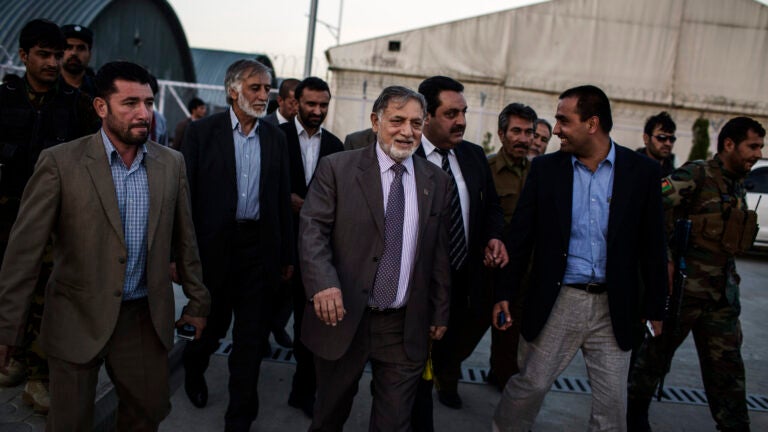
KABUL, Afghanistan — Afghanistan’s already tumultuous election grew more perilous Monday after the announcement of preliminary presidential runoff results that were rejected by the candidate Abdullah Abdullah, leading some of his most powerful supporters to call for protests and even the forming of a breakaway government.
In releasing the preliminary results, which showed Ashraf Ghani Ahmadzai roughly 1 million votes ahead of Abdullah, with 8.1 million ballots cast, the Afghan election commission cautioned that there was no winner yet, as millions of votes could be subjected to a special audit for fraud.
But the caveat seemed to have little effect on many of the candidates’ supporters. After nightfall, Ahmadzai backers went into the streets, unleashing celebratory gunfire in several cities. Some were already hailing Ahmadzai as the president-elect.
At the same time, there were reports that Abdullah supporters were demonstrating in Kabul, denouncing a “coup’’ by the election commission after his campaign tersely rejected the election’s legitimacy. One video posted on social media showed dozens of men, including police officers in uniform, chanting “Long live President Abdullah’’ and spraying gunfire.
Both candidates, along with the Afghan government, the United Nations and the United States, have called for calm and restraint in recent days. But the question of what the ethnic cores of their political bases might do — largely Pashtun for Ahmadzai and largely Tajik for Abdullah — has loomed over the deepening political deadlock in recent weeks.
That crisis had seemed to ebb in recent days, as the campaigns of Abdullah, a former foreign minister who ran for president against Hamid Karzai in 2009, and Ahmadzai, a former finance minister and World Bank official, began meeting to thrash out an agreement on how much of the vote would be subjected to an audit. At the same time, U.N. and U.S. officials separately pressed cases for a widespread audit.
The talks continued into Monday, and it remained unclear throughout much of the day whether the country’s Independent Election Commission would announce the preliminary results, which had already been delayed for days. The U.S. ambassador, James B. Cunningham, and Jan Kubis, the U.N. special envoy for Afghanistan, took part in at least some of the meetings, officials said.
The announcement finally came just as Afghans were breaking their daily Ramadan fasts, and it appeared to catch the Abdullah camp off guard, fulfilling what many campaign officials had described as one of their worst fears in the weeks since the June 14 runoff.
The ballot total reported by the commission was around 1 million votes higher than the 7 million votes it estimated in June — a figure that itself had immediately led to protests from Abdullah’s campaign, saying the total had been vastly inflated by ballot box stuffing and highly improbable turnout numbers in areas that had supported Ahmadzai in the first round. In the weeks since, the process has been fraught with tension over Abdullah’s boycott and accusations of systemic vote-rigging.
Though Ahmad Yousuf Nuristani, the chairman of the election commission, cautioned Monday that “there is no winner yet,’’ the reaction to his announcement was swift and negative from many quarters.
The Obama administration, which had remained mostly quiet about the election, offered a strongly worded statement emphasizing that the preliminary results were “not final or authoritative.’’ And it demanded that Afghan election officials “implement a thorough audit whether or not the two campaigns agree.’’
“A full and thorough review of all reasonable allegations of irregularities is essential to ensure that the Afghan people have confidence in the integrity of the electoral process and that the new Afghan president is broadly accepted,’’ said the statement, released by the State Department.
In Monday’s announcement, Nuristani said that the Independent Election Commission, while tallying the preliminary results, had already thrown out more than 11,000 votes from 1,930 polling stations. About 60 percent of the votes disqualified had been cast in favor of Ahmadzai, with the reminder cast for Abdullah.
In addition, the two candidates had agreed for votes from nearly another third of the country’s 22,000 polling stations to be set aside for a special audit to spot fraudulent votes, Nuristani said. He added that it would be up to the separate Election Complaints Commission, which is charged with adjudicating electoral disputes, to conduct the inquiry.
The complaints commission said later Monday that it was ready to do the audit on top of complaints it was already adjudicating, if the campaigns requested it. But no such request had been made, said Nader Mohseni, a spokesman for the complaints commission.
Officials from the Abdullah campaign, meanwhile, said there had been no agreement on the audit, and they said there would be no talks following the announcement, which they had been led to believe would not be made Monday.
“None of the election commissions have any legitimacy for us,’’ said Fazal Rahman Oria, spokesman for Abdullah. “The result is informal by all means, and we do not accept the result.’’
His comments were mild in comparison to statements from two of Abdullah’s most powerful backers, both former warlords with large ethnic constituencies. Muhammad Mohaqiq, who is running as Abdullah’s first vice president, described the preliminary results as a “coup’’ against voters, and said it had given Abdullah’s team the “right to form the government.’’
Muhammad Atta Noor, another former warlord who is currently the governor of Balkh province in northern Afghanistan, said in a separate statement: “Today’s announcement by the commission paves the ground for the next measures, from massive protests to the formation of a parallel government,’’ he said.
Secretary of State John Kerry responded to the threats of forming a separate government with a stern statement, saying there is “no justifiable recourse to violence or threats of violence, or for resort to extra-constitutional measures or threats of the same.’’
“Any action to take power by extralegal means will cost Afghanistan the financial and security support of the United States and the international community,’’ Kerry said in a statement released Tuesday morning in Kabul.
There was no immediate response to the announcement from Ahmadzai, but tens of thousands of his supporters took to the streets to celebrate in Kabul, where celebratory gunfire could be heard, and in many other parts of the country where Pashtuns dominate, including the southern city of Kandahar.
There, thousands of people turned out to see traditional dancing and drumming after the announcement, and a powerful member of the Kandahar provincial council, Hajji Agha Lalai, also invited thousands of people to a breakfast Tuesday in honor of Ahmadzai.
The reactions from both camps hinted at a far darker facet to the election, which increasingly appears to have exposed the ethnic and factional rifts that plunged the country into civil war in the 1990s, but which Karzai has managed to keep buried over the past 12 years.
Both candidates have been careful to avoid making nakedly ethnic appeals. But some of their supporters have been far more chauvinistic, especially in the lead-up to the runoff, and in the weeks since the vote.
Abdullah himself has been careful to avoid inflammatory remarks about parallel governments or any other radical measures in his public comments. His campaign said he would speak Tuesday.



To comment, please create a screen name in your profile
To comment, please verify your email address
Conversation
This discussion has ended. Please join elsewhere on Boston.com