
Tony Benn, devoted British socialist, dies at 88
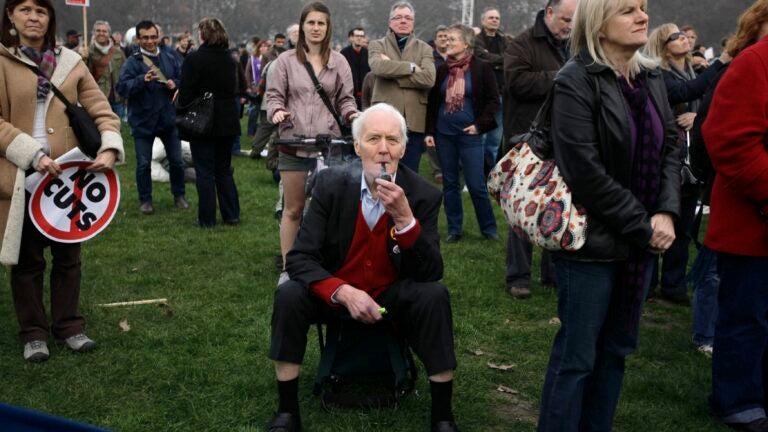
LONDON — Tony Benn, a committed British socialist who irritated and fascinated Britons through a political career spanning more than five decades and who renounced his aristocratic title rather than leave the House of Commons, has died. He was 88.
His family said in a statement that Mr. Benn died peacefully March 14 at his home in west London. It did not give a cause for death.
Labor Party leader Ed Miliband praised Mr. Benn as an ‘‘iconic figure of our age’’ who will be remembered as a ‘‘champion of the powerless, a great parliamentarian,’’ and a politician of great conviction.
‘‘Tony Benn spoke his mind and spoke up for his values. Whether you agreed with him or disagreed with him, everyone knew where he stood and what he stood for,’’ Miliband said.
‘‘For someone of such strong views, often at odds with his party, he won respect from across the political spectrum. This was because of his unshakeable beliefs and his abiding determination that power and the powerful should be held to account.’’
Prime Minister David Cameron also paid tribute while admitting his ideological differences.
‘‘He was a magnificent writer, speaker, diarist, and campaigner, with a strong record of public and political service,’’ Cameron, a Conservative, said in a statement Friday.
‘‘There was never a dull moment listening to him, even when you disagreed with everything he said.’’
Mr. Benn held Cabinet posts in Labor Party governments in the 1970s and clung unswervingly to his leftist beliefs while his party, in opposition, moved to the center and reemerged to take power again as New Labor. The change left Mr. Benn out of step with his party’s new, younger leaders.
‘‘New Labor’s prime object is to destroy old Labor,’’ Mr. Benn complained when Tony Blair led the party to a landslide victory in May 1997, ending a generation of Conservative Party rule.
‘‘But you can’t just wish away a movement, a history, with a sound bite. You just can’t do it.’’
Mr. Benn, who favored abolition of the monarchy, British withdrawal from the European Union, and any strike that was going, had not changed. But his image did. He was over time transformed from the demonized figure of the 1970s and ’80s to that often-treasured English archetype: the radical dissenter.
‘‘He had this wonderful vision of the working class,’’ former left-wing Labor lawmaker Joe Ashton recalled in a 1995 BBC television documentary. ‘‘It was almost like the noble savage and sometimes we had to bring him down to earth.’’
Born in London on April 3, 1925, Anthony Wedgwood Benn was the second son of William Wedgwood Benn, a Labor Cabinet minister, and the former Margaret Holmes, a scholar in Greek and Hebrew studies. One grandfather was a baronet, and both had been members of Parliament.
He was educated at Westminster, an expensive private school, and Oxford, where he was president of the Union, the university’s prestigious debating society.
His elder brother, Michael, was killed in World War II, making him the reluctant heir to the title viscount Stansgate, which George VI had bestowed on his father in 1941.
He was elected to the House of Commons at 25, but his parliamentary career seemed to come to an abrupt end in 1961 when his father died. As the new Viscount Stansgate, he was barred from the Commons so that he could take up membership in the unelected upper House of Lords.
For three years he battled to change the law to allow hereditary peers to renounce their titles. Voters in his parliamentary district of Bristol West elected him once more, even though he could not take his seat in the Commons.
In 1963, the bill passed, and the Times of London declared, ‘‘Lord Stansgate will be Mr. Benn today.’’
Labor Prime Minister Harold Wilson made Benn the industry secretary in 1974, but moved him to energy secretary a year later, a job where his left-wing, pro-union activities were less noticeable.
Mr. Benn was devoted to politics and family, and the pipe he was forever smoking. He never tasted alcohol and was a vegetarian.
He lost his parliamentary seat in 1983 when the Conservatives’ Margaret Thatcher inflicted her most devastating defeat on Labor. A year later he was back, returned at a special election for Chesterfield, a depressed former coal-mining district in northern England.
‘‘Committed socialist,’’ announced Mr. Benn’s campaign literature, long after the word — and the philosophy — had been expunged from New Labor.
Through decades, Mr. Benn, a notable orator with a slight lisp, preached in chilly town halls, on the hustings, and in the Commons. He had a single message: socialism and the cause of ‘‘working people and their families.’’
No setback ever seemed to depress him. not five failed attempts to become Labor leader or deputy leader; not getting dumped from the party hierarchy in the 1980s; not the emasculation of the labor unions by Thatcher; not Labor’s transformation; not the personal criticism.
‘‘Many of Tony Benn’s ideas were crazy. He sacrificed the prospect of being leader by pursuing these crazy ideas,’’ commented Roy Hattersley, a former deputy Labor leader and near-contemporary.
Mr. Benn shrugged it off.
‘‘The five lines about me are: You’re an aristocrat, you’re a multimillionaire, you’re a hypocrite, you’re mad, you’re ill,’’ Mr. Benn said in a 1994 newspaper interview. ‘‘It took me a while to realize that their purpose was to discourage people from listening to what I am saying.’’
Mr. Benn retired from the House of Commons in May 2001, after 51 years in Parliament, to ‘‘devote more time to politics.’’ By then he was the longest serving Labor MP in the history of the party, which he joined in 1942.
If anything, Mr. Benn lived more in the limelight after he retired. He became a regular broadcaster, and his 2002-3 speaking tours of Britain entitled ‘‘An Audience with Tony Benn’’ never failed to sell out. He was unsurprisingly extremely outspoken in his opposition to the 2003 war in Iraq, and days before the final commencement of hostilities traveled to Iraq to interview Saddam Hussein.
Mr. Benn was the holder of seven honorary doctorates from British and American universities and in 2003 was appointed visiting professor at the London School of Economics.
He was married to Caroline Middleton de Camp, an American and a member of a well-off Cincinnati family, from 1949 until her death in November 2000. They had three sons: Stephen, Joshua, and Hilary, who is also a Labor member of Parliament, and a daughter, Melissa.





To comment, please create a screen name in your profile
To comment, please verify your email address
Conversation
This discussion has ended. Please join elsewhere on Boston.com