
Typhoon devastates Philippines
-

Residents stood next to grafitti requesting aid in the aftermath of Typhoon Haiyan on Nov. 13 in Tacloban, Leyte, Philippines. Typhoon Haiyan, packing maximum sustained winds of 195 miles per hour, slammed into the southern Philippines and left a trail of destruction in multiple provinces, forcing hundreds of thousands to evacuate and making travel by air and land to hard-hit provinces difficult. Around 10,000 people are feared dead in the strongest typhoon to hit the Philippines this year.
-

People gathered among the ruins in the aftermath of Typhoon Haiyan.
-

A Filipino survivor was comforted by a relative as she waited at the aiport in the devastated city of Tacloban. International aid poured in for the Philippines as authorities stepped up efforts to reach survivors driven to looting after one of the world’s strongest typhoons devastated their towns. A tropical depression brought heavy rains over the central and eastern Philippines, where provinces badly hit by Haiyan are located, raising concerns that relief operations would be hampered.
-

Four days after Typhoon Haiyan devastated part of the Philippines, many have nothing left; they are without food or power and most lost their homes. Around 10,000 people are feared dead in the strongest typhoon to hit the region this year.
A Nov. 11, 2013, aerial photo taken from a Philippine Air Force helicopter showed the devastation of the first landfall by Typhoon Haiyan in Guiuan, Eastern Samar province, central Philippines. Haiyan slammed the island nation with a storm surge two stories high and some of the highest winds ever measured in a tropical cyclone. An untold number of homes were blown away, and thousands of people are feared dead.
-

US and Philippine military personnel prepared relief goods for transporting at the military base in Manila on Nov. 12, before sending the packages to the central coastal city of Tacloban which bore the brunt of Typhoon Haiyan when it swept through the central Philippines.
The United Nations launched an appeal for a third of a billion dollars as US and British warships steamed toward the island nation.
-

A member of the Philippine military carried an injured person during an evacuation of Leyte.
-

Words were spray painted on a damaged home in Tacloban city in Leyte province in the central Philippines. Four days after Typhoon Haiyan devastated islands in the central Philippines, survivors were desperate for food and clamoring to be evacuated.
-

Evacuees waited for their turn to board a military aircraft in Leyte.
-

Residents carried relief goods along the bay in Tacloban city. Haiyan, one of the most powerful storms on record, slammed into six central Philippine islands on Nov. 8, leaving a wide swath of destruction and potentially thousands of people dead.
-

A man surveyed felled trees in an area devastated by Typhoon Haiyan in Palo township in Leyte.
-

A woman wept as she carried a child to a military aircraft to evacuate an area devastated by Typhoon Haiyan in Leyte.
-

People who survived the wrath of Typhoon Haiyan disembarked from a military cargo plane that flew them out of the city of Tacloban to Manila.
-

Newborn baby Bea Joy was held as her mother, Emily Ortega, 21, rested after giving birth on Nov. 10 at an improvised clinic at Tacloban airport. Bea Joy was named after her grandmother, Beatrice, who was missing following the typhoon.
Ortega was in an evacuation center when the storm surge hit and flooded the city. She had to swim to survive before finding safety at the airport.
-

A young survivor used a plastic cover to protect himself from rain as he passed by a damaged Boy Scout statue inTacloban.
-

Dead bodies were unloaded at a makeshift morgue in Tacloban.
-

A survivor from Tacloban, which was devastated by Typhoon Haiyan sat on the ground after disembarking a Philippine Air Force C-130 aircraft at the Villamor Airbase in Manila.
Authorities said at least 9.7 million people in 41 provinces were affected by the typhoon, known as Haiyan elsewhere in Asia but called Yolanda in the Philippines. It was likely the deadliest natural disaster to beset this poor Southeast Asian nation.
-

Philippine military personnel prioritized children and women first as people waited in Tacloban for evacuation flights. Thousands of typhoon survivors swarmed the airport here seeking a flight out, but only a few hundred made it, leaving behind a shattered, rain-lashed city short of food and water and littered with countless bodies.
-

Philippine policemen secured a truck load of relief goods in the devastated city of Tacloban. Aid workers and relief supplies were being poured into eastern provinces hit by Typhoon Haiyan, which agencies and officials estimated left thousands dead and staggering destruction in its wake.
The United States will send an aircraft carrier and other Navy ships along with 20 million US dollar in emergency humanitarian aid to the Philippine. Thousands were feared dead in Leyte and nearby Samar province, as police and disaster relief officials said at least 552 were confirmed killed, mostly drowned by tsunami-like sea waves that flattened towns.
-

Two people rode bikes through a devastated area in Leyte, Philippines.
-

Aid workers disembarked a V-22 Osprey as they arrived to assist survivors in Leyte.
-

Dead bodies were lined up at a makeshift morgue in Tacloban, on the eastern island of Leyte. US and British warships were deployed to the Philippines where well over 10,000 people are feared dead and countless survivors are begging for help in rain-soaked wastelands.
-

Young boys ate near the statue of US General Douglas McArthur at the Leyte Landing Memorial on Nov. 12.
-

Survivors waited in a line to receive relief goods in an area devastated in Leyte.
-

Children packed a motorbike’s sidecar as they traveled along a street in an area devastated by Typhoon Haiyan in Leyte.
-

Governments and agencies around the world announced a major relief effort to help victims of the devastating Typhoon Haiyan which killed an estimated 10,000 people. Secretary of State John Kerry said the United States will organize emergency shipments of critically neeeded supplies to those diplaced by the typhoon.
Pictured: Philippine and US military personnel loaded relief goods on a US C-130 plane for victims of Typhoon Haiyan that hit the central Philippines.
-

A mother cuddled her sick baby aboard a military helicopter in the typhoon-devastated town of Guiuan, eastern Samar province, Philippines. Philippine authorities appealed for calm after one of the world’s strongest typhoons left survivors desperate for food and water in areas affected by the storm. More aid workers and relief supplies were pouring into eastern provinces hit by Typhoon Haiyan.
-

An aerial view of the ruins of houses after the devastation of super Typhoon Haiyan in Tacloban city in central Philippines.
-

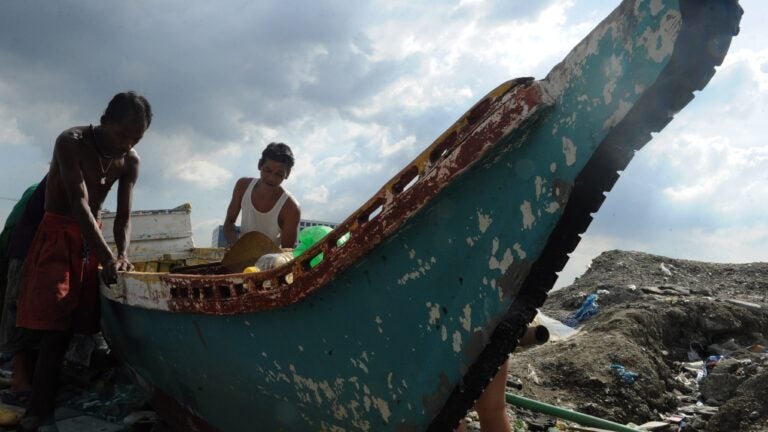
The death toll from one of the strongest storms on record that ravaged the central Philippine city of Tacloban could reach 10,000 people, officials said Sunday after the extent of massive devastation became apparent and horrified residents spoke of storm surges as high as trees. Pictured are survivors passing by two large boats after they were washed ashore by strong waves.
-

Residents carried furniture taken from a hotel in Palo on the eastern island of Leyte, three days after the typhoon decimated entire towns in the Philippines. ‘‘The water was as high as a coconut tree,’’ said Sandy Torotoro, 44, a bicycle taxi driver. ‘‘When we were being swept by the water, many people were floating and raising their hands and yelling for help. But what can we do? We also needed to be helped.”
-

A child carried a chair taken from a hotel in Palo. ‘‘There is no power, no water, nothing. People are desperate,’’ Defense Secretary Voltaire Gazmin said. “They’re looting.’’
-

A resident looked at houses damaged by the typhoon in Tacloban city. ‘‘The devastation is … I don’t have the words for it,’’ Interior Secretary Mar Roxas said. ‘‘It’s really horrific. It’s a great human tragedy.’’
-

Survivors stayed in their damaged house. Super typhoon Haiyan destroyed about 70 to 80 percent of the area in its path as it tore through Leyte province on Friday, said police chief superintendent Elmer Soria.
-

A boy who was wounded by flying debris stayed at the ruins of his family’s house in Tacloban city. As rescue workers struggled to reach ravaged villages along the coast, where the death toll is as yet unknown, survivors foraged for food as supplies dwindled or searched for lost loved ones.
-

Residents wheeled a family member to the cemetery in Santa Fe, Leyte, Philippines. Typhoon Haiyan, packing maximum sustained winds of 195 miles per hour, slammed into the southern Philippines and left a trail of destruction in multiple provinces, forcing hundreds of thousands to evacuate and making travel by air and land to hard-hit provinces difficult.
-

A girl peeked out from a makeshift shelter in Tacloban, on the eastern island of Leyte. The Philippines is annually buffeted by tropical storms and typhoons, which are called hurricanes and cyclones elsewhere.
-

A Filipino father and his children waited for food relief outside their makeshift tent in the super typhoon devastated city ofTacloban, Typhoon Haiyan tore through the eastern and central Philippines, flattening homes, toppling power lines and knocking out communications. Fierce winds ripped roofs off buildings as raging floodwaters swept debris and left vehicles piled on top of each other on the battered streets.
-

Submerged cars sat in flood waters in the aftermath of Typhoon Haiyan. The nation is in the northwestern Pacific, right in the path of the world’s No. 1 typhoon generator, according to meteorologists.
-

Residents carried a coffin in Santa Fe, Leyte, Philippines. Even by the standards of the Philippines, Haiyan was a catastrophe of epic proportions and has shocked the impoverished and densely populated nation of 96 million people.
-

Survivors walked through the rubble of damaged homes and a ship that was washed ashore in Tacloban city, Leyte province, central Philippines, on Sunday. The city remains littered with debris from damaged homes as many complain of shortages of food and water and no electricity since Typhoon Haiyan slammed into their province.
-

The central Philippine city of Tacloban was in ruins one day after being ravaged by one of the strongest typhoons on record, as horrified residents spoke of storm surges as high as trees and authorities said they were expecting a “very high number of fatalities.”
-

A resident passed by a toppled car outside an airport terminal after the typhoon slammed into Tacloban city, Leyte province, central Philippines.
-

Soldiers loaded relief supplies onto an airlift for affected areas a day after Super Typhoon Haiyan hit the Philippines.
-

A pregnant woman walked past debris left by Typhoon Haiyan after it battered Tacloban city.
-

Soldiers helped to reinforce a house in preparation for the arrival of the Typhoon Haiyan at a village in the central province of Quang Tri on in Vietnam.
-

A Filipino soldier pulled a cable inside the devastated airport tower in Tacloban city.
-

A Philippine Air Force helicoper took off at the devastated airport.
-

A victim left at the side of a street in the devastated city of Tacloban.
-

A mother wept beside the dead body of her son at a chapel in the aftermath of Typhoon Haiyan in Tacloban.
-

Bureau of Fire Protection volunteers packed relief goods bound for hard-hit areas of the southern Philippines at a government warehouse.
-

Typhoon Haiyan approached the Philippines in this satellite image.
-

A three-wheeled motorcycle maneuvered in floodwaters in Taguig city, south of Manila on Nov.8.
-

A man reinforced his house with banana stalks as powerful Typhoon Haiyan hit Legazpi city, Albay province, about 325 miles south of Manila, on Nov. 8.
-

Residents walk along the coastal village while strong winds from Typhoon Haiyan battered Bayog town in Los Banos, Laguna, south of Manila November 8, 2013. Super Typhoon Haiyan, the strongest typhoon in the world this year and possibly the most powerful ever to hit land battered the central Philippines on Friday, forcing millions of people to flee to safer ground, cutting power lines and blowing apart houses. Haiyan, a category-5 super typhoon, bore down on the northern tip of Cebu Province, a popular tourist destination with the country’s second-largest city, after lashing the islands of Leyte and Samar with 275 kph (170 mph) wind gusts and 5-6 meter (15-19 ft) waves. REUTERS/Charlie Saceda (PHILIPPINES – Tags: DISASTER ENVIRONMENT TPX IMAGES OF THE DAY)
-

A house was engulfed by the storm surge brought about by powerful typhoon Haiyan.
-

A Filipino woman used a plastic sheet during a downpour brought by Typhoon Haiyan.
-

Filipino children rode on bicycles manuevered on floodwaters in Taguig city, south of Manila, on Nov. 8.
-

A mother took refuge with her children as Typhoon Haiyan hit Cebu city, central Philippines on Nov. 8.
-

A fisherman secured his outrigger in a river near Manila bay on Nov. 8.
-

A resident walked past high waves pounded the sea wall amidst strong winds as Typhoon Haiyan hit the city of Legaspi, Albay province, south of Manila on Nov. 8.
-

Debris littered the road by the coastal village in Legazpi city following a storm surge brought about by powerful Typhoon Haiyan in Albay province on Nov. 8.
-

Authorities in the Philippines grounded air and sea transport on Thursday and urged fishing boats to return to port as Super Typhoon Haiyan gathered speed. Pictured, a fisherman’s outrigger was anchored on the shore of Manila bay.
-

Filipino residents slept on the floor as they seek refuge inside a gymnasium turned into an evacuation center in Sorsogon City.
-

Philippine President Benigno Aquino III, left, spoke about Typhoon Haiyan during a nationally televised address at the Malacanang palace in Manila.
-

Residents of a provicnce south of Manila were evacuated Thursday ahead of the super typhoon that was strengthening in the Pacific Ocean..





To comment, please create a screen name in your profile
To comment, please verify your email address
Conversation
This discussion has ended. Please join elsewhere on Boston.com