
Marcel Reich-Ranicki, Holocaust survivor, top German lit critic, dies
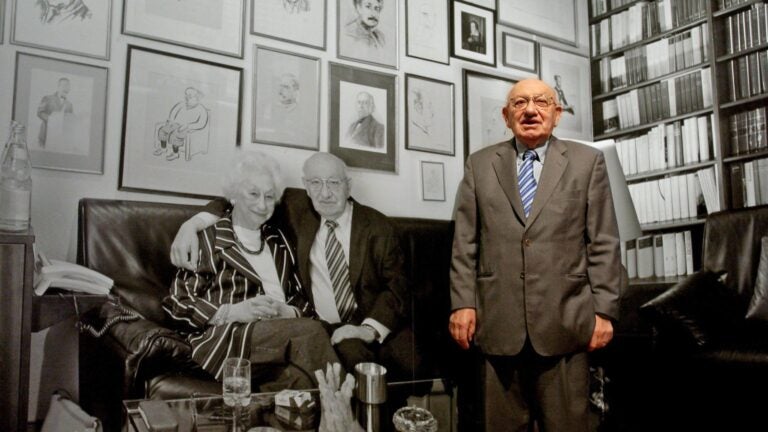
NEW YORK — Marcel Reich-Ranicki, a survivor of the Warsaw ghetto who fled Poland to become a powerful cultural figure in postwar Germany as a distinguished literary critic and a popular television talk show host, died Wednesday in Frankfurt. He was 93.
The Frankfurter Allgemeine Zeitung reported the death but gave no further details. He had a long association with the newspaper, contributing reviews and columns as recently as 2012.
A Polish-born Jew who grew up in Berlin, Mr. Reich-Ranicki had a lifelong love for the German classics, reading the poetry of Goethe and Heine even while enduring the cruelest months of Nazi terror, when he saw SS troops march his parents off to the Treblinka gas chambers.
Over six decades, he produced witty, sometimes barbed, but consistently erudite commentary in a career that saw Germany through the Cold War and national reunification. He became Germany’s leading literary arbiter and in the process paved the way for Jews to again play an important role in the nation’s culture and politics.
He lived with the irony of loving the masterpieces, even of artists whose views he detested.
“The biggest anti-Semite in the history of German culture was Richard Wagner,’’ Mr. Reich-Ranicki told an interviewer. “And the greatest opera I know is his ‘Tristan and Isolde.’ ’’
Novelist Gunter Grass once questioned Mr. Reich-Ranicki at a literary conference.
“What are you really: a Pole, a German, or what?’’ asked Grass.
“I am half Polish, half German, and wholly Jewish,’’ Mr. Reich-Ranicki replied.
He later said that the statement was untrue, that he felt himself an outsider everywhere.
He could be an irascible critic, fearless in defense of scathing judgments. Grass became a particular target. In 1995 — four years before Grass won the Nobel Prize — a photograph of Mr. Reich-Ranicki appeared on the cover of the newsmagazine Der Spiegel showing him tearing apart, literally, Grass’s latest novel, “Too Far Afield,’’ which dealt with Germany’s moral struggle to reconcile itself with its terrible past.
“He wrote a book that he considers to be the most important of his life, and he has to read in every newspaper that it’s junk,’’ Mr. Reich-Ranicki said.
And in 2012 — six years after Grass had stunned Europe when he revealed that he had been a member of the Waffen SS during World War II — Reich-Ranicki lashed out at Grass again, over a poem Grass had published, “What Must Be Said,’’ accusing Israel of being a threat to world peace. Reich-Ranicki called it disgusting.
He was born Marcel Reich in the industrial town of Wloclawek, Poland. In 1929, the boy was sent to live with relatives in Berlin, where he attended high school, became fluent in the language, and grew enthralled by German literature and music.
As a Jew, he was not permitted to attend university; his sweeping grasp of German culture since the Enlightenment was a product of his own study. In 1938, the Nazis arrested and deported him to Warsaw, where he rejoined his parents and brother.
In the ghetto, he saw German soldiers murder Jews on the street. Working as a translator, he was an eyewitness to crucial meetings between the Jewish and Nazi authorities.
Hearing that translators, and their wives, were exempt for the time being, Mr. Reich-Ranicki married his sweetheart, Teofila, that same day. (The marriage lasted seven decades; his wife died in 2011.)
In September 1942, Mr. Reich-Ranicki watched his parents board cattle trucks bound for Treblinka.
“My father looked at me helplessly, while my mother was surprisingly calm,’’ he wrote. “I knew I was seeing them for the last time.’’
Escaping the ghetto in 1943, Mr. Reich-Ranicki and his wife were taken in by Polish peasants, who hid them in a cellar until the war’s end. Grateful to the Red Army for liberating Poland, Mr. Reich-Ranicki joined the Polish Communist Party and, posted as a diplomat in London, worked for Polish intelligence, a mission for which he assumed the pseudonym Ranicki. He later merged Reich with Ranicki.
In 1949, he was thrown out of the Polish Communist Party for “ideological estrangement’’ and jailed for a time. Afterward he found work for a government publisher and eventually as a freelance literary critic, writing in Polish. In that role, he met prominent German writers, from both East and West, including Bertolt Brecht, Heinrich Böll, and Grass.
Emigrating to West Germany in 1958, Mr. Reich-Ranicki leaned on his Rolodex of German authors and established himself as one of the nation’s most incisive critics.
From 1959 to 1973 he lived in Hamburg, writing for the newspapers Die Welt and Die Zeit. In 1973, he moved to Frankfurt to head the literary section of The Frankfurter Allgemeine Zeitung, a post he held through 1988. He was still writing and editing literary columns for that paper in 2012.
Mr. Reich-Ranicki testified in at least two war crimes trials, including the 1962 proceedings against Höfle. But he “did not dwell on’’ those searing wartime experiences during the early postwar decades while he was building his literary reputation, according to his son, Andrew Ranicki, a mathematics professor at the University of Edinburgh.
“My mother and myself eventually urged him to write his autobiography before it was too late,’’ Andrew Ranicki said in 2012.
The book, “Mein Leben,’’ published in 1999, became a best-seller in Germany, and the Israeli director Dror Zahavi filmed an adaptation for broadcast on German TV in 2009. By then Mr. Reich-Ranicki had been a household name for years, having since 1988 been the host of “Literary Quartet,’’ a prime-time talk show broadcast on German public television. He remained as host until 2002.
The show so magnified his influence that his comments could make or break young writers. Newspapers called him Germany’s “literary pope.’’





To comment, please create a screen name in your profile
To comment, please verify your email address
Conversation
This discussion has ended. Please join elsewhere on Boston.com