
Cambodia’s former King Norodom Sihanouk dies at 89
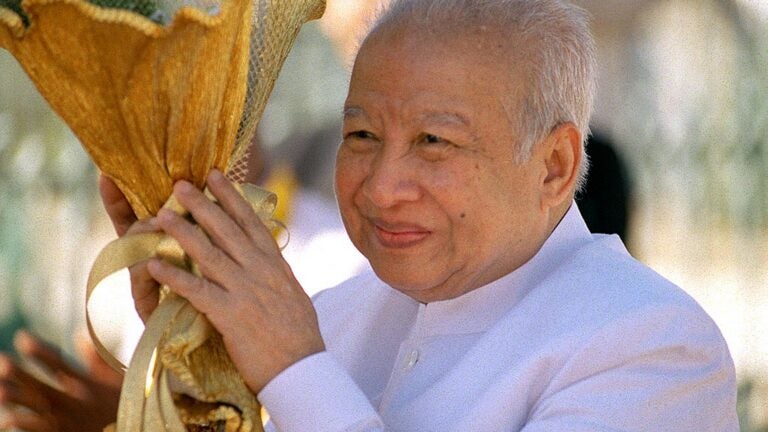
King Norodom Sihanouk, the flamboyant, mercurial ruler who led Cambodia to independence, watched it descend into genocide and civil war, and reigned once more as the country struggled to its feet, died Monday. He was 89.Prince Sisowath Thomico, a royal family member who also was the former king’s assistant, said King Sihanouk suffered a heart attack at a Beijing hospital. ‘‘His death was a great loss to Cambodia,’’ Thomico said.King Sihanouk, who abdicated the throne in 2004,
once called himself the country’s “natural ruler.’’ He often called his people his “children,’’ and biographers say he commonly identified himself as the embodiment of Cambodia. His admirers say that attitude spurred him to work tirelessly for the country’s interests. His critics say it made him intolerant of criticism and too willing to ally with any forces that claimed they could restore his honor, including the infamous Khmer Rouge.King Sihanouk was still a shy boy of 18 when he was chosen for coronation by French colonial administrators, and he reportedly wept at the thought of ruling. “The French chose me because they thought I was a little lamb,’’ he once wrote. “Later they were surprised to discover that I was a tiger.’’The king stormed to the forefront of politics in 1952 when, angered by factional bickering in the new Parliament, he dismissed the government and named himself prime minister. King Sihanouk promised independence within three years and left for France, allegedly for health reasons. Once there, he petitioned the French government for independence. Rebuffed, he took to the world stage, traveling to the United States, Canada, and Japan to give interviews stressing the injustices of colonialism. The French, weary from waging a losing battle with Vietnam, agreed to talks.Cambodia was granted independence in 1953, and King Sihanouk was proclaimed a national hero. It was the beginning of what many older Cambodians recall as a golden age, when the streets were clean and children flocked to newly built schools.For 17 years, King Sihanouk kept Cambodia out of the civil conflict engulfing its much larger neighbor, Vietnam, a tightrope walk widely seen as his greatest accomplishment. As King Sihanouk sought foreign support for his positions, he became a prominent figure within the so-called nonaligned movement of poorer countriesthat refused to take sides in Cold War power games. The king became a darling of the international left, even as he discouraged the growth of left-wing parties in his country through surveillance and arrest.After war broke out again in Vietnam in 1961, King Sihanouk began a pattern of shifting, secret allegiances that some viewed as wily strategy and others merely as unpredictability. He secretly allied with North Vietnam and began allowing Viet Cong troops to use Cambodia as a base for fighting in the South.Later, frustrated by reports of thousands of Viet Cong troops along the border, he tacitly approved limited US bombing runs on Cambodian soil. The United States commenced an overwhelming bombing campaign that took a serious toll on civilians at its peak in 1973.King Sihanouk was deposed in March 1970 in a coup tacitly approved by the CIA and led by a former military adviser, Lon Nol, who pledged to support the United States in the Vietnam War. The corrupt regime, propped up largely by US aid, soon plunged the country into civil war with communist forces. King Sihanouk then spent years in Beijing in lonely but lavish exile.A few months later, in a radio broadcast,
he urged Cambodians to take up arms against Lon Nol. He formed an alliance with the Khmer Rouge insurgents, who toured him around the countryside and pledged to support him. But soon after taking power in 1975 the Khmer Rouge imprisoned him in his palace.The Khmer Rouge eventually killed most of the king’s relatives still in Cambodia. The radical Maoist regime was one of the most brutal in the century, killing about 1.7 million of its people through extermination, fatigue, or starvation as it tried to convert the entire country into an agrarian collective.Vietnam invaded Cambodia in December 1978 and toppled the Khmer Rouge a few weeks later. Freed as the Vietnamese advanced on Phnom Penh, King Sihanouk found exile in Beijing and North Korea. From there, he headed an unlikely coalition of guerrilla groups fighting the puppet government Vietnam had installed in his country. The war lasted a decade. He engineered a cease-fire and moves toward national unity and peace.King Sihanouk headed the UN-supported interim structure that ran Cambodia until the 1993 elections, lending his prestige to attempts to unite Cambodia’s factions.The election was won by the royalist party of King Sihanouk’s son Prince Norodom Ranariddh. But it was forced into a coalition with the Cambodian People’s Party of former Khmer Rouge officer Hun Sen.Four years later, Hun Sen ended his constant bickering with Ranariddh by overthrowing the prince in a violent coup that shattered the results of the election. International pressure forced Hun Sen to accept Ranariddh’s return for a second election in 1998, which was narrowly won by Hun Sen, but bloodshed ensued as the royalists and other opposition parties forced a constitutional crisis by refusing to join a coalition with the Cambodian People’s Party.King Sihanouk stayed on the sidelines for most of the two-year crisis, but as demonstrators clashed in the streets of Phnom Penh, he finally intervened by urging Ranariddh to accept a new coalition with his enemy Hun Sen.During his last years, King Sihanouk’s profile and influence receded.



To comment, please create a screen name in your profile
To comment, please verify your email address
Conversation
This discussion has ended. Please join elsewhere on Boston.com