
Sign up for the Today newsletter
Get everything you need to know to start your day, delivered right to your inbox every morning.
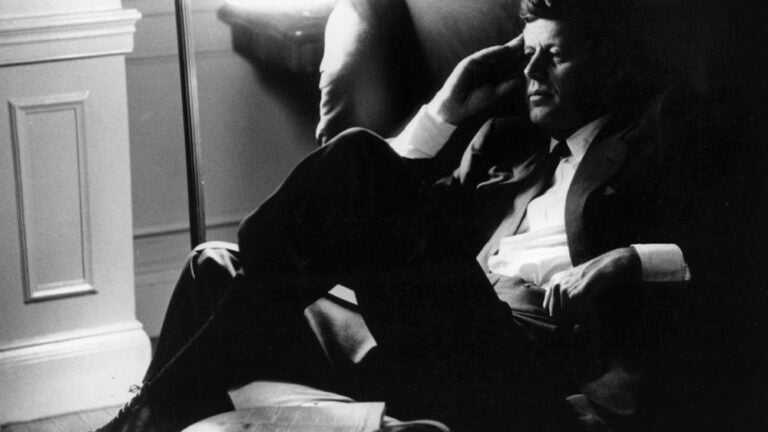
After serving in the navy during World War II, John F. Kennedy moved to 122 Bowdoin St. in Beacon Hill — and this was his official registered address up until the day he died. This Friday marks 61 years since his assassination in Dallas.
He lived in apartment 36, a two-bedroom unit that directly faces Ashburton Park at the Massachusetts State House and sits above Beacon Hill Instant Shoe Repair.
According to his lease from 1959, he paid $95 per month. As of September 2024, the median rent for a two-bedroom in Beacon Hill is $3,800 per month.
This apartment served as home base for his early political career, especially his elections into the House of Representatives in 1946 and Senate in 1952. Yet even while taking office in Washington, D.C., Kennedy kept his Bowdoin address through this presidency.
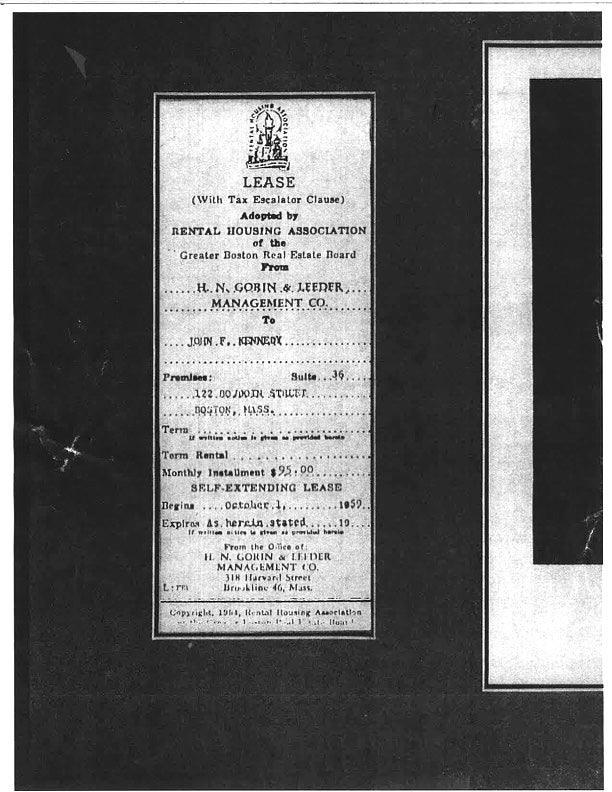
Dave Powers, who served as Kennedy’s aide and was a former JFK Library curator, wrote in a letter that Kennedy used the Bowdoin apartment starting in 1946.
But other records from the JFK Library and Museum show uncertainty around when Kennedy was officially living at his Bowdoin Street address, as he first had a room in Hotel Bellevue. The Beacon Street hotel, which is now a residential condominium, was around the corner from the Bowdoin apartment, and was also where his grandfather lived.
Historian and Harvard professor Fredrik Logevall, who is in the process of writing a three-volume biography on Kennedy, said Hotel Bellevue served as “the initial hub for this nascent campaign.” Hirsh Freed, a campaign advisor for JFK, even sent several letters to Kennedy at his hotel room in December 1946.
In fact, Kennedy had still sent life insurance payments to the Veterans Administration from the hotel the following year, and only seems to have filed an official change of address for the Bowdoin Street address with the Veterans Administration in 1949.
Coming back from the war, Kennedy decided to build his political career. He had been looking to enter politics for some time, Logevall said.
In 1946, he began to run for the Democratic nomination for the 11th Congressional district, which covered wards in Boston, Cambridge, and Somerville. Today, this area is now part of District 7.
In pursuing this seat in Congress, he wanted to move to a central location, “in order to establish his legitimacy in both the 11th district but also in the state,” Logevall said.
Then, in 1951, Kennedy ran for Senate against incumbent Republican Henry Cabot Lodge, Jr. Particularly for this race, the Bowdoin Street apartment played a key role in his eventual victory.
Almost every weekend while campaigning, Kennedy traveled from Washington, D.C. to Massachusetts, where the apartment served as headquarters. He and his team would mark up a map in the apartment that showed which communities they’d visited, enabling them to strategize how to cover the other areas of the state, Logevall said.
He added that no matter where Kennedy was in the state, even in the Berkshires or Western Mass., he always preferred to sleep in his own bed (which had a board under it for support) rather than a hotel.

It might’ve not been a fancy place, but Logevall believes that Kennedy had a personal affection for the apartment.
“I think this one had sentimental importance for him. It’s where he was when he got his political start,” he said. “It was the scene of some of his early triumphs, a lot of strategizing went on in this place.”
When he ran for president in 1960, he and his wife, Jacqueline Kennedy Onassis, even voted at the West End branch of the Boston Public Library.
“We can say now that 24 hours later he would be declared President of the United States,” Logevall said. “He didn’t know that, but even at this particular moment, his address is 122 Bowdoin. It’s pretty remarkable.”
His voter card for 1964 also stated this address. Though, according to a letter from Kennedy’s secretary, his brother Ted Kennedy had been living there since the inauguration.
David Dorsey, former head property manager who lived in the building for about 45 years, even remembers Ted once playing with him and his cousin when they were young.
“I thought it was really cool. Ted is just being with the kids, messing with the kids,” Dorsey said. “That always stuck with me because he was such a sweet man.”
Dorsey called the Kennedys part of the “fabric of the neighborhood.” His grandfather, George Washburn, who also worked for the management company for many years before he passed, would see the Kennedys every now and then, and even brought them breakfast on occasion.
“If you waved ‘hi,’ they would wave ‘hi’ back. If you wanted to shake their hand, they would shake your hand. If they wanted to talk to you, they would talk to you,” Dorsey said. “They were of the people, not above the people.”

Yes, and someone still lives there.
The building still serves as an apartment complex today, hosting 56 apartments and four retail spaces on the first floor, including Capitol Coffee House and Boston Barber Co. It also has been owned and run by the same company, Leeder Management, since the 1940s, said Walter Laughlin, chief financial officer.
But during Dorsey’s time as property manager, he noticed that most residents didn’t know Kennedy lived in the apartment building until after they moved in.
“About a quarter of people wanted to live there because he lived there,” he said. “But a lot of people that lived there, they were like, ‘Really? Wow, that’s amazing.’”
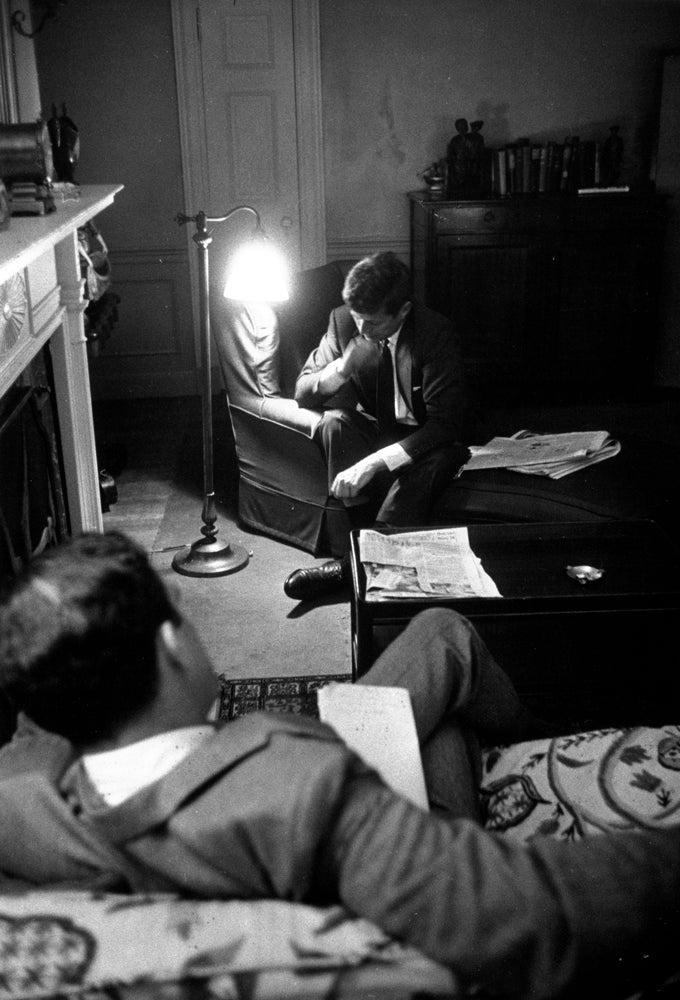

The current resident of Apt. 36 is Jack King, a former producer at WBOS radio station who now works in the stock market. King’s home is like a gallery, lined with family photos, memories, and artwork. His living room shelves showcase some memorabilia of Kennedy, including books, old photos, and a small bust statue of the former president.
King moved there with his two daughters in 2004, after living in a one-bedroom unit across the hall. Even though he’s been living there 20 years, he still gets a surreal feeling in the apartment every once in a while, remembering that Kennedy’s presence was once there, too.
“Shaving in front of the same mirror he did. Showering clearly where he used to shower. I get a feeling about that — that’s my favorite part about living here,” he said.
He often sees tourists that take pictures outside the building, and he has given many of them the opportunity to see the apartment.
“They can’t believe it. Normally they’re older, and they really remember JFK,” King said. “I’m happy to do it.”

Get everything you need to know to start your day, delivered right to your inbox every morning.



To comment, please create a screen name in your profile
To comment, please verify your email address
Conversation
This discussion has ended. Please join elsewhere on Boston.com