
Even on-time Red Line trains are overcrowded at rush hour
MBTA officials outlined the challenges facing the Red Line Monday.
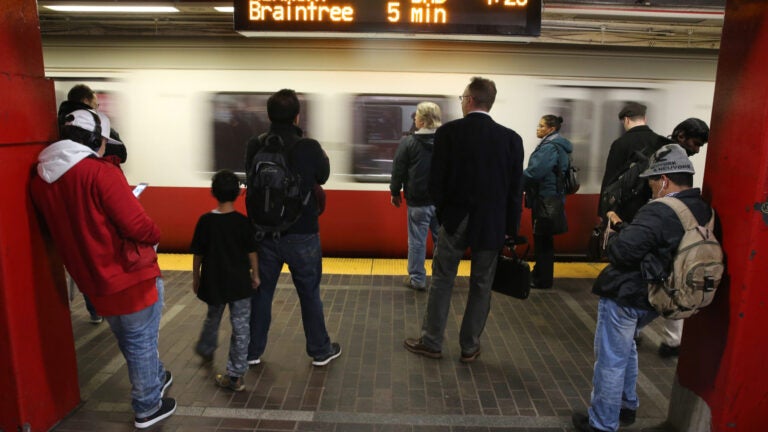
It could be a good day, absent the service disruptions and infrastructure failures its commuters are used to, and the Red Line will probably still be overcrowded at rush hour, transit officials said Monday.
“Even on those days when everything is working…our usage is certainly above [planned capacity],’’ MBTA Assistant General Manager Charles Planck told the agency’s control board during an afternoon meeting. “Probably everybody in this room has been on a Red Line train that they thought was way too crowded.’’
Under ideal morning Red Line rush-hour conditions—a blessing withheld from Monday commuters—a train should arrive at a station every 4.5 minutes on average, with a planned capacity of about 1,000 riders at a time, Planck said. But demand is greater than that, causing trains to crowd at several stations along both the northbound and southbound routes.
The T’s service plan calls for individual cars on Red Line trains to carry up to 167 people, but they sometimes wind up carrying as many as 200, Planck said.
“Some of the people are actually getting onto the train. … They squeeze on anyway and they go on their way,’’ he said. “Other people may be passed by by a train. You may be passed by by more than one train.’’
Red Line trains miss their expected arrival times by more than a minute about 25 percent to 30 percent of the time. That’s due to a number of reasons, Planck said—everything from infrastructure issues to medical emergencies. While the delays cause further crowding, capacity issues can also play a role in causing further delays: Trains are forced to dwell longer at stations because of the crowding and the resulting boarding patterns.
Meanwhile, the Red Line is in a period of growth. According to Planck, since 2008, Red Line ridership has risen about 2 percent per year on weekdays and even higher on weekends. The rest of the MBTA has seen annual ridership growth increase by about 1 percent per year, he said. Ridership at some Red Line stations has spiked by more than 20 percent since 2008, with ridership at the Ashmont station almost doubling due to nearby development.
Overall, 22 percent of the T’s ridership uses the Red Line, and the four most popular MBTA stations are all on the Red Line, Planck said.
“Capacity to be able to handle ridership growth is an issue for the authority across all of our lines,’’ MBTA Chief Operating Officer Jeffrey Gonneville said after the meeting.
Gonneville said the T will later present the board with “creative’’ solutions to the capacity issues from an “operational standpoint and management standpoint.’’ He said the presentation Monday was also meant to begin a discussion about repair and maintenance investment into the line to further address capacity issues. The Red Line accounts for $1.5 billion of the MBTA’s overall $7.3 billion repair backlog, according to Planck.
New Red Line trains, scheduled to enter the system in a few years and replace trains from the 1960s and 1980s, could help improve on-time performance, Gonneville said. But he said those gains could be negated if trains that entered the fleet in 1993 need to be taken out of service for repairs once the new trains arrive.
The presentation on the Red Line was the first of several upcoming presentations meant to brief board members on the status of each transit line. A presentation on the state of the Green Line is planned for next week.





To comment, please create a screen name in your profile
To comment, please verify your email address
Conversation
This discussion has ended. Please join elsewhere on Boston.com