
It’s one of this year’s hottest holiday gifts. But using it in public is illegal in Boston.
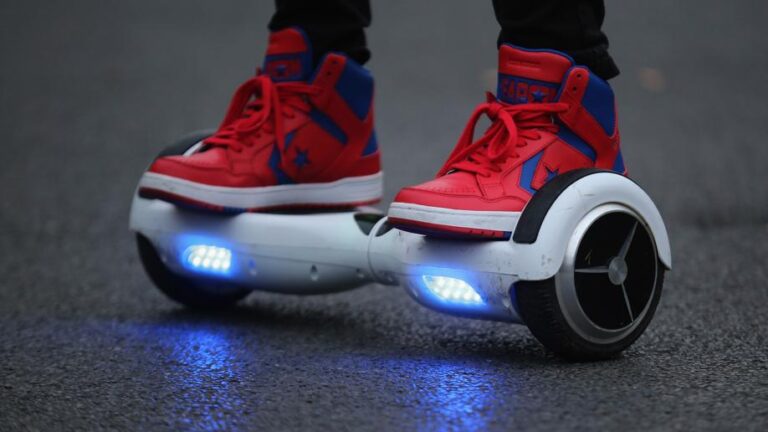
Hoverboards are the hot new holiday item, with celebrities like Justin Bieber and Jamie Foxx endorsing various models of the trendy personal transportation machines.
But parents considering spending several hundred dollars on one should beware: Public use of hoverboards is almost certainly illegal in Boston thanks to a 2011 ordinance.
Despite safety concerns and product recalls, the electric propulsion devices best described as distant cousins of the Segway are rising in popularity. As such, some schools, cities, and states are beginning to discuss regulations regarding their use.
MIT police recently emailed the student body concerning an “unprecedented increase’’ of students using wheeled devices in the halls, warning them they could be subject to a fine. On the other end of the spectrum, the state of California recently passed legislation to allow the use of hoverboards in designated bike lanes, according to The New York Times.
One place where the law surrounding hoverboards is crystal-clear, however, is Boston. Thanks to an ordinance proposed by Boston City Councilor Salvatore LaMattina in 2010 and passed by the Council in 2011, the use of electrical personal assistive mobility devices (EPAMDs) is prohibited on public property: this includes streets, sidewalks, parks, plazas, and bike paths.

The ordinance was passed largely due to of Boston residents’ concerns about Boston Gliders, a company that offered Segway tours throughout the city.
“I think it’s dangerous for the city and someone’s gonna get hurt,’’ LaMattina told WBUR in 2010. “The issue is safety for me.’’
Councilor LaMattina’s office was unable to provide a comment for this article.

Of the five-page ordinance, the majority of the provisions are devoted to issues regulating Segway tourism companies rather than individual riders. Shortly after the ordinance passed, police issued $25,000 worth of citations in a three-week period to Boston Gliders.
Nevertheless, the letter of the law is extremely clear, and the various hoverboard brands definitely qualify as “a self-balancing device with two wheels not in tandem, designed to transport only one person by an electric propulsion system,’’ as the ordinance defines the prohibited vehicles.
Under current law, individuals can be fined $50 for a first offense and $100 for a second offense. At the time of this article’s publication, the Boston Police Department had not returned a request for commen as to whether they intended to issue tickets for a hoverboard’s public use.
But parents thinking of purchasing a hoverboard should know that cruising through Boston Common could put riders on the wrong side of the law.
The ultimate Boston walking tour:
[bdc-gallery id=”116204″]



To comment, please create a screen name in your profile
To comment, please verify your email address
Conversation
This discussion has ended. Please join elsewhere on Boston.com