
How Boston inspired the marathoner who skipped a tampon to teach a lesson
Kiran Gandhi lived in Boston while attending Harvard Business School, and felt motivated by this city’s energy while running in the London Marathon.
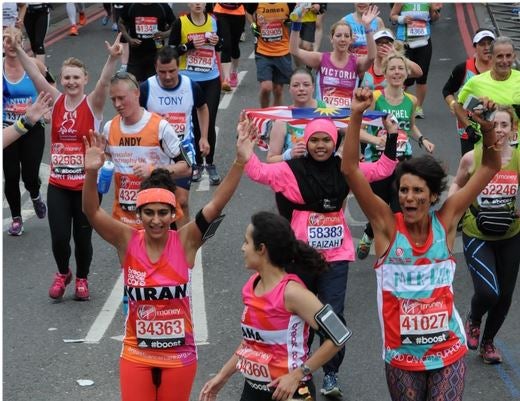
“When I first moved to Boston, one of the most immediate things I noticed was how often and how much people run,’’ said Kiran Gandhi, the London Marathon runner who made headlines for running during her period without a tampon.
“It’s inspiring, and honestly that gusto, that Boston Strong, Boston don’t give a f—, Boston can make whatever they want happen—that energy was with me on the marathon course when I got my flow,’’ she said in an interview.
Gandhi is proud to be a woman. On her site, she writes about her goal to “combine her intellectual and musical talents in order to re-imagine a music industry that is healthier for women and girls around the world.’’ Gandhi toured internationally as M.I.A.’s drummer the same year that she was accepted to Harvard Business School.
Though she prepared for the marathon for a year, she didn’t prepare for the possibility of getting her period right before the race. Noticing that her it was her “time of the month,’’ she initially felt that familiar sense of shame women all around the world know too well. She felt the need to hide it. But she also knew her situation was different.
“I knew that I was lucky to have access to tampons etc., to be part of a society that at least has a norm around periods,’’ she wrote about the experience.
Not all women have access to tampons and pads. More than 40 million women in the United States live on the brink of poverty, and sanitary products, which average $70 a year, aren’t covered by food stamps (though some lingerie and shoe stores accept EBT).
For homeless women, getting their period can be more of a challenge than getting a meal or finding shelter. Tampons and pads are often at the top of the list of homeless shelters’ needs. In countries like India and Uganda, getting your period often means missing school due to a lack of sanitary pads, and a society of shame that bullies young women for what is natural about their bodies.
Gandhi considered that she might be “a crazy chick’’ for skipping a tampon during her run, but settled on considering herself “a liberated boss madame who loved her own body, was running an effing marathon and was not in the mood for being oppressed that day.’’
In a post on Medium, Gandhi referenced Rupi Kaur, an artist whose photograph showing menstrual blood leaking through her sweatpants was removed from Instagram, twice.
[fragment number=0]
Gandhi suspected she would face less backlash.
“You can’t tell a marathoner to clean themselves up, or to prioritize the comfort of others,’’ she wrote. “On the marathon course, I could choose whether or not I wanted to participate in this norm of shaming.’’
Gandhi isn’t the first woman to run a marathon with blood running down her legs. In 1996, Uta Pippig of Germany won the Boston Marathon, and was photographed crossing the finish line, bodily fluids and all. Though initially thought to be menstrual-related, the blood was caused by “ischemic colitis,’’ or inflammatory bowel disease, with which she was diagnosed with after the race.
That was Pippig’s third Boston Marathon win in a row, making her the first woman to accomplish that feat.
“I just channeled that Boston energy and was like, ‘Well, you have a couple options here,’’’ Gandhi said. “Just be strong enough to choose the option that’s best for you and go for it.’’
The Boston Marathon through the years
[bdc-gallery id=”138482″]





To comment, please create a screen name in your profile
To comment, please verify your email address
Conversation
This discussion has ended. Please join elsewhere on Boston.com