
No Charges Filed in the 2014 Fatal Back Bay Fire. Here’s Why
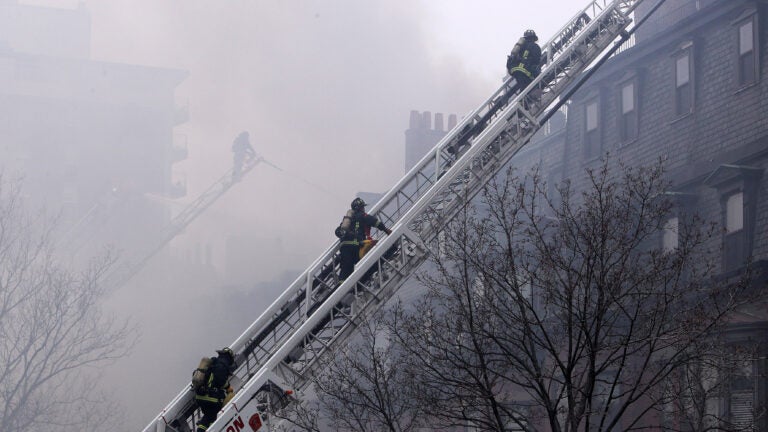
On a Wednesday afternoon in March 2014, two metalworkers from a Malden ironworks company arrived at a 10-story condominium building in the Back Bay to install wrought-iron railings. Just hours later, an adjoining building was engulfed in flames. Two firefighters, Edward Walsh and Michael Kennedy, died trying to rescue people.
Investigators would spend the next year trying to determine whether the D&J Ironworks employees should face criminal charges for the fire. Dan Conley, the Suffolk County district attorney, released his findings Tuesday and said that, while the employees acted carelessly, they did not act recklessly.
They will not be criminally charged.
“Edward Walsh and Michael Kennedy made the ultimate sacrifice while saving lives and property from a fire that engulfed an entire building in the middle of a residential neighborhood,’’ Conley said in a press release. “This decision in no way detracts from the bravery of their actions or the tragedy of their loss.’’
The investigation, which was conducted by Boston Police homicide detectives, and the joint fire investigation unit of the Boston Police and Boston Fire departments, also included a legal analysis by the DA’s chief homicide prosecutor and attorneys with special training in arson prosecutions. The report described how the fire on March 26 started, and why, even though two firefighters died, no charges will be filed.
The Boston Firefighters Local 718 and Professional Firefighters of Mass released a statement, obtained by WBZ NewsRadio, that said, “we feel the decision not to charge the workers performing the hot work is based on sound legal application of existing law in the Commonwealth. Although the workers did not intend to start the fire, it highlights the need for a certified and trained workforce, proper permitting, and enforceable oversight punishable by severe fines or imprisonment.’’
Here are the findings:
How The Fire Started
The employees brought pre-fabricated wrought-iron railings to install in the rear of the building. But one of the railings didn’t fit. The report says one worker cut, ground, and welded the railing at the scene while his coworker “held a piece of wood in place to contain the sparks.’’
At some point, authorities said a spark from the work traveled to an old, dry wooden shed sticking out from the building. Because of its condition, the shed lit up like a match when struck by the spark. It burned unnoticed.

A firefighter holds onto a ladder after flames from the third floor window hit him in the face and caused him serious injury.
The fire burned for at least a half-hour before the employees smelled something and saw smoke drifting up from where the shed attached to the building’s brick exterior, according to the report. The investigators determined the workers tried to stop the blaze with snow instead of using the fire extinguisher inside their truck. The report said their failure to use the extinguisher likely did not have any effect on the fire’s spread, as it had been fueled by strong gusts of wind while it went unnoticed.
The workers told investigators they yelled to tenants on the rear fire escape to warn them of the blaze. Witnesses said they heard the men yelling from the rear parking lot.
The workers said they did not call 911 because they said they had no cell reception. Investigators proved they were telling the truth by looking at text messages the men attempted to send to their employer when they weren’t able to get service.
When they responded, Walsh and Kennedy made their way down to the basement of the building, authorities said. A front window exploded, which intensified the fire and trapped the firefighters in the basement.
They sent out a mayday call.
Kennedy was pulled from the basement. He was later pronounced dead at the hospital. Because the fire was so extreme, Walsh’s body wasn’t recovered until almost five hours later. That day, 18 people were transported to the hospital with injuries related to the fire.
In the days following the fire, there were reports that the workers sped away from the scene. The investigation concluded they did not. Photo evidence showed they moved their truck away from the shed, but remained in the area long after firefighters responded. A firefighter also remembered seeing a man in a jacket similar to the ones the workmen were wearing waving him toward the rear of the building.
Why Investigators Aren’t Pressing Charges
No one accused the workmen of setting the fire on purpose, which meant the prosecutor needed to determine whether to charge the men with involuntary manslaughter. A charge of involuntary manslaughter requires proof beyond a reasonable doubt that the defendant knew a risk of death or serious injury was apparent, and chose to willingly run that risk rather than change his actions.
The prosecutors considered the outcome of three fatal fire cases when making their decision:
• Commonwealth v. Welansky came about because of the Cocoanut Grove nightclub fire in which almost 500 people died. In that case, even though the busboy accidentally started the fire, the owner, who ordered the fire exits locked shut, was convicted. This case eventually led the Massachusetts Supreme Court to declare in 1944, “There is in Massachusetts no such thing as criminal negligence.’’
• Commonwealth v. Huang resulted in the conviction of a building owner and property manager after a father and two young children died in a 2009 Quincy house fire. Evidence showed that the building employees were warned repeatedly that their residents were endangered because the building had no smoke detectors, and one of them responded by saying, “I don’t care.’’
• Commonwealth v. Levesque followed the Worcester Cold Storage tragedy of 1999. The defendants were men living in the abandoned warehouse, who were indicted not for accidentally starting the fire, but for knowingly failing to report it. Six firefighters died while searching for them inside. The defendants were not convicted of any crime.

Kathryn Hencir of Cambridge drops off flowers outside the Boylston Street station.
“The D&J workmen’s actions were fundamentally different from those of defendants in these cases,’’ Conley said in the report. “We cannot in good faith seek criminal charges for an accident, even one with consequences so tragically devastating. Some 60 years of Massachusetts jurisprudence have made clear that negligence, even gross negligence, is in the hands of our civil courts.’’
In addition to involuntary manslaughter, prosecutors considered charging the workers, and potentially their employer, with a criminal violation of the state fire code because they didn’t obtain a permit for the metalwork they did at the scene. But, according to the report, this also would’ve required “proof of wanton and reckless conduct.’’
And, while welding would have required a permit, grinding would not, according to the report.
Because of the scale of the fire, investigators said they can never know for sure which action — the welding or the grinding — led to the blaze.


To comment, please create a screen name in your profile
To comment, please verify your email address
Conversation
This discussion has ended. Please join elsewhere on Boston.com