
The secret life of Boston’s street corner fire alarm boxes
Boston’s telegraph-based fire alarm system predates the telephone and is still in use today.

All over the city of Boston, red fire alarm boxes stand on street corners in every neighborhood.
The boxes are such a ubiquitous part of our urban landscape that it’s easy to forget they’re there and still work, using technology that dates back to the 19th century.
When Boston turned on its fire alarm telegraph system on April 28, 1852, it was the first of its kind in the world, making its debut more than 20 years before Alexander Graham Bell was granted his patent for the telephone.
Remarkably, that telegraph system continues to serve city residents today, much as it did when it first came online 174 years ago.

‘NO LANGUAGE BARRIER’
Because it operates separately from electric and telephone lines, the system isn’t affected by power outages or downed phone lines. If there were ever a major disaster that knocked out power so people couldn’t charge their cellphones, the boxes would still work, providing a critical link to emergency services.
The red fire boxes are also simple to operate.
“When you pull the fire box, you don’t even talk to anybody,” said Mario Colucci, 65, whose job is to fix fire boxes that are in need of repair. “There’s no language barrier … They just send the fire trucks. Right then they know there’s a problem, whatever it may be.”

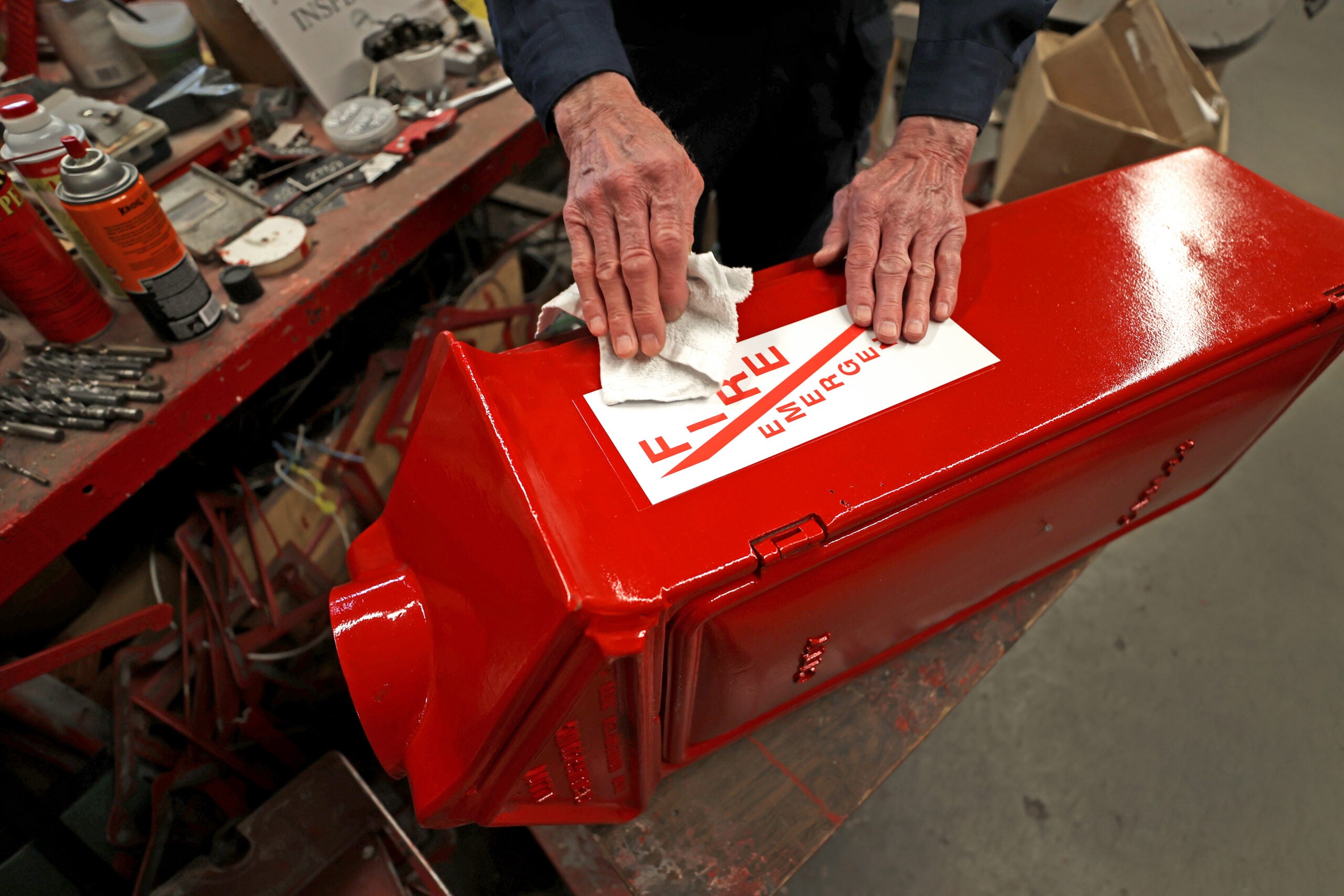
There are currently approximately 1,250 fire alarm boxes on Boston’s streets, and another 1,200 so-called “master boxes” that are connected to schools, hospitals, libraries, and other public buildings, according to Colucci, who works in the machine shop at the Boston Fire Department’s headquarters on Southampton Street.

HOW THE BOXES WORK
If you find yourself in an emergency, go to the nearest fire box. They can be found on free-standing pedestals underneath glowing red lamps and on telephone poles across the city. The first thing you need to do is pull the white handle down so the operating lever is exposed. Then push that lever down.
Every fire alarm box has a designated number that pinpoints its location. When the lever inside the box is pressed, it activates a mechanism that transmits the number via telegraph signal through underground cables to the Boston Fire Department’s central alarm office, which is housed in a fortress-like building on the Fenway.
Years ago, those telegraph signals appeared as punch-outs on a ticker tape, and dispatchers at the office had to decode them by counting the number of holes in the tape. Today, it’s much easier: the specific box number appears on a computer screen, so dispatch can send out firefighters from the nearest station to respond to the call.
Colucci is part of a team of 13 people who maintain the city’s network of street boxes. Fire alarm boxes that are damaged are brought to his workshop for repair. (One of the most common causes of damage? Motor vehicles crashing into them, said Colucci.)
Boston has continued to maintain its historic fire alarm box network, even as many other cities and towns have abandoned theirs.
Washington, D.C., stopped using its fire alarm boxes in the 1970s, and other major cities — including Atlanta, Baltimore, Dallas, Los Angeles, Philadelphia, Pittsburgh, and St. Louis — have done the same.

In Massachusetts, the city of Salem announced earlier this year that it would be decommissioning its 19th-century fire alarm system because it was deemed to be obsolete and too expensive to maintain. The city of Lynn had its fire boxes removed a few years ago, according to Chief Daniel Sullivan.
But even in today’s age of cellphones, GPS, and enhanced 911, fire officials in some places still rely on the old system of street-corner fire boxes.
Boston is one such example, as is New York City, which still has approximately 15,000 fire alarm boxes that are still in operation, according to the New York City Fire Museum.
Fire boxes also continue to be used in Dedham, Cambridge, Brockton, and Quincy.
Quincy Deputy Chief Kevin O’Connor said the biggest problem in his city is the false alarms. “People come by and pull it maliciously,” he said. “But it’s not common, it’s rare.”

STILL WORKING AFTER ALL THESE YEARS
Boston fire officials say the telegraph-based alarm system has proven to be reliable in times of need.
For example, when the entire 911 emergency phone system went down across Massachusetts for several hours one day in June 2024, Boston’s fire alarm boxes were still functioning, and Boston Police Commissioner Michael Cox made a point to remind people about that.
“If you’re having any issues, you know, medical-related or EMS or fire-related, you can go and pull your local call box,” Cox said at a news conference at the time.
During another 911 outage on Dec. 28, 2018, someone used a fire alarm box at the corner of Endicott Street and Cooper Street in Boston’s North End to report a fire.
Colucci said it’s also important to remember that fire boxes can be used for any type of emergency, not just fires.
“If you feel threatened, if there’s a car accident, anything … pull the box,” said Colucci.
Globe correspondent Hannah Goeke contributed to this report.



Be civil. Be kind.
Read our full community guidelines.To comment, please create a screen name in your profile
To comment, please verify your email address