
Amid slowdown, developers set to sell part of dormant Dorchester megaproject
The development team bought 2 Morrissey Blvd. in 2019 for $110 million. Now they’re putting it up for sale.
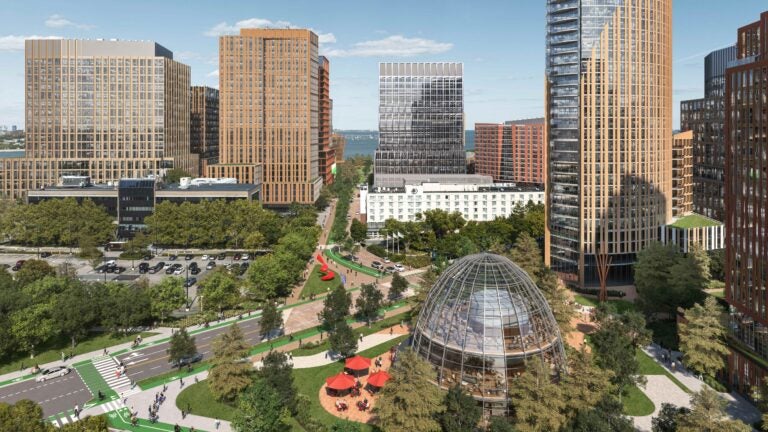
On a cold February day seven years ago, top officials from the University of Massachusetts system gathered at the UMass Club high atop One Beacon Street to announce a deal that would inject hundreds of millions of dollars into UMass Boston’s aging campus and promised to create a new mini-city along Dorchester Bay. It was “like the first day of the rest of our lives,” UMass Boston’s interim chancellor said at the time.
Accordia Partners, led by veteran developers Richard Galvin and Kirk Sykes, had agreed to a $235 million, 99-year ground lease of the 20-acre former Bayside Expo Center on Dorchester’s Columbia Point. Soon after, the developers and their investors would add two neighboring parcels — the Boston Teachers Union Headquarters, and a blocky low-rise bank office across the street — and pitch a truly mammoth project: 21 buildings, with close to 2,000 apartments and millions of square feet in laboratory space. A $5 billion investment in all.
Even by fall 2023, when city officials gave their OK, the region’s lab boom had begun to temper. Since then, a glut of vacant lab space has swelled, while the cost to build housing has surged beyond the rents new buildings can command. Amid a broad development slowdown, construction has yet to begin at Dorchester Bay City. And now, its developers are dramatically scaling back their plans, putting a big chunk of the site back up for sale.
Accordia recently tapped brokerage firm Newmark to sell about one-third of Dorchester Bay City’s real estate, a 13.6-acre parcel at 2 Morrissey Blvd., according to a marketing brochure obtained by the Globe. Newmark touts 2 Morrissey, as a “transformative mixed-use development opportunity,” and notes the city has approved 2.4 million square feet across eight buildings as part of the overall Dorchester Bay City master plan. Ares Management Corp., Accordia’s financing partner, spent $110 million to buy 2 Morrissey in 2019, and later took out an $85 million mortgage on the property, according to Suffolk County records.

Accordia says it’s still fully committed to Dorchester Bay City on the waterfront Bayside site, where the city has approved 13 buildings and 3.7 million square feet of residential, lab, office, and retail space. They’re still planning extensive infrastructure improvements and much-needed climate defenses on the site, including elevating it several feet to help prevent storm surge from washing into low-lying neighborhoods nearby. Accordia has also committed $25 million for transportation improvements, notably for nearby Kosciuszko Circle.
The 2 Morrissey Blvd. site wasn’t part of Accordia’s initial vision for Dorchester Bay City, and the developers folded the property into the project at the city’s request, Galvin said in a statement Tuesday. What’s more, he said, there’s no guarantee that Accordia will actually sell the site.
“Our investor group believed it was the right time to determine if 2 Morrissey — both as an operating asset and a permitted development site — was of interest in the larger market,” Galvin said. “We remain excited about the vision for Dorchester Bay City and are confident that the fundamental design of the project as permitted allows for flexibility to move forward in even a complex commercial real estate market.”
A sale would not directly affect Accordia’s deal with UMass Building Authority, which is set to generate between $192 million and $235 million, depending on what exactly is permitted on the site. The 2 Morrissey site is outside that agreement, and selling it does not impact the lease, said Christopher Dunn, UMBA’s executive director. Though the ground lease has not yet been finalized, Accordia has paid $32 million in fees and deposits since 2019, Dunn said.
“The agreement to lease is currently still open and UMBA looks forward to continuing to work with the developer to execute on the 99-year lease,” he said in an email.
Still, it means that if and when the 2 Morrissey project goes forward, it could be under different hands. Accordia’s initial plans there called for office, housing, and research labs, including a 306-foot residential tower where a low-rise bank office building, partially leased by Bank of America until 2030, now stands.
It was not immediately clear how much Ares and Accordia could expect to generate from selling 2 Morrissey, nor any timeline for a potential deal. Though Greater Boston is routinely among the most expensive markets in the country for new construction, it’s an especially difficult environment to build right now, industry experts say. Demand for new life-science lab space is thin, and the specter of rent control has some investors shying away from new housing here as well.

And while Accordia says it remains committed, it’s not fully clear what a sale of 2 Morrissey might mean for the broader Dorchester Bay City project. The city-approved master plan allows 6.1 million square feet across 36 acres — and that master plan still applies to the full site, regardless of owner, a spokesperson for the Boston Planning Department said. If a new or existing owner wanted to change the approved master plan, they’d have to pitch alterations to the city and hold a public meeting.
Just two of the eight buildings on the 2 Morrissey Blvd. tract are approved for housing, but Newmark’s brochure indicates that a new owner could pursue a different mix of uses for the site.
“Final site planning provides flexibility to further emphasize residential uses, allowing for greater multifamily allocation as the project is finalized,” the brochure states. “These will be surrounded by a brand-new network of streets, sidewalks and bicycle lanes, open spaces and other public realm improvements to both create a vibrant live-work-play environment and integrate the project with the rest of Dorchester Bay City.”




Be civil. Be kind.
Read our full community guidelines.To comment, please create a screen name in your profile
To comment, please verify your email address