
In a region desperate for fresh retail, Bow Market is ‘a total unicorn situation.’ Why?
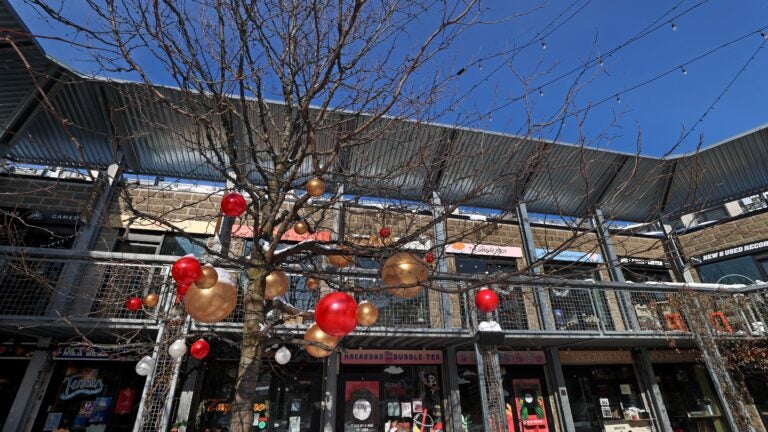
SOMERVILLE — In 2016, Zachary Baum and Matthew Boyes-Watson walked into Somerville City Hall with an unorthodox vision: to transform a vacant, U-shaped garage nestled behind a Union Square alleyway into a bustling bazaar of shoebox-sized storefronts called Bow Market.
The pitch raised plenty of eyebrows among the regulators, financiers, and neighbors whose buy-in they needed. But nearly a decade later, their big dream for that former concrete wasteland has turned into a thriving, constantly changing hub of more than two dozen entrepreneurs that hasn’t seen a vacancy longer than a month in over two years, according to Baum. Patrons brave even the bitterest of temperatures to cozy up at the Nook cocktail bar, browse zero-waste products at Green Tiger & Co., or try their luck at Pop’s Pinball Parlor.

“One of my friends says Bow Market’s the center of the universe,” said regular patron Sam Farnsworth on a recent Friday.
Somewhere between a small business incubator, a food court, and a European-style piazza, Bow Market stands as a bright spot in the Boston area’s brick-and-mortar landscape — a stark contrast to the struggling food halls and shopping malls dotting the region. But even in a region desperate for fresh retail and commercial real estate concepts, Bow Market remains just about as singular as it was when Baum and Boyes-Watson — two local thirty-somethings who run the market full time — pitched it a decade ago. That’s because all the things that make Bow the draw that it is, from its quirky use of real estate to its unique vendor mix, are also what can make it so challenging for homegrown projects like it to get all the “yeses” they need to come to life.
“There are people like us in every neighborhood and every downtown,” said Boyes-Watson. “All of these projects dance on a knife’s edge. All of them do. If you made it slightly easier, you might trip someone over into saying, ‘I’m doing this,’ versus not doing it.”
In the years since the pair founded Bow, construction costs have gotten pricier, and the financing environment is tougher. But the Bow Market founders said the far more crucial and elusive ingredient is flexibility from city hall on jumping through the legion of regulatory hoops.
“Something like this does need a champion in the local government, I think, to get it done,” said George Proakis, Somerville’s former planning chief and now the city manager of Watertown. “It’s not the thing your average zoning officer has seen.”
Proakis worked with Baum and Boyes-Watson to jigsaw the project into being, while still ensuring it wouldn’t be “locked in amber,” Baum said, and that it could evolve over time.


But that sort of municipal patience for projects that aren’t one-size-fits-all can be fleeting, the pair said.
In 2023, Bow said it would expand by about 6,000 square feet, spilling out onto Somerville Avenue. By the time it announced the expansion, Somerville had revamped its zoning code, and both Proakis and former Somerville mayor Joseph Curtatone, another supporter of Bow, had left City Hall. Baum and Boyes-Watson got the expansion done, but the whole process felt more complicated than just a few years earlier, they said, in a way that they believe would be all but impenetrable for others aspiring to create similar projects without the deepest of pockets.
“I think if we tried to do it today,” said Boyes-Watson of Bow, “we would have a way harder time.”
Part of the goal of Bow, its founders say, is for the markets’ triumphs to ripple outward to the local economy. Since opening in 2018, Bow has seeded the area with a bevy of its “alumni” who have graduated to their own standalone storefronts. But without the regulatory wiggle room granted to Bow’s owners, some of those businesses might never have opened in the market.
“I actually had absolutely no interest in opening a brick-and-mortar,” said Lauren Friel, the owner of Bow’s Rebel Rebel wine bar.
Vendors have been drawn to Bow by a few different factors: the relatively affordable rent (from about $1,300–$5,000 a month for most spaces); the manageable amount of inventory it takes to fill the storefronts (as small as 155 square feet); and the lease length (as short as a year, compared to five-year commitments common at other commercial spaces).
What ultimately sold Friel, however, was the fact that the market vendors were able to share a liquor license.
“There was just no other opportunity that existed anywhere in the city that didn’t require a half-a-million dollar investment,” she said.
Three James Beard Awards nods and two new wine bars later, she still maintains she never would have become a proprietor had it not been for Bow, which she described as “a total unicorn situation.”

Those unicorns don’t always materialize. Boyes-Watson was also part of the team behind Starlight Square, a temporary pandemic-era space that opened in 2020 to host performances and small business markets on a municipal parking lot in Cambridge’s Central Square. Cambridge later awarded the team $500,000 in American Rescue Plan Act funding to go toward developing a permanent civic space modeled on Starlight.
“That would have been another Bow Market,” said Mark Boyes-Watson, Matthew’s father and the architect behind Bow and Starlight.
But as a 2024 city report recommended the Starlight site be developed into “a mixed-use building” — with housing, retail, a public plaza, and performance space — Cambridge reallocated Starlight’s funding to another arts-focused applicant. Starlight’s temporary structure soon shut down.
Later that year, the city put out a “request for information” seeking redevelopment ideas for the site. It got six responses, but progress has since been quiet.

“The City remains deeply committed to activating Central Square and making it a place the community gathers,” City of Cambridge spokesperson Jeremy Warnick said in an emailed statement.
A new project in Lowell is a testament to what can happen when all the stars align. After the owners of Mill No. 5, an eclectic indoor bazaar, announced in late 2024 that the market would close, some of the vendors banded together to find a new home.
“We didn’t know what it was called yet, we didn’t know where it was going to be, but we were very excited to do it on our own, because we knew we could manage it and we could make it happen,” said Jennifer Simone, who ran the artist collective Hive & Forge in Mill No. 5.
The business owners turned to the city, which offered funds and other support. In November, within a year of Mill No. 5’s closure, the newly formed Hive Public Market debuted in a 13,775-square-foot space on the ground floor of Lowell’s historic Hildreth Building. The market’s dozen or so shops — selling everything from video games to stationery to kitchenwares — are a mix of vendors from Mill No. 5 and new entrants.
“The owners are really the people that were making this happen,” said Thomas Golden, Lowell’s city manager. “We, the city, stood behind getting to ‘yes.’”


Back at Bow, many vendors, along with other observers, said the market’s special sauce is Baum and Boyes-Watson themselves.
“They’re a uniquely determined group of people, both to set this up and to continue to run it for all these years,” said Proakis.
Vendors said the pair are near-constant fixtures at Bow, as likely to work with entrepreneurs on a storefront expansion as they are to shovel snow in the courtyard.
“They really wanted, I think, to create a space that felt like a place that they wanted to be at,” said Brittany Lajoie, general manager at Remnant Brewing, the market’s anchor. “An owner, operator, developer who actually has a personal stake definitely feels different.”
The pair said people occasionally reach out looking for advice on developing similar concepts in other neighborhoods. More often, though, they’re approached by people who want them to helicopter into a new area and create Bow 2.0. It’s a request that, the pair must break to them, is futile.
“The folks that are going to be able to do this are the people that exist already in a community,” said Baum. “Don’t call us to come down to Dorchester and do it again. That doesn’t work. We don’t live there.”





To comment, please create a screen name in your profile
To comment, please verify your email address
Conversation
This discussion has ended. Please join elsewhere on Boston.com