
After ambitious state law, Lexington welcomed a wave of new housing. Now people there are having second thoughts.
LEXINGTON — For centuries, one of the tallest points in this town’s historic center has been the old wooden tower on Belfry Hill, whose bells rang out at the start of the battles that began the Revolutionary War.
Soon, the belfry may have a more modern neighbor, almost as tall: a four-story mixed-use development that will include more than 50 new homes.
The new building still requires approvals from a few municipal boards, including the town’s historic districts commission. But if all goes to plan, it would pave the way for a building that, to many, symbolizes the change suddenly sweeping through a community whose identity is tied to events of 250 years ago, and the preservation of it.
Lexington is set to add around 1,600 new apartments and condominiums in the coming years, turning this community of 35,000, which has built little in decades, into the state’s new housing boomtown.
All of those new homes are the result of the ambitious plan Lexington passed in 2023 under the state’s MBTA Communities Act. Even as other towns in Massachusetts mulled rebellion, affluent, liberal Lexington became the first place to pass new zoning rules under the law — allowing tall, dense buildings in key parts of town — and won plaudits from advocates, state officials, and even a glowing article in The New Yorker.
But the reality of so much growth so quickly is, well, complicated.

Once-enthused residents are now grappling with what it means to help lead the state out of a deep housing shortage. There are worries about overstuffed schools and strained roads. The prospect of new apartments in the town’s treasured historic district has been particularly jarring to some. And last year, Lexington Town Meeting voted to roll back the MBTA Communities zoning, slowing the flow of new projects to a trickle.
“I am all for us playing our part in solving the state’s housing issue,” said Tina McBride, a Planning Board member who helped lead the rollback effort. “Things and places are always going to change, and that can be a good thing. But there is such a thing as too much growth.”
Alan Levine has lived in a small home on Reed Street since the 1980s. He knows every corner of Lexington. And on a recent drive through town, he could point out every parcel that is slated for redevelopment.
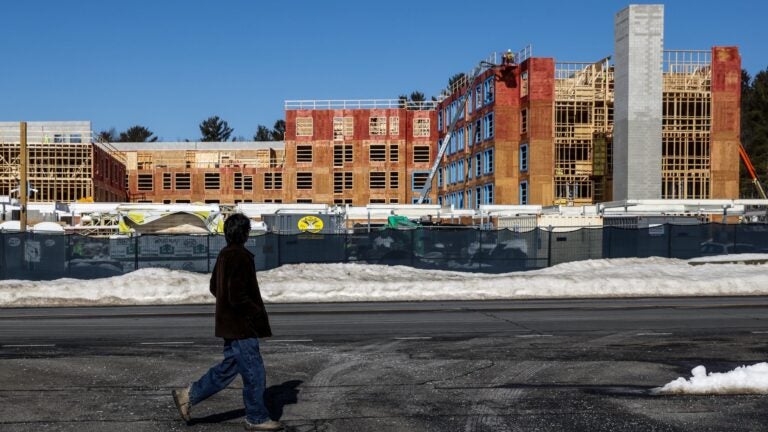
He passed two squat commercial buildings on Bedford Street, next to his dentist’s office, that will soon become 25 apartments. A few blocks away, an old single-family home surrounded by a parking lot will become seven condominiums. A little-trafficked office park a few minutes from Lexington Center is going to be demolished in favor of nearly 300 apartments. And wood framing is already up on a building that will house more than 300 apartments among the low-slung office parks of Hartwell Avenue.
“Lexington is changing,” Levine said. “It’s all happening very quickly.”
The stage was set in spring 2023, when officials and well-known residents pushed forward a plan that would rezone 227 acres, including parts of Lexington Center and old office buildings near Route 128, allowing heights up to six stories with few restrictions on density. They estimated the plan would generate between 400 and 800 new units over a decade, a move, they said, that would position the town as a progressive leader on one of the state’s most intractable problems.
“This is a chance for Lexington to lead,” Mike Kennealy, then the state’s secretary of Housing and Economic Development and a Lexington resident, said ahead of the Town Meeting vote on the plan. “Isn’t that what we want to do?”
Town Meeting passed the plan with more than 60 percent in favor. Renowned climate activist Bill McKibben, a Lexington resident, hailed the town in a New Yorker article: “A Massachusetts Town Leads a Way Out of the Housing Crisis.” Governor Maura Healey sent her personal congratulations.
But Lexington underestimated just how much demand there would be to build in Lexington. Developers big and small lined up with ideas for underused parking lots and key corners, and the new plan meant those buildings didn’t need special review. One of the state’s wealthiest suburbs — a place where the median single-family home price last year was $1.8 million — was suddenly wide open for development.
“We did not necessarily expect the market to react so quickly,” said planning director Abigail McCabe. “But the zoning was designed to create new housing. And in that respect, it was and still is successful.”
Today, more than 1,600 units are under construction, approved, or in the approval process in Lexington, all of them in multiunit buildings — a big shift from the sprawling single-family homes on large lots that predominate here. In the prior decade, Lexington had approved just two multifamily units.

Ask around, and most in Lexington will say they want to help Massachusetts dig out of its housing crisis. Everyone knows someone who is struggling with the high cost of rent. But when actual projects started to materialize, feelings began to shift.
Residents were alarmed when the condo development at 89 Bedford St. went before the planning board, fearing the project would disturb the character of the neighborhood and exacerbate flooding issues. But because the project was filed under the more permissive new zoning rules, there wasn’t much they could do about it.
Soon, there was a full-fledged push to dramatically scale down the zoning. Some residents claimed they’d been misled about the scale of what the plan allowed. Kennealy, now a Republican candidate for governor, has flipped his stance on the law and is on the campaign trail criticizing Healey’s enforcement of the guidelines he helped write while working in the Baker administration.
“People started seeing the reality,” said Lin Jensen, a Town Meeting member who was elected to the planning board on Monday. “The growth we’re seeing now is unplanned. We didn’t have any say in what got approved.”
The influx of new apartments added fuel to last year’s debate over whether to spend $660 million on a new high school, with some residents worried the school would not be big enough to hold all the newcomers. Still, voters approved the plan in December.
There were other concerns, too: Could Lexington’s roads handle so many new vehicles? Could the police force keep up? And who exactly are these fancy new buildings for? The cheapest condo at 89 Bedford St. is listed at $1.2 million.
Last year, Jensen helped lead an effort to roll back the plan, reducing the MBTA Communities zone from 227 acres to 90, and tightening density and height limits. Town Meeting approved it, 164-9, with five abstentions.

One of the nine who opposed the rollback was Kunal Botla, Lexington’s youngest Town Meeting member.
The 20-year-old, who also ran for Planning Board this month but lost, is among those who see all the new housing as a good thing. Yes, the growth is a lot to absorb all at once, he said, but Lexington’s previous strategy simply drove prices out of reach. New housing might actually benefit places like Lexington Center, which, for all its history, also holds a four-lane road, a sea of parking lots, and small commercial buildings whose tenants constantly turn over.
More housing would mean more customers, he said, and it would give more opportunity for people like him to stay and build a life in the town where they grew up. He, for one, sees a future for himself in town, perhaps in a studio apartment in that big project on Hartwell Avenue.
“Of course we want to be measured about our approach to growth,” said Botla, who is living with his parents while in school at Tufts University. “At the same time, it is important for places like Lexington to keep growing and changing, so people like me can live here and contribute to making it a better place.”





To comment, please create a screen name in your profile
To comment, please verify your email address
Conversation
This discussion has ended. Please join elsewhere on Boston.com