
‘My scientific career is essentially over.’ A brain drain imperils Massachusetts’ biomedical future.
In a first-of-its-kind survey, the Globe asked hundreds of scientists about the impact of federal funding cuts.
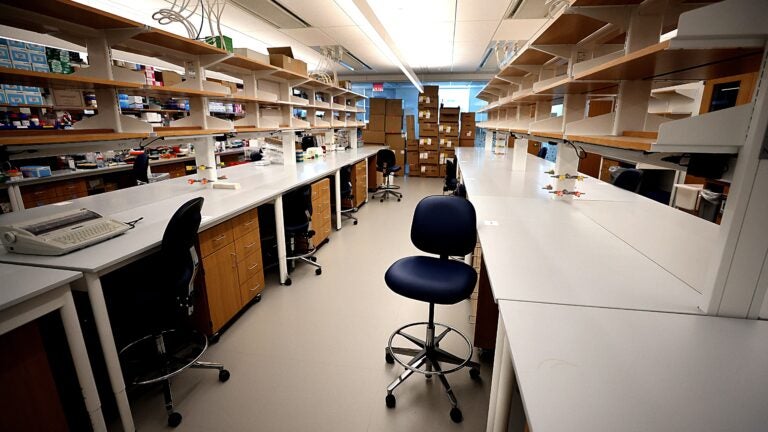
A prominent cancer scientist is uprooting his Harvard University lab of two decades and moving it to Texas. A laid-off expert on aging abandoned academia for a more secure municipal research job in New York City. And a women’s health researcher, exhausted by the churn of immigration policies, made the wrenching decision to start over in Canada.
Their departures illustrate a sobering new reality: The Trump administration’s research funding cuts, abrupt policy shifts, and crackdown on immigration are driving a brain drain that threatens Massachusetts’ standing as a global hub of biomedical research, its economy – and the fight against major diseases such as childhood cancers, Alzheimer’s, and sickle cell.
To better understand the impact of the cuts, the Globe partnered with MassINC Polling Group. Together they reached out to nearly 4,000 scientists who received funding from the National Institutes of Health. Ultimately 367 completed the survey, which MassINC’s president, Steve Koczela, described as a solid response rate.

The results were stark: Over two-thirds said they recommend their students consider careers outside academia. The majority had delayed hiring in their labs, and one-third had laid off workers. More than one in six said they have lost researchers to institutions in other countries since Trump took office. Sixty-eight percent said funding cuts and federal policy changes had moderately or significantly reduced the scope of their work.
The Globe spoke with more than two dozen of the respondents who said the cuts and policy changes had taken an incalculable toll on their professional and personal lives. Several expressed anguish over whether they would be able to continue their life’s work, given the political climate. Some said they were at a loss as to whether to tell young people to pursue their dreams of scientific careers.
The Globe emailed the survey over two weeks in December to NIH grant recipients from 2022 to the present, using public datasets. Reporters and editors consulted with opinion researchers, including Gillian SteelFisher, director of the Harvard Opinion Research Program, to craft questions. With no existing dataset capturing the full scope of what was happening inside Massachusetts universities and labs, the Globe survey sharpened the picture, revealing clear patterns in the pressures scientists face.
Asked how the cuts have affected science, one Boston Children’s Hospital researcher said, “This is like asking, how do you think dropping an atomic bomb on New York City will affect the future of Broadway musicals? This is a generational loss of innovation, technology, and economic power.”
The Globe’s poll numbers, combined with other recent data, raise questions about how the state’s scientific ecosystem will attract and retain the best and the brightest.
Setbacks to medical innovation in Massachusetts, long a cradle of the world’s cutting-edge science, could have global consequences. Researchers in Boston and Cambridge pioneered the world’s first chemotherapy for childhood leukemia, performed the country’s first successful organ transplant, paved the way for the polio and measles vaccines, and refined CRISPR gene editing, which is saving lives.
But now, it’s as if the scientists who responded to the survey are “calling out from inside a burning building,” said Koczela.
“We are seeing science policies playing out right now that are really terrifying,” said Harvard professor Sean Eddy, 60, who has long suggested that young researchers consider academic jobs overseas to broaden their perspectives but is now doing so with greater urgency. The molecular and cellular biologist worries his own NIH funding may run out in June, forcing him to lay off roughly half of the 10 scientists in his lab.

An exodus of scientists would harm the local economy, threatening small businesses, leaving apartments vacant, and prompting belt-tightening in households.
One in six survey respondents said they’d applied for jobs outside Massachusetts.
Just as it’s difficult to assess the damage after a bombing with the ground still smoldering, it is unclear how far-reaching the impact will be from the Trump administration’s year of yo-yo-like funding cuts, restorations, and threats to cut again.
Massachusetts research institutions lost between $47 million and $100 million in NIH funding last fiscal year compared to the year before, according to analyses by the Massachusetts Biotechnology Council and STAT, the Globe’s sister publication.
As a result, the Northeast had the most clinical trials disrupted out of any region in the country, one study showed. In Massachusetts, NIH funding disruptions affected at least 13,000 patients and 18 clinical trials on conditions including colon cancer, pregnancy complications, and strokes, according to a letter Governor Maura Healey wrote to Health Secretary Robert F. Kennedy Jr. last month to demand he restore all funding.
Healey said the Globe’s survey results confirm what she feared would happen – the administration is driving scientists to other countries, which are more than happy to embrace these highly skilled workers. Canada, for example, recently announced a $1.7 billion investment over 12 years to recruit researchers.
The actions by Trump and Kennedy threaten not just Massachusetts but the country, Healey said.
“We have people I know in labs who have been on the cusps, the cusps of treatments and cures,” Healey said. “Why would you take that away and kill hope for families who were looking for that cure for cancer, for Alzheimer’s, for Parkinson’s?”

To be sure, most of the money the Trump administration froze or cut in 2025 has returned to researchers and institutions, following court challenges. And Massachusetts still received the nation’s largest share per capita of NIH funds last year, about $478 for each resident.
Congress passed legislation last week that fully funded the NIH and bolstered protections from the Trump administration’s efforts to cut overhead costs.
But significant damage has been done, scientists said.
Uncertainty about the Trump administration’s plans going forward is driving institutions to tighten budgets and freeze hiring. Looming over them are the administration’s stated goals of redistributing more research grants to the heartland — a move many fear could lead to fewer dollars for Massachusetts and undermine one of the state’s major economic engines. Meanwhile, the administration’s new funding process means fewer grants are awarded, while its research priorities continue to shift.
“This is miserable,” said Rachael Sirianni, a biomedical engineer working on improving treatments for pediatric cancers at the University of Massachusetts Chan Medical School in Worcester. “Right now, looking forward, there’s no way to predict, and it makes it impossible to make choices and decisions about either the work that we’re doing or the professional trajectory.”
Before the federal cuts forced layoffs, and the immigration crackdowns made it challenging to recruit promising young international stars, Sirianni had eight full-time researchers and a large start-up account, only half of which had been spent. And she believed her lab was on the verge of a breakthrough: developing a new approach of delivering drugs to the brain.
She’s now down to three full-time researchers, and her lab operates at 10 to 20 percent of its previous productivity.

– Suzanne Kreiter/Globe Staff
“I’m holding my breath. I can’t even articulate what I would do beyond the next month or two because this situation is so in flux,” Sirianni said late last year. “If any laboratory gets to the point where they can no longer fund the people who work in the lab, that work stops, and it’s very difficult to pick up again. In reality, much of it will be lost forever.”
Sirianni had expected to run out of money by April, but received a small new NIH grant last month to support her research.
UMass Chan is one of several schools slashing admissions for graduate students in the sciences, suggesting that damage from federal policy changes could extend well into the future. Biomedical PhD students there plummeted to 15 last fall, from 73 a year earlier.
Harvard announced it will cut PhD enrollment in science by half. Boston University has paused enrollment in six fields and imposed a five-year funding cap. Brown, despite a planned PhD expansion, has followed suit. Graduate fall enrollment in science and math fields also declined last year at Boston College, UMass Boston, and Worcester Polytechnic Institute.
At the same time, the widespread hiring freezes mean fewer research positions available for freshly minted postdocs.
Forty percent of those surveyed by the Globe said their institution had rescinded offers to students, staff, or postdoctoral researchers. Sixty-one percent said postdoctoral fellows or staff were laid off.
“We lost three-quarters to a year of research effort,” said Lisa Berkman,a Harvard professor of public policy and global health, who had to lay off two-thirds of her staff last year, many of them at doctoral level, when her lab’s funding was frozen.
The money was eventually restored, but by then her team, which studies aging and dementia in low-income countries, was down to three staffers and one temporary worker.
With Harvard’s hiring freeze, and fears that the Trump administration may appeal court rulings that restored the funds, Berkman said she hasn’t been able to rehire anyone. “We are moving cautiously.”
Last fiscal year, during Trump’s first year in office, the number of NIH actively funded projects to Massachusetts researchers declined by at least 363 to a total of 5,574 – the lowest number since at least 2018.
Some of that drop stems from how the Trump administration awards NIH grants. Instead of sending researchers their allotted money each year over the course of their multiyear award, the new system doles out the entire amount upfront. This approach means there’s less available money each year for new projects, and many that normally would have been funded are being left on the table.


Such funding plays a significant role in fueling the state’s larger economy. Across Massachusetts in 2024, NIH grants generated almost 30,000 jobs and nearly $8 billion in economic activity, according to United for Medical Research, a researchers coalition. A recent study commissioned by the Greater Boston Chamber of Commerce found that every dollar lost in Massachusetts from the NIH translates to roughly two dollars lost in total economic output.
“Researchers pay rent, go to games, buy flowers,” said Lee Huang, a principal at Econsult Solutions Inc., the Philadelphia firm that produced the chamber’s study. “You are pulling all that money out of that sector.”
If there was any question the research landscape in Massachusetts will continue to face upheaval under Trump, NIH director Dr. Jay Bhattacharya’s visit to the state in December left little doubt. In an interview with the Globe, Bhattacharya talked of spreading precious NIH dollars more evenly across the country — a move many fear could lead to less money for Massachusetts.
“I want Iowa, Nebraska scientists, scientists at every institution, to be able to compete on the same level playing fields with the brilliant scientists here in Massachusetts,” he said. The NIH recently started using “geographic balance” as a factor in determining where to send money.
Asked again in late January about the administration’s plans for NIH funding for Massachusetts in light of the Globe’s poll results, a US Department of Health and Human Services spokesperson said in a statement that a “huge amount” of NIH funding for too long has been concentrated in specific states and institutions.
“There are incredible scientific ideas coming from all over this great nation, and NIH is committed to making sure innovative proposals receive appropriate attention, regardless of where they originate,” he said. “Dr. Bhattacharya’s vision to disperse NIH funding more widely across the country ensures the agency funds rigorous, unbiased, evidence-based science, regardless of location.”
Instead of even-handedness, however, Harvard’s Eddy sees only an attack on science. He recently began recommending to young researchers the 2003 biography “Einstein in Berlin,” which traces the nearly two decades Albert Einstein spent in Germany before leaving in 1932 amid the rise of the Nazi Party and condemnations of the Nobel laureate’s discoveries as “Jewish physics.” The book, Eddy said, essentially asks, “How long does a scientist put up with this before just leaving?”
Skeptical that his lab will receive more federal funding in the second year of the Trump administration, Eddy has told employees that he will have to let them go in June. Nick Carter, a software engineer who has worked there for almost 10 years, is among them.
Carter, 57, who earns around $165,000 a year, said he wants to stay in Massachusetts and would prefer to remain in academia but he is concerned about job prospects at colleges in the state.
“The other universities in the area haven’t been hit as hard as Harvard, but a lot of them have hiring freezes right now,” he said. He and his longtime partner are holding off on big expenses, including repairing cracks in the foundation of their garage in Acton.

– Jessica Rinaldi/Globe Staff
Magnify that financial uncertainty by the tens of thousands of people who work in research in Massachusetts, and it can add up.
At Catalyst, a restaurant in Cambridge’s Kendall Square, business was down 5 to 8 percent last year. The owner attributed the decline to a variety of factors, the NIH cuts to MIT and Harvard among them.
“When you’re counting on funding from the National Institutes of Health, that stuff trickles down to the whole ecosystem of life sciences,” said chef and owner William Kovel.
Some scientists who lost research positions in Massachusetts negotiated circuitous paths to new ones – outside the state, and outside academia.
Kojo Ayernor, a sociodemographer who specializes in research on aging and dementia, is one of the many recent PhDs laid off from Harvard when funding was frozen last year.

Ayernor, 45, desperately wanted to remain in research, but with a wife and 7-year-old son to support, getting a paycheck was his priority. He emailed 100 applications across the country, applying to jobs outside his field. He briefly considered driving an Amazon delivery truck.
Born in Ghana, Ayernor became a US citizen three years ago. His wife, who works in banking and was on a visiting visa, returned to Ghana with their son as the family tried to get its bearings amid the shifting research and immigration landscape.
“At some point it came down to survival, how to pay the bills,” Ayernor said.
Persistence paid off. Ayernor landed a job as a researcher on aging issues for the city of New York. Unlike academia, the salary is not tied to a federal grant.
“I am hoping over a long period of time this [upheaval in science] will be a blip on the radar,” Ayernor said. “I think science will survive, but in what form or shape I am not sure.”

Sparsh Makhaik, an Indian immigrant who recently earned her PhD in chemistry at UMass Amherst, had hoped to remain in Massachusetts, where she built a life over seven years. In November, she moved to the University of Alberta in Canada to continue her research, citing precarious federal funding. and concerns about the Trump administration’s tightening of visa policies. She said she is more secure professionally, but still feels a lingering sadness about the state of American science.
“I moved because I felt and saw uncertainty in science and at the NIH in the US, and that uncertainty still continues,” said Makhaik, 34. “As an immigrant, I didn’t feel safe or independent in my thought and speech. It wasn’t an easy decision, but given the current situation, I had no doubts.”
Makhaik has shifted her research focus from women’s health to disease diagnostics.
Asked whether she would consider returning to Massachusetts, Makhaik was cautious. “I need to see what things are like in a couple of years. At this point, I don’t think I want to move back,” she said.
Harvard genomic scientist John Quackenbush, a leading computational biologist and cancer researcher, plans to leave Massachusetts around April 1. The National Cancer Institute, part of the NIH, last year abruptly shuttered a major grant program he relied on. The 64-year-old scientist had expected a second Outstanding Investigator award worth nearly $7 million over seven years. The program’s termination forced him to shrink his lab from eight postdocs and one PhD student to just two postdocs.
Quackenbush considered an offer to move his lab to the renowned University of Oxford — “Who wouldn’t want to go and be Dumbledore,” the long-haired professor said — but the financial package didn’t make relocating to England worthwhile.

– Suzanne Kreiter/Globe Staff

He recently got a pledge of $8 million from the state of Texas and Baylor College of Medicine that will require him to move his lab to Houston. The new job will free him from having to apply for NIH grants for five years, although he likely will continue to seek federal funds.
Quackenbush, who has worked at Harvard for about 20 years, said the federal cuts are driving away talent and investment. Now Texas, not Massachusetts or Harvard, will benefit economically from his research.
“I thought I would work [at Harvard] until I couldn’t work anymore,” said Quackenbush. He expects his two remaining postdocs will at least initially work with him on the Houston venture.
Public health researcher Colleen Reynolds, 30, spent seven years at Harvard studying reproductive health in LGBTQ communities — work that helped fill critical gaps in data on access to care and maternal health for groups often overlooked in federal research.
She built a career she assumed would lead to an NIH-funded postdoc and eventually a faculty job in the US. After the federal funding cuts, her lab lost support, her position vanished, and the path she’d counted on collapsed.
The cuts signaled to Reynolds that fields such as queer health, and public health more broadly, were becoming too unstable, even explicitly targeted.
So she, too, joined the quiet exodus. Reynolds left Massachusetts in September for a postdoc role in the Netherlands.
“It’s been painful,” she said, to watch colleagues scatter.
But in Rotterdam, she’s found stability.
“It is fantastic,” she said. “I’m at peace being in an environment where my work and my personal life are safer.”
J. Emory Parker of STAT, the Globe’s sister publication, contributed reporting.



To comment, please create a screen name in your profile
To comment, please verify your email address
Conversation
This discussion has ended. Please join elsewhere on Boston.com