
How the sale of a brand-new, empty office building in Cambridge will reshape the real estate market
The building could sell for less than half what its developers paid to build it.
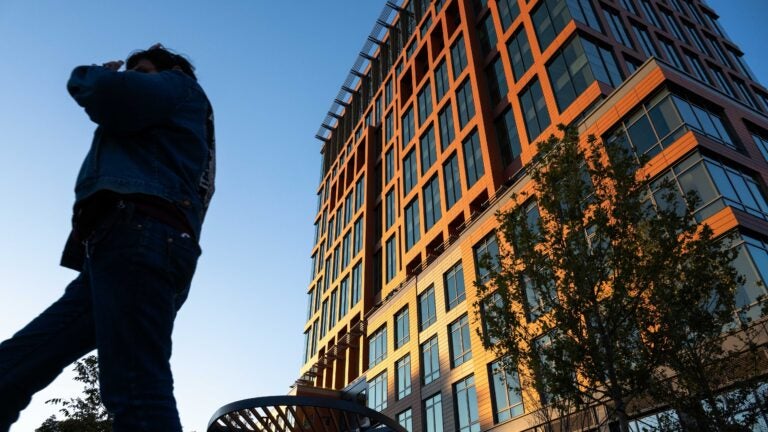
In 2018, a vacant one-acre lot in the center of Kendall Square sold for $50 million — a sign from the real estate world of just how much investors would pay to build in East Cambridge.
Today, just a half-mile away, the bank that financed the conversion of the old Sullivan Courthouse into a brand-new 20-story office tower said it has already lost $72.4 million on the project, and will soon force a fire sale if the developers can’t either start filling it or find new investors.
It’s the kind of loss that would once have seemed inconceivable for a new office building in East Cambridge, where the world’s largest biotechnology companies and institutions have long snapped up office and lab space faster than developers could build it. Of course, many of those deals were finalized prior to the pandemic, and the upheaval it brought to commercial real estate.
It was 18 months into the pandemic, in September 2021, when Arkansas-based Bank OZK lent $300 million to developers Leggat McCall Properties of Boston and Granite Properties of Plano, Texas, to finally launch the long-stalled conversion of the abandoned courthouse into office space and affordable housing. The building opened in late 2024, with no office tenants signed, and OZK’s construction loan came due in January.
Leggat and Granite are talking with a potential tenant who’d lease about one-third of the building, Bank OZK said in a recent earnings release, and are looking for new investors to bring a cash infusion. In the meantime, Bank OZK CEO George Gleason told analysts, the lender is making moves to take the building back in foreclosure.
“Our rule is you pay, you stay,” Gleason said. “You don’t pay, you don’t stay.”

Not staying would mean bringing in a new owner more than a dozen years after the state tapped Leggat to redevelop the courthouse into offices and apartments, and likely for a price much lower than the investment that’s been put into it so far. If the courthouse does sell, the deal would be viewed as a barometer for Cambridge real estate value.
For its part, Leggat McCall and Granite noted there has been “challenging office market forces” in Greater Boston and said their preference is to partner with new investors in the vacant office tower — the only new Class A office space in East Cambridge, they note, that also provides “critical housing” — 48 affordable units on its lower floors.
“Looking ahead, whether the building is recapitalized and/or the bank assumes ownership, all parties are committed to moving the asset forward in a constructive way by continuing ongoing leasing efforts to maximize any opportunity,” said Leggat McCall spokesperson Pam Jonah in an email. “We’re proud of what we’ve produced but obviously disappointed in market timing.”
Indeed, the timing of the project — for which Leggat McCall first won development rights in 2012 — couldn’t be much worse. Twenty-four percent of Class A office space in Cambridge is either vacant or available for sublease right now, said Jeff Myers, research director for real estate brokerage Colliers International in Boston. While that’s not the highest of this economic cycle, it’s close, he said.
“We haven’t been in this range since coming out of the dot-com bust back in the early 2000s,” Myers said. “There’s a lot of empty space that needs to be filled.”
And many of the tenants that previously would have been fighting for high-quality space at a prime Cambridge address haven’t been growing at nearly the rate they did prior to the pandemic, Myers said. Venture capital funding to technology and life-science companies is well below historic levels, and there are vanishingly few initial public offerings. Meanwhile, some of Cambridge’s larger office tenants have relocated to Boston or elsewhere, including CarGurus, InterSystems, and Pegasystems.
“Cambridge has to get its mojo back,” Myers said.
If Bank OZK does end up foreclosing on 40 Thorndike, it could end up selling to a new owner who’d pay far less than the project cost to build, said Andrew Maher, managing partner of real estate firm Anchor Line Properties. He estimated that it cost Leggat McCall and Granite approximately $800 per square foot to develop the 475,000-square-foot property, or around $380 million.
Now it might only fetch half of that — an attractive price point to a number of investors, including Anchor Line, Maher said.
“It’s one thing when it’s replacement cost and the building’s 20 years old,” he said. “It’s another thing when it’s replacement cost and the building’s six months old.”
While several Boston properties have sold at dramatic discounts, there have been far fewer deals across the Charles. Real estate lenders are in constant dialogue with brokers to gauge their sentiment on a building’s value, Maher said, trying to gauge whether they should take the building back and eat a big loss, or restructure a loan and give the building’s developers time to lease the property.
“Every deal is different on that front,” he said.
Regardless, office buildings here by and large are worth less than they were prior to COVID-19, which is having a big impact on tax bases of communities across Greater Boston.

Boston’s wave of buildings selling at lower prices has helped re-set the market, which hasn’t yet happened in Cambridge, said Wil Catlin, senior partner at real estate firm Boston Realty Advisors.
“The Cambridge market is still in a correction phase,” he said. “Boston has a certain activity across the market that I think didn’t exist a year ago. Cambridge doesn’t have that yet.”
That can create “a bit of a standoff” between owner and lender, Catlin said, as lease negotiations become ever more extended. Prior to the pandemic, companies would often snap up space quickly to prevent being shut out of a tight market; now, tenants can take their time. (Indeed, in a recent deal, leadership for a local biotech company said they considered 30 sites when looking for a new headquarters.)
“Lenders don’t want to own real estate,” Catlin said. “They want to lend on real estate.”
Bank OZK, for its part, was among the more prolific construction lenders for life-science projects in the years immediately following COVID-19, and is holding a lot of distressed properties in its portfolio, said Jenn Schultz, a Nixon Peabody partner who leads the law firm’s national real estate development practice. That could prompt a wave of sales to excise bad debt from its balance sheet.
“If you were the debt on a lot of office and life-science, where that debt was issued anywhere from 2018 until yesterday, you’re not looking at a great-looking portfolio right now,” Schultz said.
That could, however, mean a prime deal for a new owner, she said.
“Who doesn’t want to buy low, sell high, right?” Schultz said. “It gives you so much more flexibility.”





To comment, please create a screen name in your profile
To comment, please verify your email address
Conversation
This discussion has ended. Please join elsewhere on Boston.com