
The MBTA says it’s still ‘testing’ South Station fare gates. Commuters are calling them ‘obnoxious.’
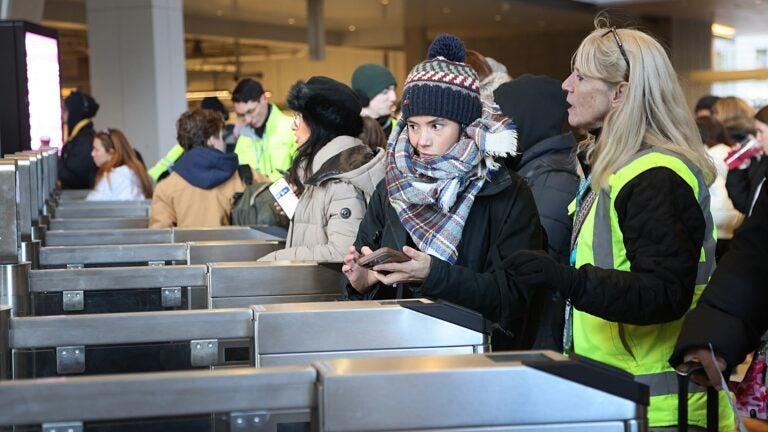
On a breezy weekday morning in January, Frank Truscott, of Dorchester, disembarked an inbound commuter rail train at South Station and approached a phalanx of fare gates separating him from the city.
The 55-year-old IT worker planted his phone screen on the gate’s sensor. Its folding doors remained obstinately shut. He walked a few steps to another gate, its doors fixed open, where a commuter rail employee stood guard. Truscott flashed his ticket and passed through.
“It feels like they’ve done no testing,” Truscott said. “It’s very on brand for the MBTA.”
The gates, only a few weeks old, are the T’s latest major attempt to recoup fares on a historically leaky service. The agency in late 2022 installed gates at North Station to the same end, and, it says, with some success: fare revenues increased, and some riders say commuters have grown accustomed to the change.
Gates at Ruggles and Back Bay are slated for installation this year.
The new South Station fare gates have, at times, stumbled during their first few weeks in operation.

When the gates first went live, the T said “testing” would continue after their launch. Keolis says employees from the gates’ manufacturer “are on site daily to calibrate the technology at the gates and troubleshoot any issues.”
“It’s very normal that these things don’t work perfectly the first time,” said Joshua Schank, a partner at InfraStrategies, a California transportation consultancy.
The gates, in theory, should part when riders scan valid digital passes (daily or monthly), physical cards, or paper tickets. Active military IDs are also accepted.
“There have not been any widespread issues tied to a specific fare type,” a Keolis spokesperson said.
Meanwhile, frustrations for some passengers have festered.
“It’s a pain,” said Randy Whinnery, a 55-year-old Fidelity employee living in Cohasset.
Whinnery failed to open two different gates with his phone before escaping the train platform on a recent January morning.
“It’s early days,” he said, “but one out of five times so far I’ve tried to swipe this thing, it’s worked.”
The gates debuted two days before the new year. It was a less than optimal inauguration.
Plenty of passengers passed through without hassle. Some struggled until a station worker hovering nearby intervened. At one point, during a morning influx, a group of gates appeared to momentarily deactivate; workers shepherded riders through a side door.

The T says the South Station fare gates cost about $1.3 million to purchase from company Scheidt & Bachmann, and another $2 million to install. The agency hopes the investment will pay long-term dividends.
Analysts estimated in 2019 that the T lost about $10 million to $20 million in revenue because of unpaid commuter rail fares. Many commuter rail passengers describe on-train fare checks by conductors as inconsistent.
The state inspector general in 2025 rebuked the T for not doing enough to shore up fare collection on the service.
The commuter rail generated about $133 million in fare revenue in 2024 — almost a third of the agency’s total fare intakes that year, according to the Federal Transit Administration. Fares from all modes covered about 19 percent of the agency’s operating expenses that year.
Some riders have bought into the mission. Others find their belief in the cause dampened by their frustrations with the barriers.
Passage success rates have varied. So too do impressions of the severity of bottlenecks created by the gates.
Kristen McGovern, a 43-year-old Walpole resident working in finance, estimated her phone ticket successfully parts the gates 80 percent of the time. She described queues at the gates as “manageable,” usually not tacking on more than a minute to her journey.
Angela Zaino, a 31-year-old scientist awaiting the Providence train Wednesday, said she’s encountered “a couple of errors” trying to scan the pass on her phone.
“But for the most part, it’s been fine,” she said.

Kayla Medeiros, a 28-year-old social worker living in Mansfield, has spared herself the potential exasperation of phone-scanning by tapping through the gates with a physical CharlieCard.
Still, she says, the confusion and misfortune of others struggling to breach the gates has slowed down her commute.
“I’ve been late for work a couple of times, which is really obnoxious,” Medeiros said.
Riders at South Station must check their tickets at fare gates to enter and exit the train platform. They should still expect to show conductors their tickets once aboard to verify they’re traveling to the appropriate zone (fares vary by distance traveled).
At several points during rush hour crushes in both the early morning and late afternoon, the Globe witnessed Commuter Rail employees stand by open gates and visually check rider tickets, an apparent attempt to ease congestion and get passengers on their way.
The workers functioned, effectively, as human fare gates, yielding an affirming phrase like “Good to go,” instead of a pleasant, high-pitched bing as riders went through.
“Financially, they can’t have one person manning every gate forever,” said commuter Steve Cavagnaro, 46.
Keolis, the company operating the commuter rail, told the Globe that the “passenger concierges” are permanent. They still mill about North Station, where fare gates went online in 2022.
“They worked at South Station before the gates were installed and will continue to be on site at all times gates are in operation,” a Keolis spokesperson wrote.
The T and Keolis had their dress rehearsal at North Station in late 2022. Passengers there also weathered a period of confusion and angst after encountering fare gates for the first time. But the T estimates that fare collection across the lines branching from North Station rose around 15 percent since the gates came online.
“I think people are pretty used to them, for the most part,” said Craig Scheipers, a 37-year-old retail worker living in Salem who had just passed through the North Station gates on a recent weekday morning.
North and South Stations are, of course, quite distinct.
South Station, on a given weekday, services far more riders. Its fare gates, though covered, are also outdoors.
A common evening rush hour ritual involves passengers congregating under the courtyard’s soaring arched ceiling before a large screen. Once the display broadcasts their platform, passengers hustle, at varying speeds, to get through the fare gates.
A mile away, North Station’s gates are packed cozily inside the terminal. Outbound passengers, once past the barriers, can wait out the moments before their departure in an indoor concourse with wooden benches and a Dunkin’.
At South Station, Cavagnaro theorized why the gates struggled to pick up QR codes. “This is outside, so that glass [on the gate sensor] isn’t always perfectly clean, right?”
Though frustrations are simmering for some, Scheipers, the commuter at North Station, trusts his fellow riders from the south will acclimate in time.
“You’ll get used to it,” he said.




To comment, please create a screen name in your profile
To comment, please verify your email address
Conversation
This discussion has ended. Please join elsewhere on Boston.com