
‘You name it, this place is run by immigrants’: In Nantucket, fears of an economic chilling effect after ICE sting
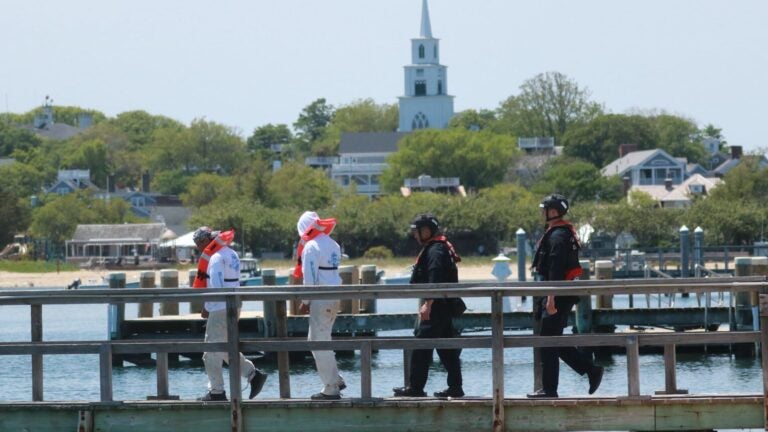
NANTUCKET — It was an unmistakable aspect of the crowd filing off the first ferry of the day shortly after 7 a.m.: tradesmen in construction boots or paint-smattered pants. Some wore sweatshirts advertising HVAC and plumbing services.
Others gripped lunch bags and picked up their toolboxes from checked-baggage containers on a wharf slick with rain. One group chatted in Spanish.
They are not here to check out the Nantucket Whaling Museum or to order a $46 lobster roll. They’re here to work.
It’s fair to assume, some locals say, that some in that crowd are immigrants, a population that represents a linchpin of the island’s economy, and one that has become increasingly fearful under President Trump’s dramatic push to arrest and deport more immigrants.
It’s a reality that was brought into sharp relief this week, as federal immigration authorities arrested about 40 people on Nantucket and Martha’s Vineyard. US Immigration and Customs Enforcement claimed that group included an MS-13 gang member and a child sex offender, but the agency did not release the names of those it detained.
The chilling effect of the arrests on aspects of local business was immediate, some say, as people are fearful to go to work.
“It’s a really hard time,” said Eduardo Calles, a 46-year-old who grew up in El Salvador, has legal status in the United States, and has worked on Nantucket for years. “Some people stay home, they don’t go anywhere, they don’t go to buy groceries.”
Calles, who does tile work and painting and acts as a pastor for Iglesia de Jesucristo Principe de Paz Nantucket, found it ironic that in a land known for freedom, people don’t feel free to leave their homes.
In a place renowned as a favorite vacation spot for the well-heeled, immigrants contribute in an array of industries, locals say, from landscaping to restaurant work to construction and the building trades to hotel and inn hospitality to public sector work for the town.

Their influence can be seen in ways large and small. There is a Caribbean lilt to some baristas’ accents. There is a taxi driver from the Balkans who works the graveyard shift, hustling for a better life. A Bulgarian school, a food mart that offers traditional Central American fare, a weekly Mass in Spanish at a Roman Catholic church in the heart of Nantucket’s downtown district.
PJ Antonik, a 45-year-old contractor who is rehabbing two homes on the island, noted that some employees haven’t shown up for work since the ICE actions. He has heard of other general contractors who have taken to picking up employees at their homes because they are too nervous to drive themselves to job sites.
“Everyone’s freaked out,” he said. “It’s crazy.”
Antonik, a Cape Cod native, said he could not do his job if it weren’t for immigrants, who he estimated make up about 80 percent of his workforce.
The chilling effect from the arrests, he said, is “slowing us down for sure.”
“We’re navigating through it,” he said.

State Senator Julian Cyr, who represents the Cape and the Islands, said that without immigrants, the economies of Nantucket, the Vineyard, and the Cape would collapse.
“Your vacation is made possible by immigrants,” he said. “Immigrants . . . who serve your food, make your beds, mow the lawns.”
He added, “You name it, this place is run by immigrants.”
Even whispers of immigration actions can have a significant impact on everyday lives, said Cyr. He recalled how earlier this year there was a rumor of ICE enforcement on the Vineyard, followed by a huge spike in absenteeism among public school students.
The vast majority of immigrants locally, Cyr said, are here through work-sponsored programs or have green cards or other kinds of immigration status.
“But they have someone or know someone in their family who may not,” he said. Immigrants not showing up to work in the aftermath of the ICE arrests, Cyr said, is understandable.
Indeed, there was an undercurrent of fear and paranoia in Nantucket this week. The Nantucket Food Pantry posted a message in English, Spanish, and Portuguese to social media saying that if people are not comfortable going to the pantry themselves, “send a friend or trusted neighbor — we’ll welcome them with open arms.”
Superintendent Elizabeth Hallett also shared a message with public school families, saying the district “welcomes all children, no matter what their immigration status, and we want [you] to know that your children will be safe in our classrooms and schools.”
Attached to that mass email was a letter Hallett had sent out earlier this year in three different languages that outlines how the district will handle ICE requests.
“If an ICE agent seeks access to a student at school, school staff have been directed not to permit the agent to enter the building but instead to send the agent to the Central Office,” reads the letter.
Matt Fee, 65, serves on the Nantucket Select Board and has run Something Natural, a bakery and sandwich shop, for about 40 years.
He does not hire undocumented workers, he said. But locally, even people who have legal status are nervous, according to Fee.
“It’s having an impact,” he said. “If people self-deport or are deported or choose not to come here, the island will have a difficult time servicing at the level people expect.”



To comment, please create a screen name in your profile
To comment, please verify your email address
Conversation
This discussion has ended. Please join elsewhere on Boston.com