
Extra News Alerts
Get breaking updates as they happen.
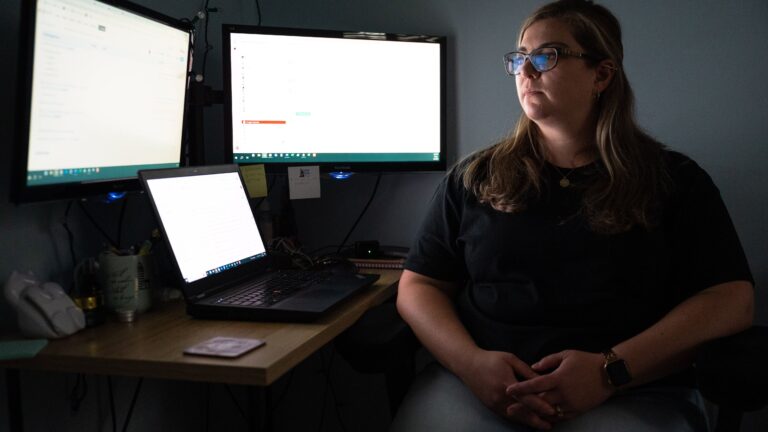
These days, Kim White sits in a dark home office as she works from her South Boston apartment, after getting a July electric bill that was nearly triple her June bill.
“Now I’m forcing me and my husband to be a lot more cautious,” said White, 36. “On the weekends, I’m making sure we shut down all of our computers, unplug things, because I don’t want to be accidentally using more electricity.”
After seeing their energy use jump from 497 kilowatt hours in June to 1,363 in July, White said, she joined the growing ranks of residents in Greater Boston who are unplugging appliances, turning off lights, and limiting A/C use when they can to keep electric bills down.
Their goal is to be able to crank the air-conditioning when they really need it, as stretches of sizzling days and sweaty nights this summer have pushed many residents to run their window units or central air around the clock.

Nate Cornwell, who shares a Saugus apartment with two roommates, recently helped one of them get a part-time job as a patient care technician for a Melrose health care provider — in addition to his full-time job — after the trio’s electric bills ballooned.
“He was already working 40 hours at his full-time job,” Cornwell said. “He’s going to basically have to leave that job [at the end of the day], come to this job two to three nights a week, and potentially even weekends, just to make up for that money.”
Cornwell, 27, said the energy cost “was reasonable” when he moved into the apartment in March, but the last two bills have been around $600.
“March and April were very normal, like what I would expect for a bill,” he said. “And then as soon as May and June hit, it seemed to more than triple.”
To the average electric customer, it may feel as if rates are going through the roof, and there have been increases in recent years as inflation has driven up prices across the economy. Back in 2019, for example, National Grid set its summer supply rates at 10.793 cents per kilowatt hour. Last year, the summer rate was 14.115 cents.

But most residential supply rates in Massachusetts are fixed every six months and are not affected by fluctuations in the spot price market, which reflects the how much electricity is used in real-time and how strained the grid might be.
“There have not been any recent rate changes reflected in the bills for July that customers have recently been receiving, so higher usage is the key factor at play here,” a spokesperson for Eversource said. And that usage adds up, with some customers paying as much as 40 percent more in the summer months, the spokesperson said.
The real story has been the humidity. This summer has been brutally muggy, with much of New England experiencing one of the most humid summers on record.
But the heat has been blistering, too. Daily high temperatures have been 2 to 6 degrees higher than normal this summer, and they aren’t dropping at night as much as they did in the past. Boston’s average nighttime low temperature from June to August has jumped 3 degrees since 1936, from about 62 degrees to 65 degrees, based on data from the National Oceanic and Atmospheric Administration. The average summertime high temperature in the city has risen 1.2 degrees.
Those high temperatures have helped build up the moisture level in the air, which acts like a blanket and slows the release of heat back through the upper atmosphere, trapping warmth close to the ground overnight.
The more humid the air becomes, the harder it is for air conditioners to produce cool, dry air. Air conditioners take hot air from inside homes and cool it with a refrigerant for recirculation indoors while pulling hot water vapor out of that air and sending it outside.
When humidity levels are high, evaporation rates slow significantly and it takes much longer to reach the desired cooler temperature.

Heat has become an issue across much of the nation. About 7 in 10 Americans said extreme heat has driven up their electricity bills in the last year, and most have seen at least a minor impact on their outdoor activities, according to a new poll from the Associated Press-NORC Center for Public Affairs Research.
Another 7 in 10 US adults who have experienced some type of severe weather event or weather disaster in the past five years said they believed climate change was a contributing factor.
Art O’Dea, a 62-year-old Amesbury resident who has seen electricity use in his four-bedroom home go from 956 kilowatt hours in July 2020 to 1,363 this July, is among those who think climate change has helped drive the increase in severe weather.
“I am a believer in trusting science, and I do think that we need to take some sort of action to try to stem the impact of our actions on climate,” O’Dea said. “We’re seeing it in real time in our checkbooks.”
From January 2020, the first full month that O’Dea and his wife lived in their home, the 12-month average of their total monthly utility bills has increased by nearly $140, by his calculation, “and goes up constantly.”
“Electricity costs are going up per kilowatt hour, but also my actual usage of electricity is going up,” he said. “I guess really it’s kind of a general trend, summer and winter.”
Jonathan Spiller, an advocate for people with disabilities who lives in a subsidized apartment in Arlington, pays a reduced rate for electricity but has seen a big jump in his monthly bill.
The 39-year-old usually pays $15 to $20 a month for power, but after using his air conditioner day and night through much of July, his bill was $74 for the month, he said. Since Spiller lives on a fixed income, that extra expense has meant cutting back on his grocery budget, he said.

“Even though I have the discounted rate, it doesn’t seem like a discount, because how can it be so high?” Spiller said.
White, the South Boston woman whose electric bill nearly tripled, called Eversource to try to understand why. They walked her through the bill “but didn’t have any explanation for why this would have changed,” she said.
She is hoping elected officials will take action to require more transparency from utility companies, so she can at least know why she’s paying so much.
“I don’t even have a clear solution or something to point to, to say this is what is increasing your bill,” she said. “If I had that, I could make those adjustments. In the meantime, I’m just sitting in my office in the dark.”
Material from the Associated Press and previous Globe coverage was used in this report.
Get breaking updates as they happen.





To comment, please create a screen name in your profile
To comment, please verify your email address
Conversation
This discussion has ended. Please join elsewhere on Boston.com