
As much of downtown struggles, Chinatown is emerging strong from COVID days
The tight-knit neighborhood has had a high turnover of businesses, but also persistent demand from customers.
If you walk around Chinatown today, the streets are alive and bustling with people. Walk a few blocks north, and you’re sandwiched among the still-underused office buildings and empty storefronts of the Financial District.
Three years ago, when COVID closures bruised businesses all over the city, few would have predicted that Chinatown would be the neighborhood springing back toward recovery at such a fast clip. The restaurant-dense enclave was hit particularly hard, as it struggled to overcome a wave of anti-Asian prejudice after the virus first emerged in China in 2020. But now there are barely any vacant storefronts, people are everywhere, and businesses say they’re busy.
Neighboring business districts are in an intertwined ecosystem — if one hurts, so will the one next door. The postpandemic malaise downtown has kept office vacancies at persistently high levels, which, in turn, has eliminated a chunk of Chinatown’s weekday lunch crowds. Many in the community say business turnovers have increased in the past couple of years.
But some say that’s typical in a neighborhood that has long been more dynamic than it may look to outside eyes.
“There is some turnover,” said Ye Huang, an attorney who represents businesses in Chinatown. “But that’s pretty much normal.”
It’s a change that generally remains hidden behind the scenes, as business owners come and go, quickly replaced by new ones who carry on the business. Store fronts stay the same and the business on the front-end operates as normal.


This recently happened at Ming’s Supermarket, a large grocery store on Washington Street in Chinatown, when New Ming Inc., the New York-based supermarket operator who has run the business for the last few years, filed for bankruptcy. The store is now back in the hands of its previous operator, Ming’s Supermarket Inc.
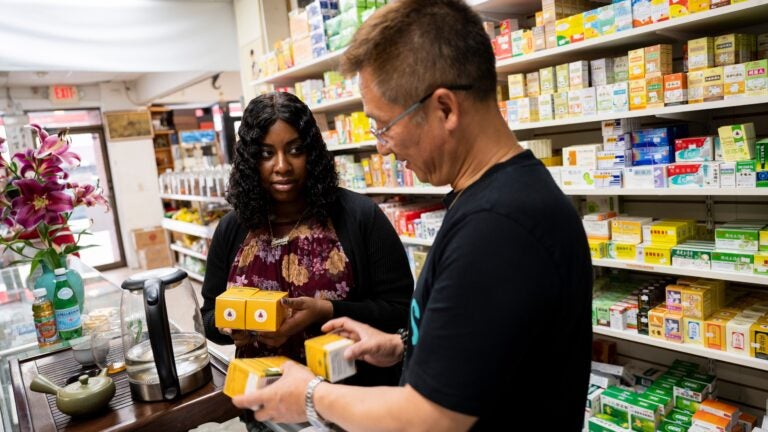
But that turmoil can’t be felt in the aisles of the store. Shoppers see the same produce, meat, and other food products on the shelves. On a recent visit, one customer said they have been shopping at Ming’s for the past 30 years. Another said they relied on coming to the store for products they couldn’t find elsewhere.
And that’s another reason why businesses have pulled through. They’re unique, with supermarkets, specialty shops, and herbal medicine stores selling products that their mostly-Asian customers can’t find at Whole Foods or CVS. And those customers will sometimes travel up to an hour to get there.
“My wife shops at Ming’s Supermarket,” said Huang, the attorney, who lives in Wellesley. “She was telling me that their produce is very fresh and can last for one or two weeks. Ming’s Supermarket’s pricing is also very reasonable compared to other supermarkets.”

Still, the draw of Chinatown goes beyond the specific products available at Asian stores, which can be found in other enclaves of Chinese immigrants around Boston. It’s the congregation of so many in one place, combined with the strong social and cultural roots, that makes it an attractive location to frequent.
“You may go to Quincy and get food there or do groceries there, but you may miss something else,” said Huang. “You miss the action. We have friends and people who associate with us here. It is the center of everything the Asian community has.”
For Xu Zheng, a public relations specialist at Gallop Global Travel Agency in Chinatown, the neighborhood’s cultural pull is a big part of what makes it desirable for many businesses, even as the effects of the pandemic linger in the economy.
“Business owners want to get into Chinatown,” she said. “Before COVID there was not much opportunity because every business makes money here, so they don’t get out of Chinatown. But after COVID, some have had to close their business and that creates the opportunity for new ones to come.”
Chinatown remains an extremely interconnected ecosystem, said Angie Liou, executive director of the Asian Community Development Corporation. Customers and business owners rely on each other — consumers want food, medicines, and other products that are specific to their culture and also want to visit businesses where workers speak their native languages. Those businesses, in turn, hire, cater to, and are supported by local residents.
“There’s an interconnectivity between the small businesses and the residents,” Liou said. “Many of the residents in Chinatown are workers in these businesses.”

Because of this symbiotic relationship, Asian-oriented businesses can trust there will continue to be a demand for their products from neighborhood residents.
Debbie Ho, executive director of Chinatown Main Street, an organization helping the Chinese business community, said the direct effect of the pandemic was only felt by a handful of businesses in Chinatown, and that normality has resumed.
“Everything is pretty much back to normal” she said. “There are new businesses opening up. If there’s an empty storefront, it goes within days.”
Despite the bustling streets, Q.J. Shi of the Asian Business Empowerment Council in Boston warned against making broad generalizations about how the Asian business community is performing.
Dynamics that existed before the pandemic continue to present challenges to business owners in Chinatown


According to a research brief analyzing Asian-owned businesses in Massachusetts from 2002 to 2017, 88 percent claimed they had not received any advice or coaching in the past year, while many cited rising costs, access to capital, and hiring as major concerns.
“Language access is something that is a big challenge for folks, especially when you have to apply for permits, or talk to your local representatives,” Shi said. “That’s a big barrier.”
Klysler Yen, a Boston resident for past 45 years and the chairman of the Asian American Association of Boston, said most businesses in Chinatown were family businesses and employees don’t receive much training; that can cast a shadow on their future.
They don’t speak much English, they don’t work computers,” he said. “It’s very difficult.”
While Chinatown seems to be back on its feet, despite the straggling effects of the pandemic, advocates like Shi and Yen believe there is still work to be done.
“When the pandemic hit, Asian and Chinatown businesses were some of the hardest hit ones,” said Liou of the Asian Community Development Corporation. “Many of them are still struggling. Those cultural ties have allowed them to persevere and hang on.”


To comment, please create a screen name in your profile
To comment, please verify your email address
Conversation
This discussion has ended. Please join elsewhere on Boston.com