
Nantucket oceanfront home condemned after erosion strips away 35 feet of dune since November, official says
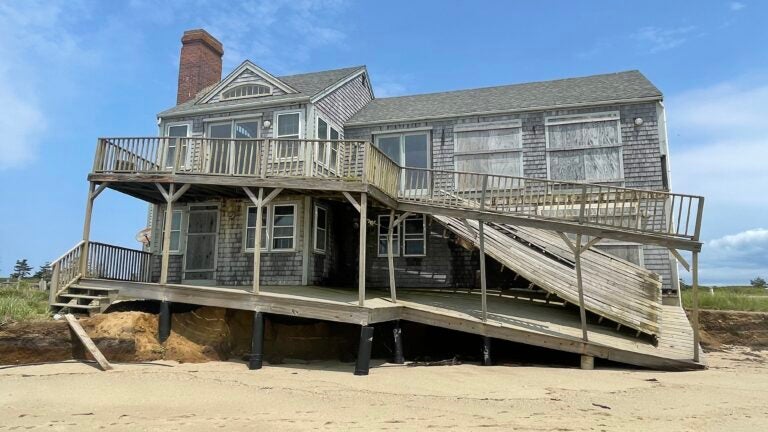
Another coastal property has been lost on Nantucket, just the latest home to be condemned on the Cape and Islands as erosion carves away at shorelines, stripping bluffs and dunes from beneath waterfront structures.
The Nantucket Board of Health issued an emergency condemnation order for a home at 21 Sheep Pond Road last week, citing the precarious position of the structure on the beach and violations of the state sanitary code.
Encroaching waters have stripped away the land beneath the home, leaving much of the structure’s foundation exposed and its deck collapsed on the sand. The dwelling now protrudes from a grassy dune and leans to the side with the ocean mere steps away.
The property has lost approximately 35 feet of dune since the last measurement in November and is now located entirely within the coastal dune and beach, according to Morgan Sayle, a coastal resources technician, who inspected the property on June 30.
Most of the foundation on the seaward facing side is entirely exposed to the surf, and the septic system appeared to be as well. On the inspection form, Sayle recommended the removal of the house and associated infrastructure from the property “as soon as possible.”
Kathy LaFavre, the health inspector on Nantucket, issued the condemnation and order to vacate the Sheep Pond Road property earlier this month. The Board of Health formally voted to ratify the orders on Thursday.
In a letter to property owners George and Marie Frazza of New York, LaFavre said the conditions of the home have been deemed a danger to the health and safety of the occupants and the public. The house has no electricity, water, or septic service, all considered violations of the sanitary code.
The Frazzas could not immediately be reached for comment on Monday. They were ordered to begin the removal of the deck, all septic components, and the well, in addition to applying for an abandonment permit and securing the dwelling to prevent any entry.
The shingled structure was first built in 1976, and the Frazzas have owned the 2,380-square-foot home since 1995, when they purchased it for $557,500, according to property records.

Structures dotting the shore are on the frontlines of coastal erosion, exposed to powerful winds and tides, severe storms, and rising sea levels. Experts predict that climate change may make intense weather events more common.
Over the years, a number of homes along Cape Cod and the Islands have been lost to the relentless forces of nature.
A home on Chappaquiddick on Martha’s Vineyard was demolished in February before it collapsed after years of being battered by winds and heavy surf. Three homes in Sandwich collapsed during a nor’easter in 2021, and a home in Truro that sat close to a coastal bank was demolished in May. Another home on Sheep Pond Road lost its battle with erosion a decade ago.
The Center for Coastal Studies in Provincetown found in 2018 that around 65 acres of the state’s shoreline is swallowed by the sea annually. Nantucket and Martha’s Vineyard are highly vulnerable to frequent flooding and have some of the highest rates of beach erosion statewide, according to the 2021 Trustees of Reservations’ State of the Coast report.
Parts of the south coast of Nantucket have receded up to 1,800 feet since the 1800s, with maximum short- and long-term annual rates of 17 and 11 feet, respectively, according to the report.
The islands have lost about 5.1 square miles of coastal areas due to erosion since 1887, and FEMA predicts the coast may erode another 1,350 feet by 2100, according to the report.

While it’s difficult to pinpoint a specific reason behind the significant loss of dune in just eight months, Sayle said Monday that erosion is “episodic.” The average rate of loss of feet on an annual basis is not a particularly “accurate representative number.”
For example, she said, five years could pass without losing any bluff at all. “Then one storm event could come, or some really high tides, and the winds were just right, and it would just shear off a whole bunch of dune,” Sayle said.
There were not any severe storms this winter that Sayle could recall, but there were some high winds and tides shortly after Memorial Day weekend. The home on Sheep Pond Road, she said, is “in an area that’s been eroding rapidly for a very long time — and it was just the next to go.”
Nantucket drew up a coastal resilience plan in 2021, which offers a roadmap for preparing for and adapting to the threats posed by rising sea levels, coastal flooding and erosion. Officials are considering measures to combat erosion including erecting flood barriers and installing rain gardens.
Sea levels have risen eight inches between 1965 and 2019 on Nantucket, according to the resilience plan. With the frequency and intensity of storms increasing, the impacts of storm surge will be felt on the island, threatening infrastructure, homes, and natural resources.
Through 2070, more than 2,300 buildings on Nantucket — most residential — are at risk of flooding or erosion. By 2070, nearly 30 miles of roadway are expected to be inundated by more than 6 inches of floodwater during high tides. And over the next 50 years, sea level rise is expected to cause over $3.4 billion in damages on Nantucket.
Some communities in coastal regions, including along the Massachusetts shoreline, have sought to prevent erosion by allowing residents to build seawalls or otherwise fortify their bluffs in recent years. But “managed retreat,” a strategy that shifts development away from the coast as the shoreline moves inland, is likely to become increasingly common, experts have said.
For example, one couple moved their Chappaquiddick house back from the edge of the cliff years ago after noting dramatic erosion on their property. A historic house in Truro that was on the brink of collapse because of erosion was moved back in February 2022.
While the Frazzas’ property could not be saved, town officials have been working with landowners in the Sheep Pond Road area to move the road and preserve access to homes, the Nantucket Current reported.





To comment, please create a screen name in your profile
To comment, please verify your email address
Conversation
This discussion has ended. Please join elsewhere on Boston.com