
How a tiny Massachusetts river has become a star in the fly-fishing world
Cold water, big fish, bigger crowds.
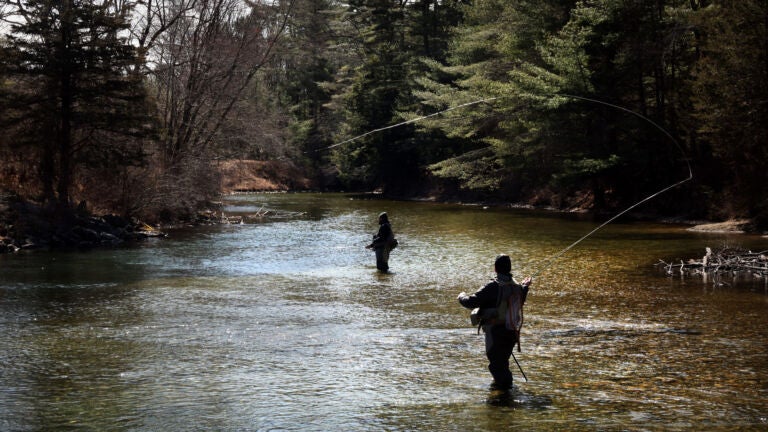
BELCHERTOWN/WARE LINE — John Katzenbach set off down the trail toward the water, geared up with the standard tools of anyone who has spent years fishing the Swift River. He wore waders and a vest. He had a fly rod and some flies. And, most importantly, he carried a ready excuse, which he described as “an impending sense of doom because you know the fish are smarter than you are.”
Katzenbach, a best-selling novelist who lives in nearby Amherst, was repeating the most oft-told yarn about the Swift River — and in the tall-tale world of Massachusetts fly fishing, the Swift is a category all its own — which is that the native brook trout on this tiny stretch of river in Western Massachusetts are not only the largest in the state, they are also the wisest. They’d have to be, the theory goes, to survive the endless pressure from the anglers who crowd its banks year-round.
But before we get to those massive, savvy fish, we must tell the story of the Swift itself, which begins, rather dramatically, with the Windsor Dam. The largest in the state, the behemoth structure opened in 1939 and eventually backed up the original three branches of the Swift River, flooding four towns off the map forever. The body of water that formed behind the dam was named the Quabbin Reservoir, and today it supplies drinking water for much of Greater Boston.
Our story begins just on the other side of that dam, with what fishermen call “the bubbler.” It’s a gurgling volcano of water coming from a pipe at the bottom of the dam, and it restarts the Swift with something crucial for trout — constant, cold water.

“It’s essentially the perfect trout habitat,” said Adam Kautza, the cold water fisheries project leader for MassWildlife, who had done extensive studies of the Swift River. “There are 1,300 wild trout streams in Massachusetts, and you see things at the Swift you don’t see anywhere else. We have stretches where there are several thousand wild brook trout per mile, and they’re huge. Anywhere else, they max out at 7-8 inches. On the Swift we find brook trout up to 22 inches, and there are loads in the 12-18 inch range.”
This stretch of river, which forms the border between Ware and Belchertown, is an angler’s dream, so also a nightmare, for the Swift is not a secret. Crowds on the half-mile stretch behind the dam, which is reserved for catch-and-release fly-fishing, can get downright congested on a weekend. Pandemic closures – which pushed more people into outdoor pursuits of all sorts, including fly-fishing – only magnified those crowds.
“I’m from the school that says you are supposed to give someone room for a cast upstream and a cast downstream, but that etiquette has gone to hell,” said Daniel Trela, who at 76 is often referred to as “the dean of the Swift River.”

Trela runs a fly shop out of his house in Ware — D.T. Kustom Tackle — that specializes in making flies and rods specifically for the Swift. He no longer battles the crowds behind the dam and instead fishes mostly on the other side of the Route 9 bridge, near another public works project that is an accidental boon to the trout in the Swift River: a state fish hatchery.
The McGlaughlin Fish Hatchery breeds trout, then “stocks” them into rivers throughout the state, including the Swift, which gets supplied with nonnative rainbow and brown trout to join the native brook trout. The hatchery fish are grown in concrete canals constantly fed by cold water from the Quabbin, and the runoff is piped into the Swift. What’s important about that, if you’re a trout in the Swift River, is that discharge is loaded with uneaten food from the thrice-daily feedings of the fish at the hatchery.
This creates the second-most crowded fishing spot on the Swift – the “hatchery hole,” where it is thought the knowing trout wait for the free buffet to come down stream. Trela suspects they even know the times of the feedings.

As he drove there on a recent visit, Trela, a retired pharmacist, insisted that in 66 years of fishing the Swift he had only failed to catch a fish one time. This day would make two, although he could reasonably say it was because he constantly helping his guest, a demonstrably inept fly fisherman, cut his line out of trees.
“There’s no question you have to be a good fly fisherman to catch a fish in the Swift,” said Rick Taupier, a guide and the owner of Swift River Fly Fishing in New Salem. “You need tiny flies and good technique, and then you need to do everything right or you’re probably not going to catch anything.”
The exception to this is if the state has just stocked the Swift, since hatchery fish are said to be dumb and trained to bite anything a human feeds it, though they are also said to wise up fairly quickly. Fishermen say a lot of things.

So is there any truth to this idea that the fish in the Swift are somehow smarter than your run-of-the-mill trout elsewhere in the state? That the constant, year-round pressure from anglers has left them smarter than their cousins elsewhere in the state?
Or perhaps the real appeal of the Swift River is knowing that it will always be full of fish to catch, and excuses when you don’t.




To comment, please create a screen name in your profile
To comment, please verify your email address
Conversation
This discussion has ended. Please join elsewhere on Boston.com