
Sign up for the Today newsletter
Get everything you need to know to start your day, delivered right to your inbox every morning.
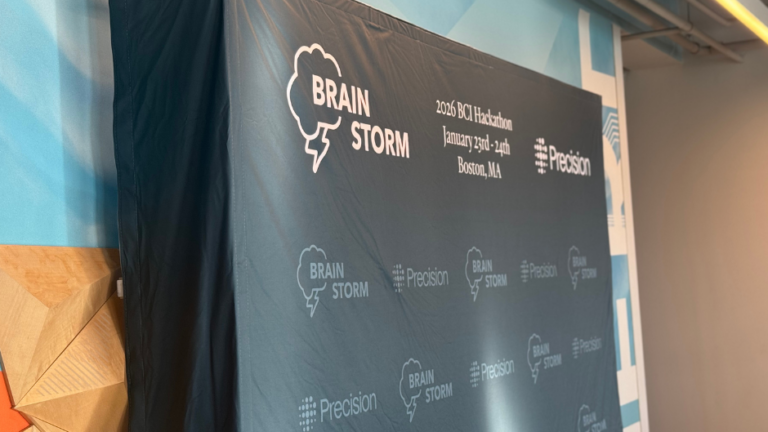
Inside a quiet office building usually reserved for professional engineers, the clicking of keyboards and low murmurs of debate filled the air, as students crowded around screens displaying brain signals instead of spreadsheets.
That energy marked the Brain Storm BCI Hackathon, a two-day event held over the weekend that transformed the Microsoft New England Research and Development Center in Cambridge into a temporary lab. As the clock ticked down, 88 students raced to explore the future of brain-computer interface technology, or BCI.
Hosted by Precision Neuroscience, a company developing technology to help people with paralysis control devices using brain signals, the hackathon drew students from universities across Greater Boston. Competing in teams of up to six, participants worked to build new tools at the intersection of BCI, artificial intelligence, signal processing, and health care innovation.
Chief People Officer Joel Greengrass said Precision hosted the hackathon to spark interest in neuroscience and invest in the field’s future leaders.
“It’s really investing in the next generation of talent and helping to develop it,” he said. “If we’re constantly investing in something that’s never been done before, why not go back and start investing in the people who are going to actually be doing all of this work?”
Before the competition began, Precision Senior Manager of Machine Learning Molly Lucas addressed the students, emphasizing that successful BCI development depends on collaboration across disciplines.
“Expertise is critical to success in BCI. There are no two people on my team who are alike, and this is by design,” she said. “As you start the hackathon, try and take a step back and think about the big picture of the system, find teammates that see the world differently from you and use that as a way to elevate your collective ideas.”
From there, participants selected one of three competition tracks, each designed to reflect real challenges Precision faces in developing BCI technology, said Federico Claudi, a senior machine learning applied scientist at the company.
“The idea was to find problems that are obviously amenable to being completed within two days but also that mimic the kind of challenges that we face when we’re actually developing the BCI technology in the company,” he said.
Claudi said the first track challenged teams to build a computer model that interprets brain signals, while the second focused on creating a demo app to help a surgeon place a small brain implant accurately. The third track addressed how to design an intuitive, engaging way to collect brain data over time so the system can continue to improve, he explained.

To make the experience as authentic as possible, teams worked with real neural data from animals, Greengrass said.
Each track awarded first- and second-place winners, with first-place teams receiving $1,000 and second-place teams $500.
For many students, the hackathon offered hands-on exposure to a field that can feel difficult to access.
A.J. Shulman, a junior at Brown University studying computer science and neuroscience, said the event allowed students to make meaningful progress in a short period of time. Shulman, who previously ran a hackathon at Brown, volunteered to help Precision organize the event while also competing alongside four other students.
“Hackathons are always a lot of fun, and [it’s] always fun to get into a room with people who are excited to build,” he said.
Elinor Rosen, a Tufts University senior studying computer science and engineering psychology, competed with four teammates and said she was drawn by how closely the event aligned with her academic interests.
“I’ve always been interested in the intersection between cognitive science and computer science and AI,” she said. “So, I felt like this was the perfect hackathon to explore that interest.”
For Northeastern University sophomores Raymond Cheung and Anderson Liew — both computer science majors — the hackathon was a chance to explore an emerging field firsthand. Cheung said he joined to learn more about BCIs and how similar systems are built.
“It’s cool that this is sponsored by a Neuralink competitor, and this will definitely be really useful,” he said.
The pair went on to win track three with another Northeastern student, Mukhilkanna Balakumar.
“It’s kind of cool to be a part of the future,” Liew said.
Tian Wang, a doctoral student at Boston University, said he learned about the hackathon through a professor. Wang attended with postdoctoral researcher Adam Smoulder and doctoral student Pierre Boucher, all of whom work together in BU’s Grand Lab.
Networking was one of the group’s primary goals, Wang said, along with gaining experience working with a new type of data.

“There’s only certain kinds of data that we analyze,” Smoulder said. “The kind of data we’re going to be working with here, that Precision is doing with their clinical trials, is … a different kind of neural data for us to explore and learn how to work with.”
Smoulder added that the condensed format made the experience especially valuable.
“The fun thing about these is that you get a really concentrated time period to play with a new kind of data or learn a new kind of skill really quickly,” he said. “It’s almost like taking a fast, full-week summer course during undergrad, where you have dedicated time for something when your normal work day you don’t.”
Get everything you need to know to start your day, delivered right to your inbox every morning.



To comment, please create a screen name in your profile
To comment, please verify your email address
Conversation
This discussion has ended. Please join elsewhere on Boston.com