
Sign up for the Today newsletter
Get everything you need to know to start your day, delivered right to your inbox every morning.
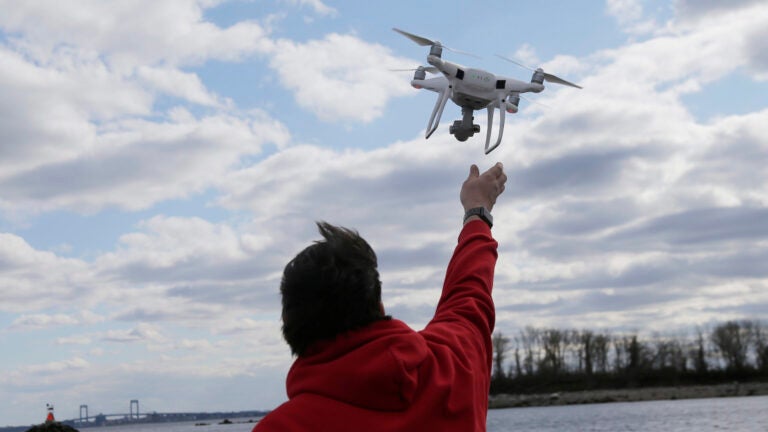
Boston’s skies may soon be abuzz with more drones zipping overhead and criss-crossing traffic.
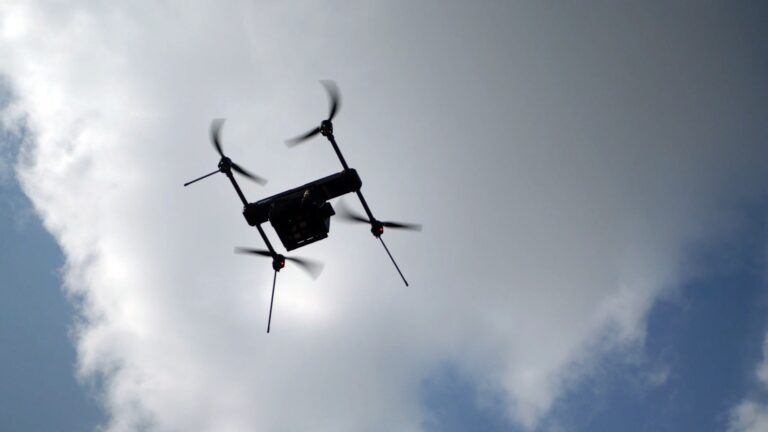
The Federal Aviation Administration recently awarded Canadian drone manufacturer Draganfly a waiver to fly over people and moving vehicles in Boston, a “rare” milestone the company’s CEO said unlocks new potential for the technology in industries like medicine and public safety.
“As we continue to lead the way in UAV [unmanned aerial vehicle] technology, this achievement underscores our vision of a future where drones seamlessly integrate into our daily lives, enhancing safety, efficiency, and innovation,” CEO Cameron Chell said in a video announcing the waiver.
Draganfly has already dipped a toe into Boston’s airspace, teaming up with Mass General Brigham on a futuristic medical drone delivery pilot. Announced in early 2024, the project explores the possibility of using drones to deliver medical equipment and supplies to patients in MGB’s Home Hospital program, which offers hospital-level care at home.
Draganfly recently reported the successful completion of its initial test flights for the “proof-of-concept, research-and-development” project, including takeoff and landing within hospital infrastructure. While those flights didn’t actively contribute to care, they helped demonstrate how drone deliveries could minimize logistical delays in transporting medical supplies or laboratory samples, the company explained in a December press release.
In a promotional video showcasing a test flight, Mass General Brigham said the Home Hospital team plans to conduct further testing to validate the system’s operational range.
“We are also actively looking at — with MGB, and on some other projects — first responder activities, so being able to do things like deliver insulin, EpiPens, AEDs [automated external defibrillators],” Chell told Boston.com, adding, “There’s AEDs everywhere, but I bet you don’t know where any of them are, right? Because you just don’t pay attention to that stuff until you need it.”
He said Draganfly has multiple “Drone as First Responder” initiatives ongoing in the U.S. The general idea is that a drone may be able to arrive at an emergency quicker than first responders, delivering critical supplies or providing crews information about conditions at the scene.
“We have multiple initiatives happening with police departments, health care providers, first responders, search and rescue operations,” Chell explained. “Some of our equipment might be being used in things like consumer delivery — you know, the Amazon or the Walmart type of stuff — but our primary focus is much more on public safety, medical type of response.”
When it announced the FAA waiver last month, Draganfly said the exemptions showcase the company’s “readiness to meet the evolving needs of its defense, government, and commercial partners.”
Draganfly’s website gives some insight into what those needs might entail; a section on the company’s work in public safety offers monitoring and reconnaissance, police and border patrol, search and rescue operations, and scene digitization as a few examples.
“Draganfly drones provide an aerial vantage point for law enforcement to scout their area of operations, breach structures, conduct indoor searches, and even negotiate with suspects while keeping personnel out of harm,” the webpage explains. “They can be used to follow, monitor and aid in the apprehension of suspect individuals before they can cause further harm to the community.”
Another page about Draganfly’s work in the military and government sector boasts about the company’s “extensive experience working with several U.S. Department of Defense approved entities.”
Other industries listed on Draganfly’s website skew more quotidian — agricultural, environmental, humanitarian, and insurance work, for example.
The special provisions issued to Draganfly for its FAA waiver include a number of stipulations about how and where the company can fly its drones. For example, drones weighing more than 0.088 pounds are prohibited from operating over open air assemblies (think: concerts, parades, and sporting events). Also prohibited are sustained flights over moving vehicles or people who are not directly involved in the flight.
“For the purposes of this waiver, sustain is defined as loitering, hovering, and continuous or sequential overflight of non-participating persons or moving vehicles, including the payload delivery portion of the flight,” the document states.
The provisions further bar night flights and stipulate that routes must be designed to avoid flight over people and traffic.
“I can say in general, [the flight paths] are going to follow things like rivers, train tracks,” Chell explained. “As much as possible, they’re going to avoid flight overtop of people, and that’s just a matter of practicality. But there will be sections of it where it’s going to have to cross overtop of a highway or a freeway or something like that in order to get to its location.”
According to Chell, all of Draganfly’s drone flights are logged, and all have a flight plan. He said the drones are fully monitored at all times and tracked visually and on GPS. They also have a built-in parachute system to slow their fall in the event something goes wrong mid-flight.
“Not to say that it’s not still dangerous, but that’s why we’re doing all these pilots,” he said. “That’s why it has taken years. … The reason that it’s taken so long is the appropriately excruciating methodology that the FAA and the regulators have gone through to ensure safety.”
Privacy is another chief concern when it comes to drones. The American Civil Liberties Union, for example, has painted the technology as something of a doubled-edged sword, recognizing uses for it in law enforcement and emergency response while also raising concerns about undue or unrestrained drone surveillance.
Chell addressed some of the privacy implications of more widespread drone usage, particularly as it relates to Draganfly’s work in Boston.
“There’s extensive work done by the entire public safety industry around that,” he said. “And so, you know, depending on where you’re flying, who’s flying, why it’s being flown, that type of reason, there’s no cameras on. There’s no recording that happens. There’s no data that’s being saved.
“Many of those standard operating procedures are in the midst of being developed right now, and I know that there’s a lot of public discussion and interaction between various aspects of public safety and the public so that they’ve got a level of assurance that these drones are for emergency response, or first responders, or medical delivery, or whatever the case is, and they’re not surveillance required,” he continued. “Now, that said, if there’s a law enforcement agency that is on an active scene with an active shooter or something like that, it’s a different ball game altogether.”
He also confirmed Draganfly’s drones don’t record video during flights for the MGB pilot program.
Amid a rapidly changing technology landscape, Draganfly has promised to “[push] the boundaries of UAV applications” and “redefine the role of drones across multiple sectors.” According to Chell, the new FAA waiver represents a leap forward for both Draganfly and the industry at large.
“We’re really excited about where the industry is going,” he said. “We’re pleased to be where we’re at and selected to do this type of work and look forward to very pragmatically moving it forward appropriately with the regulators, with public discussion and, of course, with our customers being the health care industry.”

Get everything you need to know to start your day, delivered right to your inbox every morning.



To comment, please create a screen name in your profile
To comment, please verify your email address
Conversation
This discussion has ended. Please join elsewhere on Boston.com