
Boston Banished Parking App Last Summer, but Space Saving Still OK
What does Haystack, the mobile app that allowed users to buy and sell access to on-street parking spaces, have to do with the blizzard that just passed? Space saving, of course. We’re talking about space saving.
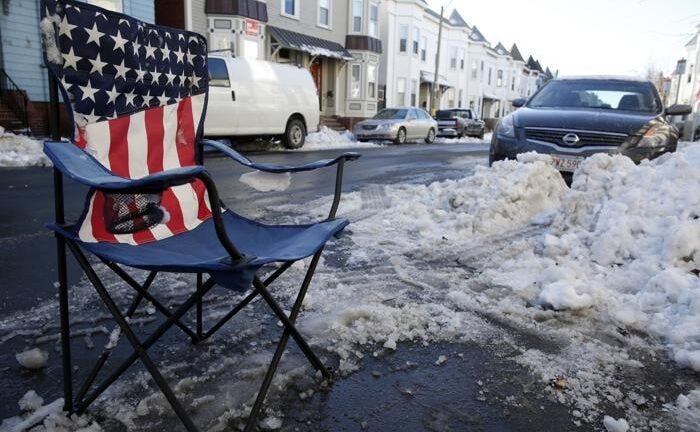
In the aftermath of a Boston snowstorm, there are few things more divisive than the space saver, be it in the form of a beach chair or a traffic cone or a big cardboard box or an Elvis head. If you shoveled your car out of an on-street parking spot, is it yours to claim? The rules have always been ambiguous, without a clear directive from City Hall, and have occasionally resulted in conflict when the terms of the loosely defined social contract were violated.
Former Mayor Tom Menino put something of a guideline in place during his tenure, allowing conquering shovelers to mark parking spaces as their own for 48 hours after the end of a snow emergency. (Even that has shown itself to be less than a hard-and-fast rule.) Mayor Marty Walsh adopted the policy after coming into office last year. You can read all about the history of space savers, as well as an effort in the South End to do away with them this winter, here.
Critics of the practice may be interested to know they at least have the letter of the law on their side. However, it’s a pretty hollow victory.
That brings us to Haystack. The lightning rod of an app debuted in Boston last July. It allowed users parked in a public space to put the spot up for grabs for a few bucks. The idea was decried by City Hall and the city council, and by the end of August, an ordinance proposed by City Councilor Frank Baker ran Haystack out of town.
The ordinance was direct and to the point. “No person or entity other than the City of Boston and any of its departments or designees shall have the authority to sell, lease, reserve, or facilitate the reserving of any street, way, highway, road or parkway, or portion thereof, under the City of Boston’s control,’’ it read.
Haystack CEO Eric Meyer disputed at the time that his company did any of the above. Instead, he argued that it allowed users to share information about parking spaces. But in any event, he shut down operations in Boston. Meanwhile, the language left over makes it clear: You can’t reserve a public parking space. And that, in theory, would mean you can’t hold on to your parking spot using a space saver.
The thing about space savers, though, is that they exist in a wishy-washy area between city rules and neighborhood understanding. The Haystack ordinance isn’t enough to drag space savers out of that vortex, according to mayoral spokesperson Melina Schuler. When it comes to space savers, the city won’t enforce it.
“Councilor Baker’s August 2014 ordinance clarified Boston’s commitment to protecting the public’s fair and equal access to public amenities, like parking spaces in the public way, and protects Boston residents from private efforts to sell, lease, or reserve public spaces,’’ she said in a statement. “Space savers, which are used on a short-term basis, under very specific circumstances, and do not result in a marketplace where a public amenity is being bought, sold, or traded, are not captured in the spirit of this ordinance.’’
So that parking space you shoveled out remains yours to claim, if not by law then at least in practice. Once the snow emergency is lifted, you’ve got 48 hours. (Or something like that.)


To comment, please create a screen name in your profile
To comment, please verify your email address
Conversation
This discussion has ended. Please join elsewhere on Boston.com