
How the Aereo Decision Resembles Uber, Airbnb Regulatory Efforts
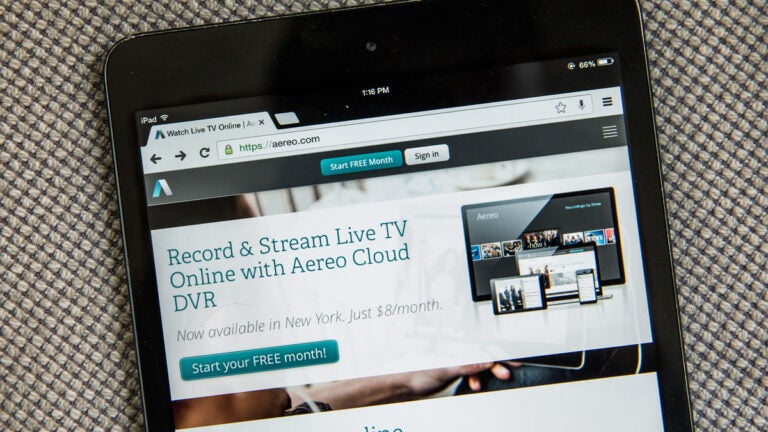
The Supreme Court’s ruling Wednesday that effectively spelled the death of streaming TV service Aereo, at least in its current form, focused on copyright infringement. So the extent of its legal precedent probably only stretches to the digital sharing of copyrighted materials.
However, the decision does in one way mesh with recent debates over the regulation of so-called sharing economy companies, most prominently Uber and Airbnb.
Here’s the CliffsNotes of the background: Aereo is a service that offers customers, who pay a low monthly fee, to watch broadcast TV on any Internet-connected device. Well, that’s the end result. What customers actually pay for is the ability to lease an antenna, which picks up broadcast signals, and then tune into what their antenna is capturing. (It also allowed for use of a DVR-like recording service.) This, Aereo argued, made it no different than users who kept an antenna at home and picked up broadcast signals for free. Rather than being a content provider, Aereo said, it was a technology company that made watching television easier.
Broadcasters likened it more to cable companies, who pay for the right to bundle those local broadcast channels with non-broadcast channels like ESPN or MTV or what have you. By subverting that system, they said, Aereo was performing copyrighted material. In the end, the court agreed with the broadcasters, 6-3. (And even though the dissenting opinion picked at some of the nuances as to whether the company or its users were the ones violating copyright, it still agreed the service should be shut down.)
In doing so, the court effectively told Aereo: “Well, you might not be a cable company…but let’s be real: You’re basically a cable company.’’
From NPR:
[fragment number=0]
[fragment number=1]
And from New York Magazine:
[fragment number=2]
[fragment number=3]
To be clear, the decision only carries any weight as it relates to companies that meddle with copyrights. The inventories of the other services mentioned above, like Airbnb’s short-term rentals or Uber’s rides across town, are volunteered by those companies’ user bases. There’s absolutely no legal precedent put forth from the Aereo case that would relate to an Uber or an Airbnb.
But there is an interesting rhetorical parallel between how the court addressed Aereo and how regulators address those companies, in the “look-like-a-duck, quack-like-a-duck’’ argument described above.
Uber, for instance, bills itself as a technology company—like Aereo. While the service ultimately results in users getting a ride from place to place, Uber’s tech systems are at its heart. Airbnb, too, is primarily seen as a web service, even though at the end of the day it serves to help users find lodging.
Regulators who contest the services haven’t really given a damn about the tech company distinction, instead choosing to emphasize what ultimately happens. States and cities, including Cambridge, have sought to regulate Uber like a taxi service, and others have sought to regulate Airbnb like a hotel company. A ride is a ride is a ride, the argument goes, and lodging is lodging is lodging.
Airbnb has inched that way, recently agreeing to pay San Francisco and Portland, Ore., hotel taxes. Uber, too, has shown a willingness to negotiate with regulators in places like Colorado and Seattle.
Once again, the Supreme Court’s Aereo decision means zilch for those companies’ practices. But it’s interesting to hear the court talking about a company that repurposes an existing inventory to subvert business as usual by essentially dismissing the technology and legal loopholes that power it as reason to keep it alive. And it begs questions of whether that could bolster officials’ positions as they attempt to regulate companies that do much the same in other industries, however different their inventories might be.



To comment, please create a screen name in your profile
To comment, please verify your email address
Conversation
This discussion has ended. Please join elsewhere on Boston.com