
Explainer: What You Need to Know About Net Neutrality
-

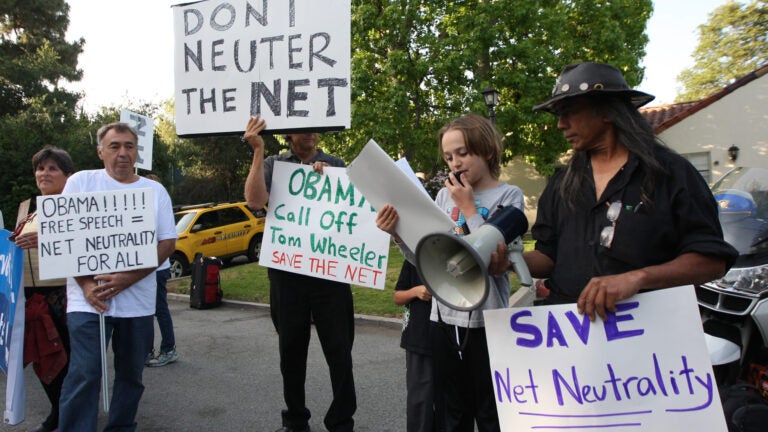
Later this week, the Federal Communications Commission will vote on new net neutrality rules proposed by its head, Tom Wheeler. The Thursday vote could have a big effect on the future of the Internet, and is sure to generate a lot of discussion.
“Yeah, yeah, I know,’’ you might say, followed by, “Wait, what is net neutrality, anyway?’’
If you’ve been following net neutrality issues closely—and many people have been for years—this article might not be for you (though you’re welcome to follow along and chime in).
But if you keep hearing about it, know that it’s got a bunch of people up in arms, and could use a quick explainer on what’s happening, we’re here to help.
-
What is net neutrality?

Net neutrality is the concept that all web content and traffic should be treated equally by Internet Service Providers. Advocates for net neutrality say a company like Comcast, just to use the most prominent example, shouldn’t have the ability to make it more or less difficult for consumers to access anything on the web, or for producers to reach those consumers.
ISPs see this as a problem because delivering some services requires more of them than others. Another prominent example: Netflix, featuring its trove of streaming video and huge demand from users, puts a lot of pressure on servicers compared to your typical website. So Comcast thinks it should be able to charge Netflix to get its content to consumers quicker. Netflix-Comcast, by the way, is not a hypothetical example; more on them later.
Since it’s a pretty technical concept, the common metaphor has become physical infrastructure. Imagine a highway that stretches from Netflix’s servers to your computer. That’s your service provider. Netflix is sending that content in a car. Comcast wants to give Netflix’s car access to a fast lane on that highway, and charge them a fee to use it.
-
And why is it a big deal?

Those in support of an open Internet, who for shorthand purposes we’ll refer to as activists, say that if ISPs get what they want, it will come at the cost of consumers. Example: If Amazon has to pay more to get to its customers, who do you suppose will shoulder that cost burden? Most likely, it will pass on to their customers. Beyond that, if some websites and services run faster than others, consumers probably won’t be thrilled with the relative slow speed of others. (Taken to its extreme, the end of net neutrality could allow ISPs to block users from visiting certain websites, but the proposal in question this week would forbid that.)
But perhaps more prominent is the innovation concern. Netflix and Amazon are massive companies with household names. Imagine, though, if 10 or 15 years ago Walmart and Blockbuster (let’s ignore Blockbuster’s fatal arrogance during the rise of the web) paid for a leg up over the young upstarts. That would represent a financial leg up for the old guard. Today, Netflix or Amazon could presumably make the investment, but its own young competition, when faced with the need to do so, might not be able—or even if they were, the cost would represent a drain on their comparatively limited resources.
-
What are the recent developments?

The FCC has had rules in place since 2010 that sought to keep net neutrality intact. But earlier this year, a federal appeals court said those rules were illegal, thus opening up a big can of worms.
Shortly thereafter, Netflix and Comcast (remember them?) reached an agreement by which the streaming service would pay money to get to its subscribers more quickly. Netflix’s download speeds sharply increased almost immediately for Comcast subscribers. While that deal is technically not in violation of net neutrality principles, it has shown the effect of paying for faster services, bolstering activists’ arguments.
-
What’s the alternative, then?

The court struck down the FCC’s previous rules more or less on a technicality. Those rules, the court said, asserted that broadband Internet was subject to common carrier laws, like those that govern railroad lines and phone services. But because the FCC has not classified the Internet as a utility, it can’t be considered a common carrier and thus those rules were no good.
If the FCC were to reclassify Internet service as a utility, common carrier laws would be A-OK and net neutrality would stay intact. Many activists see reclassification as the only way to ensure a truly open Internet. But reclassification would also just about guarantee the FCC a grueling, high-profile fight with some of the most powerful companies in the country.
That’s not to make the FCC sound like an underdog white knight. Some of its commissioners are opposed to tough regulations on ISPs. And the very skeptical point to the history of Tom Wheeler, the FCC chair, who previously worked as a lobbyist for the cable industry.
-
What’s happening Thursday?

In order to stem the tide, Wheeler, shown on the right, came up with a new set of regulations last month that would pave the way for “fast lane’’ deals. The public quickly cried foul.
The FCC’s preliminary vote on the proposal is scheduled for this Thursday. Public outcry against it was loud enough that the FCC had to ask the public to email rather than call about the issue. Meanwhile, more than 100 leading tech companies also expressed their discontent to the FCC last week, and some venture capital has already begun backing away from startups that require a lot of bandwidth in response.
Wheeler has since revised the proposal, the Wall Street Journal reported Sunday, offering language that stresses scrutinization of all such deals. His proposal, if passed, will also invite public comment on whether to ban the deals outright and on whether to classify broadband Internet access as a utility. (However, two FCC commissioners say they hadn’t even seen the plan as of Tuesday afternoon, The Hill reports.)
If the FCC votes yes Thursday, the proposal will then formally open to public comment, meaning the FCC could take public opinion into consideration when finalizing the rules. In that case, you can expect activists to really push for broadband classification during the public comment period. For many of them, it’s reclassification or bust.




To comment, please create a screen name in your profile
To comment, please verify your email address
Conversation
This discussion has ended. Please join elsewhere on Boston.com