
Scenes from the 2013 DARPA Robotics Challenge
-

Seventeen teams from the United States, China, Japan, and Korea participated in the Defense Advanced Research Project Agency’s Robotics Challenge Trials at Florida’s Homestead-Miami Speedway from Dec. 20 to Dec. 21.
The event was a test of some of the most advanced robots in the world, competing to prove the feasibility of using robots to assist humans when natural and man-made disasters strike.
“Robots played a supporting role in mitigating fallout from the Fukushima nuclear plant disaster in Japan, and are used by US military forces as assistants for servicemembers in diffusing improvised explosive devices,’’ DARPA said.
“True innovation in robotics technology could result in much more effective robots that could better intervene in high-risk situations and thus save human lives and help contain the impact of natural and man-made disasters.’’
-

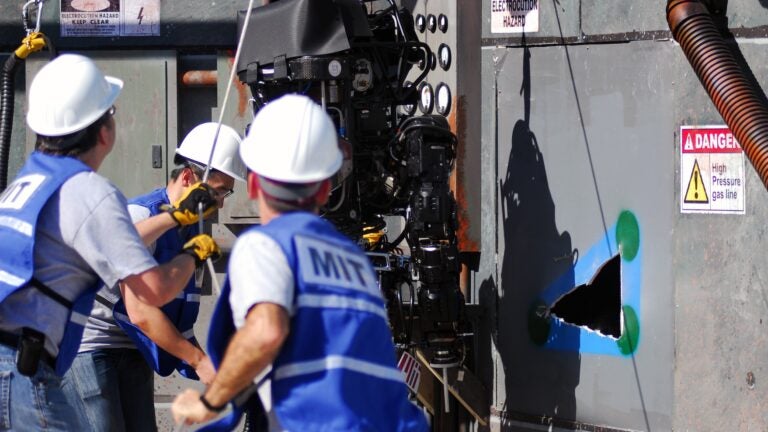
Worcester Polytechnic Institute and the Massachusetts Institute of Technology were among the competing teams. Robots from each team attempted to complete the challenge of performing eight tasks related to disaster response in the quickest time and with the least human intervention possible. The MIT team finished fourth, and the WPI team finished seventh, meaning they advanced to the final round in the competition.
-

Members of Team MIT were so excited to participate in the event, some planned their vacation time around the event date, Russ Tedrake, planning and control lead for Team MIT, said in a video about the team.
-

The goal of the challenge was to generate groundbreaking research and development in hardware and software that will enable future robots, in tandem with human counterparts, to perform the most hazardous activities in disaster zones, thus reducing casualties and saving lives.
-

Team MIT consisted of faculty, research staff, and students from many different departments, including mechanical engineering and aeronautics and spacenautics.
-

The tasks assigned to the robots simulated unpredictable situations that could unfold in the real world. The challenge required that a robot maneuver effectively in environments it has not previously encountered, use whatever human tools are on hand without the need for extensive reprogramming, and continue to operate even when degraded communications render motion-level control by a human unfeasible.
-

Team MIT fashioned a 300-pound robot to complete the tasks outline by DARPA, which included opening doors, climbing a ladder, and holding a hose.
-

The trials will give DARPA a baseline view of the current state of robotics and determine which teams will continue to receive DARPA funding to expand on their potential.
-

One of the main concerns Team MIT had during the challenge was whether their robot would be just as reliable outdoors in Miami as it would be inside their Massachusetts lab.
-

Spectators came from all over the world to see the competition.
-

WPI received its robot in July 2013. It took about two months for the team to understand the intricacies of the robot and begin programming, team leader Matt DeDonato said in a team video.
-

The competing robots had to be disassembled when sent to Miami and then reassembled before the start of the competition.
-

Team WPI consisted of about 30 people who worked around the clock with their robot.
-

WPI worked with staff at Carnegie Mellon University for the project.
-

The teams that finished in the top eight after last weekend’s challenge will continue to receive DARPA funding to compete in the Robotics Finals event to be held next December. One team will win a $2 million prize.
-

WPI introduced the first undergraduate robotic engineering program in the nation six years ago. Now, many of the teams enlisted the help of their undergraduate robotics teams for this project.
-

DARPA, which provided the basic robot to the competitors, expects the robots be able to demonstrate roughly the competence of a 2-year-old child by the time the final round takes place. That means the robots should be able to autonomously carry out simple commands such as “Clear the debris in front of you’’ or “Close the valve.’’




To comment, please create a screen name in your profile
To comment, please verify your email address
Conversation
This discussion has ended. Please join elsewhere on Boston.com