
MIT scientists help discover Earth-like planets that could potentially support life
They’re only 40 light years away.
The search for extraterrestrial life just got a lot more interesting.
An international team of astronomers, including one from MIT, have discovered three Earth-like planets only 40 light years away from Earth, according to a study published in scientific journal Nature.
The planets were discovered orbiting an ultracool brown dwarf star about the size of Jupiter and much cooler than our sun. Researchers from the University of Liège in Belgium relied on observations by TRAPPIST (TRAnsiting Planets and PlanetesImals Small Telescope), a 60-centimeter telescope located in Chile, to make the discovery.
“The three discovered planets are the first places for which we could find life outside our solar system,” Michael Gillon, a lead author of the study from the University of Liège, told The Boston Globe.
Scientists have previously searched for exoplanets—planets outside our solar system—orbiting stars more similar in size and temperature to our sun. The problem faced by scientists is that those stars shone brightly enough that signals from any planets orbiting them were often lost, according to MIT News.
TRAPPIST instead looked at dwarf stars, which are harder to spot due to their relative dimness and distance from Earth, but also do not drown out signals from nearby planets.

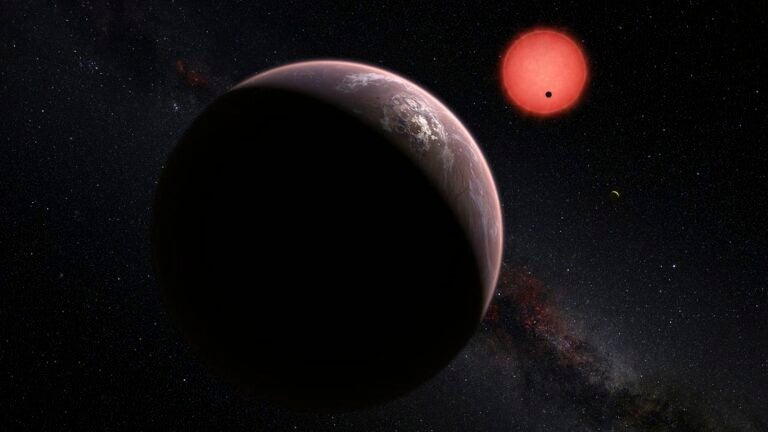
An artist rendering of the surface of one of the three planets.
ESO/Getty Images
According to co-author Julien de Wit, a postdoc in the Department of Earth, Atmospheric, and Planetary Sciences at MIT, the discovery has huge ramifications.
“These planets are so close, and their star so small, we can study their atmosphere and composition, and further down the road, which is within our generation, assess if they are actually inhabited,” de Wit told MIT News. “All of these things are achievable, and within reach now. This is a jackpot for the field.”
The planets are tidally locked, which means that, like our moon, the same side of the planet always faces the celestial body it is orbiting. That means that the two planets orbiting closest to the star may only have a small “sweet spot” between the two sides that is temperate enough to sustain life. The third planet, on the other hand, may be “entirely within the habitable zone,” according to the release.




To comment, please create a screen name in your profile
To comment, please verify your email address
Conversation
This discussion has ended. Please join elsewhere on Boston.com