
Will a new species change everything we thought we knew about human history?
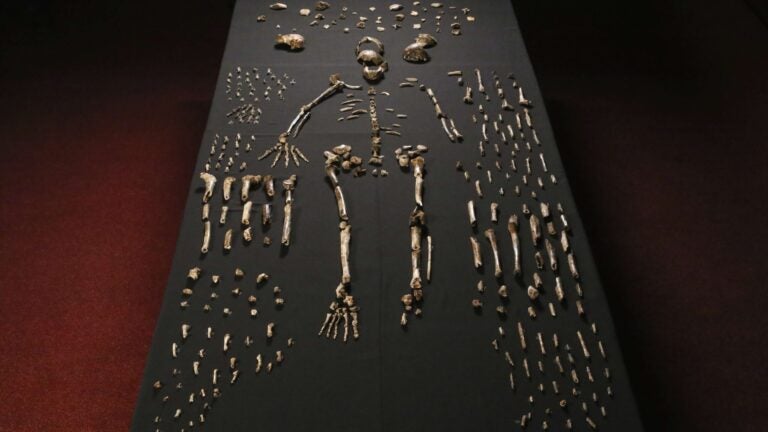
About two years ago, scientists spelunked their way through the “Rising Star Cave’’ in Johnanesburg, South Africa, hoping to find fragments of the creatures who had lived there eras before. They found more than they had ever imagined—more than 1,550 bones in a one square yard area—and soon realized that the specimens seemed humanlike. They’d discovered an ancient human ancestor.
On Thursday, a team of more than 60 scientists led by American paleoanthropologist Lee Berger officially announced the new species. They christened it “Homo naledi.’’ Naledi means star, and was chosen because of the location where the fossils were found.
Berger and his team were able to complete the excavation with funding from National Geographic, which, in an article detailing the new species, claims “This Face Changes the Human Story.’’
But, does a newly discovered species that remains undated really change everything we know about human history? Boston.com asked Daniel Lieberman, chair of Harvard’s Department of Human Evolutionary Biology, to talk about how much Homo naledi resembles a human, the scale of the bones that were recovered, and whether this discovery will really change our concept of human evolution.
So this new species was placed in the genus “Homo’’ because it has human features, correct? Can you elaborate on those?
Correct. The way you define a genus is a little unclear. But there are many aspects of the Homo naledi that are very much like what you find in other species of the genus “Homo.’’ It’s similar to the “Homo erectus,’’ and in fact, it’s like a very small homo erectus.
In what ways is it like the Homo erectus?
The head of this thing is extremely like the Homo erectus. It has a brain that’s a little larger than a chimpanzee, which is the smallest end of the range of brain sizes in the genus Homo. The shape of skull is homo erectus. And its brow ridge, the shape of the face, and teeth, pretty much from the neck up, a lot looks like the Homo erectus.
Are there any ways in which it’s not like the Homo erectus?
From the neck down, there’s a mixture of features. Its legs were smashed up, but the foot was beautifully preserved and looks a lot like a human foot, except for the arch being a little flat.The upper body, arms and shoulders, look very primitive, like Lucy. Are you familiar with Lucy? She was of the Australopithecus species. There was a beautifully preserved hand that was also very humanlike. The hands were humanlike in most regards except for the fingers and thumbs, and the shape of the wristbones. The phalanges, the bones that make up the fingers, are extremely curved, which you’d find in apes. It’s an interesting mixture of stuff, some modern, some early Homo, and a few things you’d find in the Australopithecus. It’s entirely reasonable for them to create a new species.
With such a mixture of traits, can they tell how old the species is?
They haven’t submitted any of bones to be radiocarbon dating, so no. Also, a lot of the bones were sub-fossilized and not completely fossilized, which might mean they’re not all that old. Of course, researchers prefer to think of these as very ancient, and it’s true they might be from a really early species from genus Homo. It’s also possible they’re more recent. And, if that’s the case, it’ll be like The Hobbit. That was a recent species that has a lot of ancient features, but survived in Indonesia. Now, I’m not saying this is what happened, but wouldn’t it be interesting if that was also the case for this species but in South Africa?
It would! I read that researchers had to crawl into a really tight cave to recover the remains, and it seemed as though it was a burial ground. Do you have any thoughts about this? I know some experts have said burying the dead is a very human characteristic.
It was a crazy deep cave, and getting in there wasn’t easy. When they got in, there was nothing but the remains of this species. It’s hard to imagine them getting there other than being intentionally deposited there. It smells to me like that’s a form of burial, and it’s a reasonable conjecture.

A reconstruction of a Homo naledi face by paleoartist John Gurche.
How uncommon is this? Did any of the other species we talked about bury their dead?
This is not like anything else anyone’s ever found, with exception of pit of bones found in Northern Spain. It was a species called the Homo heidelbergensis, and it was another difficult to access pit. They found more than 20 individuals of this early ancestral species. So, there is another example in the fossil record of people doing this thing, but this is a different scale. No one’s ever found anything this large.
Can you tell me about the scale of the findings?
They’ve excavated 1,500 bones so far, but a lot of individuals were dumped into this pit or this cave. They’ve really only scratched the surface. It presents this completely astonishing and unique opportunity to look at a large population of non-humans. I think many people are looking forward to finding out more about it.
Once they do find out more about Homo naledi, do you think it’ll change everything we know about the history of the human species?
People often, when new species are reported, say this is going to change everything. Usually that’s a hyperbole. We don’t know if this will change any fundamental views about human evolution. The most exciting thing is not who’s who and adding another twig to the giant human species family tree. To me, the most interesting thing is the opportunity to look at a population of a species. Because they’ve recovered such a large number of bones, more than just a few individuals, it should be able to give us detail unlike we’ve ever seen before about what populations of past humans were like. That’s very exciting.
Related gallery: Photos of Homo naledi
[bdc-gallery id=”116624″]





To comment, please create a screen name in your profile
To comment, please verify your email address
Conversation
This discussion has ended. Please join elsewhere on Boston.com