
‘It turns out’ both the teen and the Museum of Science were right. How?
This is why people hate—and love—math.
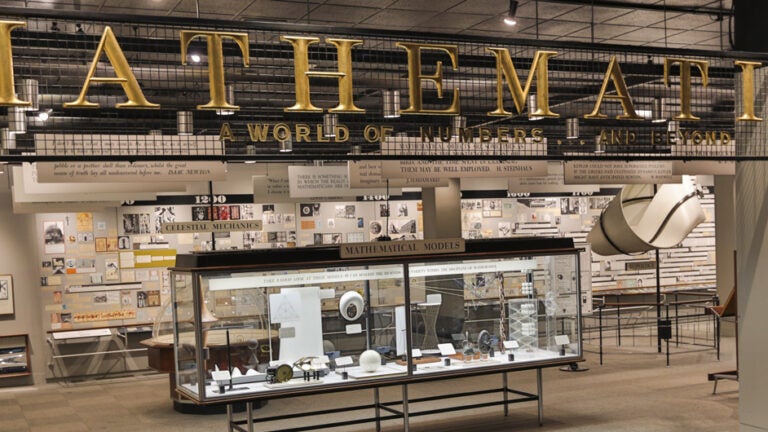
“You are right that the formula for the Golden Ratio is incorrect,’’ a Museum of Science employee wrote to Joseph Rosenfeld after the 15-year-old filled out a comment card pointing out an error in the Golden Ratio “Mathematica’’ exhibit.
But now the museum is telling a different story. “It turns out that both the exhibit and the student were correct,’’ Museum of Science spokeswoman Erin Shannon said.
Apparently math isn’t that simple.
Shannon released a statement Tuesday that made everyone collectively cringe at their memories of confusing high school math classes:
“The Museum of Science is thrilled at Handley High School sophomore Joseph Rosenfeld’s enthusiasm about math and our Mathematica exhibit. And it’s not at all surprising that this enterprising student noticed the minus signs because the way the Museum presents the Golden Ratio in its exhibit is in fact the less common—but no less accurate—way to present it. It’s exciting that people around the country are talking about math and science and that, in the process, we learned something too. Let’s hear it for STEM education and for Joseph Rosenfeld!’’
Arthur Mattuck, an emeritus professor of mathematics at MIT, told The Boston Globe that “the two numbers are the same even if they look different.’’ But Mario Livio—author of The Golden Ratio: The Story of PHI, the World’s Most Astonishing Number, and Brilliant Blunders—didn’t agree with that.
“That of course cannot be true. To say the two numbers are the same even if they look different is a bit confusing,’’ Livio told Boston.com. “It sounds as if you’re saying the square root of 1 plus 2 is equal to the square root of 1 minus 2. But then he says the student is just presenting the fraction upside down; That is correct.’’
Huh?
Here’s the formula Joseph saw on display at the museum:

Though the formula is technically correct, Livio says “it’s a matter of definition,’’ and he prefers a different definition of the Golden Ratio.
The museum display states that the formula is using the “short side divided by the long side,’’ but Livio doesn’t like that version.
“The way I define it in [my] book, and the way it is more commonly defined, is the long side divided by the short side,’’ he said. “It’s exactly the reciprocal of what they wrote.’’
Livio appreciated that Joseph noticed the deviation from the more common Golden Ratio formula. If you’re used to seeing the Golden Ratio defined one way, then seeing it in this form at the museum “would seem incorrect to you,’’ he said.
“I think it’s very nice that he didn’t just accept what was there but compared what was there with what he knew,’’ Livio said. “He’s certainly observant, and he knew something about the Golden Ratio.’’
So the formula wasn’t actually incorrect, but even the Museum of Science thought it was at first after reading Joseph’s comment card.
“I would’ve thought that to avoid confusion, especially for the more casual viewer, they should have written it as the long side divided by the short, with a plus sign,’’ he said.
Joseph’s way.
Free museums in Boston and beyond
[bdc-gallery id=”114724″]





To comment, please create a screen name in your profile
To comment, please verify your email address
Conversation
This discussion has ended. Please join elsewhere on Boston.com