
Photos of the Solar Eclipse That We Unfortunately Can’t See
One of the most breathtaking sights in the world is one Bostonians couldn’t enjoy Friday.
In much of Europe, parts of northern Asia, and a swath of northern and western Africa, however, a partial solar eclipse accompanied the first day of spring.
People in the Faroe Islands and the Svalbard archipelago off of Norway’s Arctic coast were even able to see a total eclipse of the sun. We’re jealous.

A total solar eclipse is seen in Longyearbyen on Svalbard.
Why are people so drawn to solar eclipses?
John Huth, Donner Professor of Science at Harvard University, told Boston.com that they are “rare and yet predictable,’’ a killer combination that makes eclipses so magical to behold.
“The human mind is very good at coming up with mythologies’’ about natural occurrences, Huth said.
For example: In 1504, marooned off the coast of Jamaica and knowing that a lunar eclipse would occur soon, Christopher Columbus managed to manipulate the island’s inhabitants by threatening to make the moon disappear, according to Science News.
Sure enough, it did. Promising that the moon would return pending their compliance, Columbus got his way.

Students pose for a photograph wearing protective glasses at the Royal Observatory Greenwich in London, England.
Huth also shot down the modern myth that looking at a solar eclipse is more dangerous than looking at the sun on an ordinary day. People just tend to want to stare longer, and need to protect their eyes as they do so.

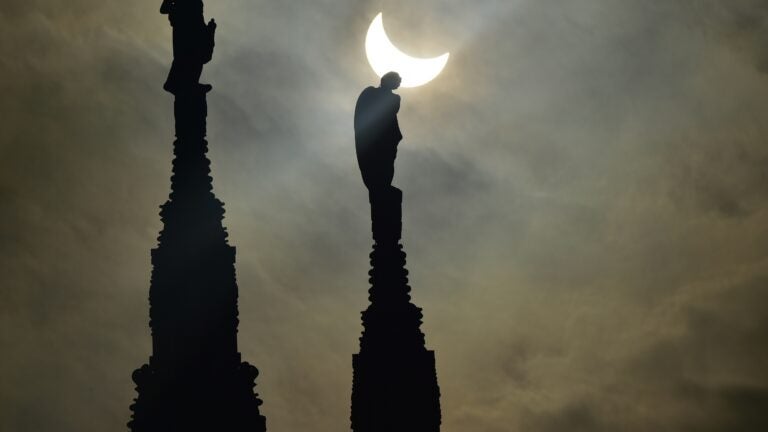
A partial solar eclipse of the sun is visible next to the statues of Milan’s cathedral.

A partial solar eclipse of the sun is visible in Elvas, Portugal.

This handout picture released by the European Space Agency shows the solar eclipse as captured by ESA’s Sun-watching Proba-2 minisatellite.

The eclipse as seen over a statue at the General Staff Headquarters in St. Petersburg, Russia.

A solar eclipse is seen behind a statue of an ibex in Kranjska Gora, Slovenia.

A man uses special glasses to view a partial solar eclipse near the Sphinx at the Giza Pyramids on the outskirts of Cairo.

A multiple exposure image showing the different phases of the partial solar eclipse as seen in Vienna, Austria.

People watch a total solar eclipse from Longyearbyen, Svalbard.

People watch a partial solar eclipse through exposed x-ray film in Marseille.

A solar eclipse is seen through a dark glass plate in Sarajevo, Bosnia.
When will we get to see a solar eclipse in the United States? Our time is coming soon.
According to NASA, areas located within a “narrow corridor’’ of the U.S. from the Pacific Northwest to Georgia will be able to see a total eclipse on August 21, 2017. A partial eclipse will be visible across a larger portion of the continent, however.
Another total solar eclipse is set to cross the U.S. on April 8, 2024 and swing closer to the Boston area, where we will see a partial eclipse.



To comment, please create a screen name in your profile
To comment, please verify your email address
Conversation
This discussion has ended. Please join elsewhere on Boston.com