
MIT Researchers Create Running, Jumping Robot Cheetah
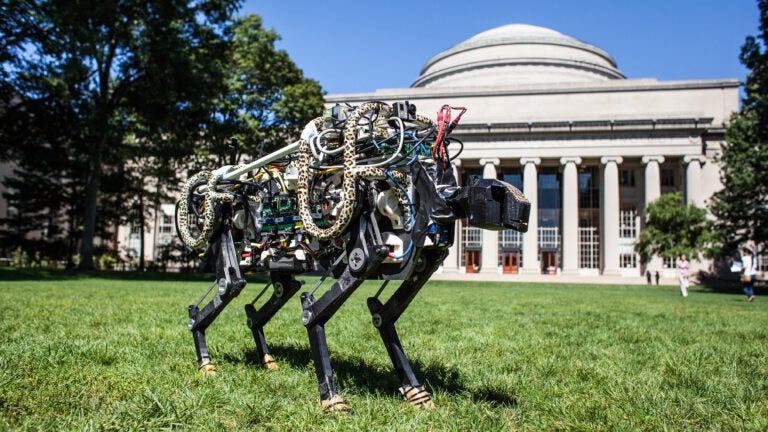
Outrun this, Miss Massachusetts: researchers at MIT have unveiled a robotic cheetah that can sprint up to 10 mph and leap hurdles without missing a beat, successfully mimicking the natural bounding motions of a real cheetah. According to a video posted by the MIT News Office, the cheetah-bot, a bundle of batteries, motors, and gears that weighs about as much as its real-life counterpart, could be tweaked to eventually reach speeds of up to 30 mph, no power cords attached.
[fragment number=0]
Thanks to a new “bounding algorithm’’ that calculates the varying amounts of force required to propel an animal forward or to jump over obstacles, MIT’s cheetah-bot can leap across uneven terrain such as a grassy field while still maintaining a steady speed. The robot also easily cleared a 33 centimeter foam hurdle on a treadmill in the lab.
[fragment number=1]
The bounding algorithm models the running mechanics of world-class sprinters like Olympian Usain Bolt: the faster the desired speed, the greater the force the legs exert. An older version of the cheetah-bot, first developed for the Defense Advanced Research Projects Agency, ran a top speed of 28.3 mph on a treadmill — outpacing Bolt’s record 27.44 mph — but it was tethered to a power source.
“Most robots are sluggish and heavy, and thus they cannot control force in high-speed situations,’’ Associate Professor of Mechanical Engineering Sangbae Kim said in the video. “That’s what makes the MIT cheetah so special: You can actually control the force profile for a very short period of time…which makes it more stable, agile, and dynamic.’’
[fragment number=2]
MIT’s untethered cheetah-bot, however, is more than just a fun (and slightly terrifying) toy.
“We are trying to understand how [animals] efficiently run in the field and nature, so we can take that inspiration and use it in our engineering world,’’ Kim said. “For example, to create prosthetic legs out of that technology, or to make a new transportation replacing cars so that you don’t need the road in our world.’’
“I think there’s this really exciting future where robots can be quiet, efficient, and also powerful,’’ he added.



To comment, please create a screen name in your profile
To comment, please verify your email address
Conversation
This discussion has ended. Please join elsewhere on Boston.com